
Updated PClock Ransomware Still Comes Up Short

In recent years, ransomware families are often glamorized as being some of the most dangerous types of malware. They’ve certainly caused a wealth of damage to end users with some of the more prominent malware families, such as CryptoLocker, CryptoWall, TorrentLocker, and TeslaCrypt infecting millions of users overall.

For readers that might be unfamiliar with ransomware, it’s a type of malware that is responsible for encrypting a user’s files with a key known only to the attackers. Examples of files that might be encrypted include financial documents, home movies, photos, or business-related files. In order to decrypt these files, the victim must provide a ransom, or payment, to the attacker, often in the form of a digital currency. Continue reading "Updated PClock Ransomware Still Comes Up Short"

Chinese Actors Use ‘3102’ Malware in Attacks on US Government and EU Media

On May 6 and May 11, 2015, Unit 42 observed two targeted attacks, the first against the U.S. government and the second on a European media company. Threat actors delivered the same document via spear-phishing emails to both organizations. The actors weaponized the delivery document to install a variant of the ‘9002’ Trojan called ‘3102’ that heavily relies on plugins to provide functionality needed by the actors to carry out on their objectives.

The 3102 payload used in this attack also appears to be related to the Evilgrab payload delivered in the watering hole attack hosted on the President of Myanmar’s website in May 2015.  Additionally, we uncovered ties between the C2 infrastructure and individuals in China active in online hacking forums that claim to work in Trojan development.

Palo Alto Networks WildFire detected the payload delivered in these spear-phishing attacks as malicious, and the payload was also tagged in Palo Alto Networks AutoFocus as 9002.

UPDATE 9/24/2015: The Palo Alto Networks platform detects the 3012 malware with its spyware signature 9002.RAT.Gen Command And Control Traffic (ID# 14359).

Continue reading "Chinese Actors Use ‘3102’ Malware in Attacks on US Government and EU Media"

More Details on the XcodeGhost Malware and Affected iOS Apps

A few days ago, we investigated a new malware called XcodeGhost that modifies Xcode, infects iOS apps and is seen in the App Store. We also found more than 39 iOS apps were infected, including versions of some pretty popular apps like WeChat or Didi, potentially affecting hundreds of millions iOS users. We also analyzed XcodeGhost’s remote control functionalities that can be used by attackers to phish or to perform further attacks. In this post we will discuss a few more details since learned about XcodeGhost and its behavior.

Actions to Stop the Attack

Since our post on September 18, Palo Alto Networks has cooperated with Apple, Amazon and Baidu to share samples, threat intelligence and research. All of them have taken actions to stop the attack or to mitigate the security threat. Continue reading "More Details on the XcodeGhost Malware and Affected iOS Apps"

Update: XcodeGhost Attacker Can Phish Passwords and Open URLs through Infected Apps

On Thursday we posted the initial analysis report on XcodeGhost malware and then found it had infected 39 iOS apps, potentially impacting hundreds of millions of users. XcodeGhost embedded malicious code into those infected iOS apps. In the first report, we noted that the malicious code uploads device information and app information to its command and control (C2) server. But that isn’t all it does.

Today, inspired by a post by “@Saic” on Sina Weibo, we analyzed the malicious code in more detail and found additional capabilities in the malware.  In summary, the malicious code that XcodeGhost embedded into infected iOS apps is capable of receiving commands from the attacker through the C2 server to perform the following actions: Continue reading "Update: XcodeGhost Attacker Can Phish Passwords and Open URLs through Infected Apps"

Malware XcodeGhost Infects 39 iOS Apps, Including WeChat, Affecting Hundreds of Millions of Users

Yesterday we posted an analysis report on a novel malware XcodeGhost that modifies Xcode IDE to infect Apple iOS apps. In the report, we mentioned that at least two popular iOS apps were infected. We now believe many more popular iOS apps have been infected, including WeChat, one of the most popular IM applications in the world. Continue reading "Malware XcodeGhost Infects 39 iOS Apps, Including WeChat, Affecting Hundreds of Millions of Users"

Novel Malware XcodeGhost Modifies Xcode, Infects Apple iOS Apps and Hits App Store

UPDATE: Since this report's original posting on September 17, three additional XCodeGhost updates have been published, available here, here and here. 

On Wednesday, Chinese iOS developers disclosed a new OS X and iOS malware on Sina Weibo. Alibaba researchers then posted an analysis report on the malware, giving it the name XcodeGhost. We have investigated the malware to identify how it spreads, the techniques it uses and its impact.

XcodeGhost is the first compiler malware in OS X. Its malicious code is located in a Mach-O object file that was repackaged into some versions of Xcode installers. These malicious installers were then uploaded to Baidu’s cloud file sharing service for used by Chinese iOS/OS X developers. Xcode is Apple’s official tool for developing iOS or OS X apps and it is clear that some Chinese developers have downloaded these Trojanized packages.

(UPDATE: Following notification by Palo Alto Networks of malicious files hosted on their file sharing services, Baidu has removed all of the files.) 

Continue reading "Novel Malware XcodeGhost Modifies Xcode, Infects Apple iOS Apps and Hits App Store"

Palo Alto Networks Researchers Discover Critical Vulnerabilities in Internet Explorer and Adobe Shockwave Player

Palo Alto Networks researchers have been credited with discovery of new vulnerabilities affecting Adobe Shockwave Player and Microsoft Internet Explorer.

Palo Alto Networks researcher Tongbo Luo discovered a critical vulnerability in Adobe Shockwave Player affecting Shockwave versions 12.1.9.160 and earlier for Windows. The vulnerability and upgrade instructions are detailed by Adobe in a Security Bulletin dated September 8, 2015.  Continue reading "Palo Alto Networks Researchers Discover Critical Vulnerabilities in Internet Explorer and Adobe Shockwave Player"

Musical Chairs: Multi-Year Campaign Involving New Variant of Gh0st Malware

The Gh0st malware is a widely used remote administration tool (RAT) that originated in China in the early 2000s. It has been the subject of many analysis reports, including those describing targeted espionage campaigns like Operation Night Dragon and the GhostNet attacks on Tibet. Musical Chairs is a multi-year campaign which recently deployed a new variant Gh0st we’ve named “Piano Gh0st.”

Our evidence suggests the actors behind these attacks have been operating for over five years and have maintained a single command and control server for almost two. They use compromised e-mail accounts to distribute their malware widely and their targeting appears opportunistic rather than specific. Continue reading "Musical Chairs: Multi-Year Campaign Involving New Variant of Gh0st Malware"

KeyRaider iOS Malware: How to Keep Yourself Safe

Earlier this week we published an analysis of KeyRaider, which is an iOS malware family and a reminder of the risks users take when they choose to jailbreak their mobile devices.

Attackers used KeyRaider malware to steal more than 225,000 Apple accounts. KeyRaider targeted only jailbroken Apple devices, primarily through Chinese websites and apps that provide software for those jailbroken phones.

The best way to keep a mobile device safe is to keep it up to date with the latest software updates. That also means not jailbreaking your phone in the first place, as today there aren’t any Cydia repositories that perform strict security checks on apps or the tweaks used to change them.

But if your device is already jailbroken, what steps can you take to protect it against KeyRaider? Continue reading "KeyRaider iOS Malware: How to Keep Yourself Safe"

KeyRaider: iOS Malware Steals Over 225,000 Apple Accounts to Create Free App Utopia

Executive Summary

Recently, WeipTech was analyzing suspicious Apple iOS tweaks reported by users and found over 225,000 valid Apple accounts with passwords stored on a server.

In cooperation with WeipTech, we have identified 92 samples of a new iOS malware family in the wild. We have analyzed the samples to determine the author’s ultimate goal and have named this malware “KeyRaider”. We believe this to be the largest known Apple account theft caused by malware. Continue reading "KeyRaider: iOS Malware Steals Over 225,000 Apple Accounts to Create Free App Utopia"

Banking Trojan Escelar Infects Thousands In Brazil and the US

Unit 42 for the past three months has been tracking a banking Trojan targeting victims in Brazil and the United States. Escelar originally surfaced in January of this year, and has since had roughly 100,000 instances of attempted infections.

Attackers deliver the Trojan using generic Portuguese language phishing emails and are currently targeting seven Brazilian banks. Once delivered, Escelar has multiple installation stages where malware is downloaded using direct connections to multiple Microsoft SQL servers. These SQL servers are also used for command and control (C2) functionality. Continue reading "Banking Trojan Escelar Infects Thousands In Brazil and the US"

RTF Exploit Installs Italian RAT: uWarrior

Unit 42 researchers have observed a new Remote Access Tool (RAT) constructed by an unknown actor of Italian origin. This RAT, referred to as uWarrior because of embedded PDB strings, has been previously described by an independent researcher who noted a potentially unknown exploit being used against Microsoft Office. Continue reading "RTF Exploit Installs Italian RAT: uWarrior"

Retefe Banking Trojan Targets Sweden, Switzerland and Japan

Retefe is one of the most targeted banking Trojans currently in the wild. While other families such as Zeus and Citadel are widely adopted by attackers targeting banking websites around the world, Retefe is consistently used to target victims in Sweden, Switzerland and Japan.

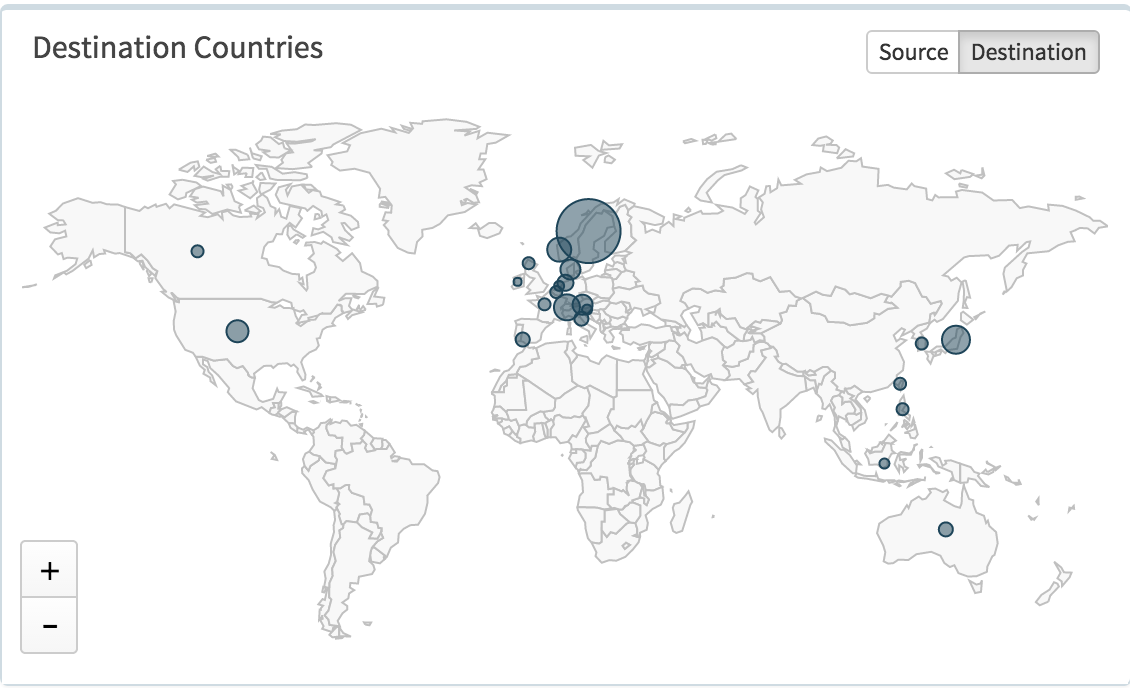
In the last two weeks we have detected a surge of e-mails using AutoFocus, each carrying the Retefe Trojan and targeting organizations in Western Europe and Japan.

retefe1

Figure 1: AutoFocus map of recent Retefe Trojan recipients Continue reading "Retefe Banking Trojan Targets Sweden, Switzerland and Japan"

What’s Next in Malware After Kuluoz?

Regular readers of this blog have heard all about the infamous Kuluoz malware. This family was the latest evolution of the Asprox malware and at its peak in 2014 it accounted for 80% of all malware sessions we observed in WildFire. When the team published our Threat Landscape Review in December of last year, we highlighted this family as a scourge that impacted nearly every company Palo Alto Networks protected in 2014. Kuluoz was primarily distributed through e-mail, which means we saw large numbers of SMTP sessions, but also downloads over a variety of webmail clients. Continue reading "What’s Next in Malware After Kuluoz?"

UPS: Observations on CVE-2015-3113, Prior Zero-Days and the Pirpi Payload

A June 23 FireEye blog post titled “Operation Clandestine Wolf” discussed a cyber espionage group, known as APT3, that had been exploiting a zero-day vulnerability in Adobe Flash. Unit 42 also tracks the APT3 group using the name UPS, which is an intrusion set with Chinese origins that is known for having early access to zero-day vulnerabilities and delivering a backdoor called Pirpi.

The UPS group has exploited several zero-day vulnerabilities, most recently using the zero-days released in the Hacking Team breach that we discussed in our July 10 blog post, “APT Group UPS Targets US Government with Hacking Team Flash Exploit”. However, the most recent original zero-day released by this group is tracked by CVE-2015-3113, which has similarities to the once zero-day vulnerabilities CVE-2014-1776 and CVE-2014-6332 exploited by UPS in May and November 2014, respectively. We’ll discuss here the similarities observed between the various components used to exploit these two vulnerabilities, specifically focusing on the malicious Flash files and the payloads delivered. Continue reading "UPS: Observations on CVE-2015-3113, Prior Zero-Days and the Pirpi Payload"